Conodonts: The Enigmatic Early Vertebrates of the Paleozoic
For decades, paleontologists were puzzled by tiny, tooth-like fossils found in ancient marine rocks. These structures, known as conodonts, remained a biological mystery until the discovery of soft-tissue impressions revealed they belonged to a sophisticated group of early vertebrates. Spanning a vast geological timeline from the Middle Cambrian to the earliest Jurassic (Hettangian), conodonts provide critical insights into the early evolution of the chordate lineage.
Key Facts
- Temporal Range: Middle Cambrian to Earliest Jurassic.
- Classification: Phylum Chordata, Subphylum Vertebrata, Infraphylum Agnatha.
- Defining Feature: Complex phosphatic feeding elements (the "teeth").
- Size Range: Typically 4–5 cm, though some species like Promissum may have reached 40 cm.
- Anatomy: Possessed large eyes, fins with rays, and a notochord or dorsal nerve cord.
The Mystery of Nomenclature
The term "conodont" has a complex history, often used interchangeably to describe both the individual fossilized elements and the animals that produced them. The original German term conodonten was introduced by Pander in 1856. Over time, various scientific names were proposed to categorize these organisms, including Conodontes, Conodonta, and Conodontophorida (meaning "conodont bearers"). Today, they are formally recognized within the class Conodonta.
Conodont Elements and Apparatus
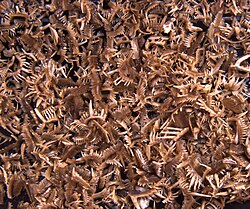
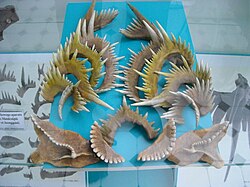
The most common fossils recovered are the conodont elements—microscopic, tooth-like structures used for feeding. While these are often found as lone elements, they were actually part of a complex, multi-element feeding apparatus.
These apparatuses consisted of several distinct element types, each serving a specific functional role:
- S elements (b and c): Paired structures; S b are asymmetrical, while S c are highly asymmetrical and bipennate.
- P elements (a and b): P a are blade-like structures, whereas P b are arched.
Understanding the arrangement of these elements allows scientists to reconstruct the feeding mechanisms of these extinct creatures and better classify their species.
The Conodont Animal: Anatomy and Ecology
While the hard elements are the most frequent finds, rare body fossils have provided a glimpse into the actual animal. Conodonts were eel-like creatures characterized by large eyes and fins supported by fin rays. Their internal structure included chevron-shaped muscles and an axial line, interpreted as either a notochord (a flexible rod supporting the body) or a dorsal nerve cord.
In terms of size, most species were small. For example, Clydagnathus and Panderodus typically measured between 4 and 5 cm. However, estimates suggest that Promissum could have reached lengths of up to 40 cm, assuming it shared the same body proportions as its smaller relatives.
Classification and Evolutionary History
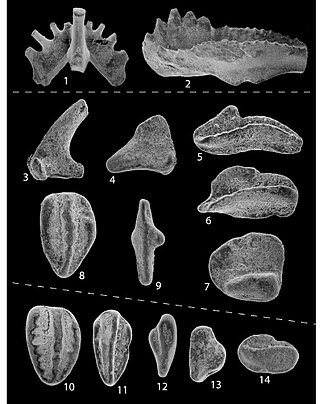
Conodonts are classified under the phylum Chordata and the subphylum Vertebrata. Because individual elements are difficult to categorize, modern researchers rely on multi-element assemblages to infer phylogenetic relationships.
The taxonomy is divided into several major groups, including the Cavidonti and the Conodonti. Within the Conodonti, several orders are recognized, such as the Protopanderodontida, Panderodontida, Prioniodontida, Prioniodinida, and Ozarkodinida.
| Category | Details |
|---|---|
| Kingdom | Animalia |
| Phylum | Chordata |
| Subphylum | Vertebrata |
| Infraphylum | Agnatha (Jawless) |
| Temporal Range | Middle Cambrian to Earliest Jurassic |
| Key Orders | Ozarkodinida, Prioniodontida, Panderodontida, etc. |
Frequently Asked Questions
What exactly are conodonts?
Conodonts are an extinct group of jawless vertebrates that lived from the Middle Cambrian to the Early Jurassic. They are primarily known from their microscopic, tooth-like phosphatic elements.
Were conodonts fish?
They are classified as vertebrates within the infraphylum Agnatha. While they shared characteristics with early fish—such as fins and a notochord—they represent a distinct early lineage of chordates.
How large were conodont animals?
Most were small, ranging from 4 to 5 cm in length, although some genera like Promissum are estimated to have reached up to 40 cm.
What is a conodont apparatus?
A conodont apparatus is the complete set of feeding elements found in a single animal, consisting of various paired and unpaired structures (S and P elements) used for grasping or slicing food.
Why are conodonts important to science?
Because they evolved rapidly and are found globally, they are invaluable for biostratigraphy (dating rock layers) and for understanding the early evolution of the vertebrate skeleton.