Cephalaspidomorphs: The Armored Jawless Fish of the Paleozoic
Long before the rise of modern sharks and bony fish, the ancient oceans were inhabited by the Cephalaspidomorphs. These primitive, jawless vertebrates, also known as cephalaspids or Monirhina, represent a critical chapter in evolutionary history. Characterized by their heavy armor and unique anatomy, they provide vital clues about how early vertebrates transitioned from simple filter-feeders to the complex jawed fishes that dominate the waters today.
Existing between approximately 438 and 359 million years ago, these creatures thrived during the Silurian and Devonian periods. While most biologists consider the group extinct, their legacy persists in the study of early chordate evolution.
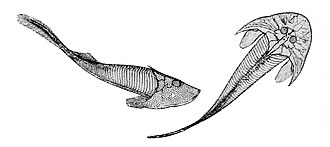
Key Facts
- Temporal Range: 438 to 359 million years ago (Ma).
- Defining Feature: Heavy armored head-shields protecting the brain and gills.
- Feeding Style: Likely algae- or filter-feeders that combed the seabed.
- Locomotion: Used a heterocercal (asymmetrical) tail fin and, in some species, paired pectoral fins.
- Evolutionary Role: Regarded as the closest relatives to the Gnathostomata (jawed fishes).
Biology and Morphology
The most striking feature of the Cephalaspidomorphs was their external armor. They possessed a highly developed head shield that protected the head, gills, and the anterior portion of the viscera. This shield was not merely for defense; it featured a series of grooves that functioned as an extensive lateral line organ, allowing the fish to detect vibrations and pressure changes in the water.
Their sensory organs were modest, with small eyes positioned on the top of the head. Because they lacked a jaw, their mouth was surrounded by small, flexible plates. While these plates allowed for movement, the animals were incapable of biting.
Skeletal Structure and Movement
Unlike modern fish, Cephalaspidomorphs had no known internal bony skeleton outside of the head shield. Their axial skeleton likely consisted of an unsegmented notochord (a flexible rod-like structure), and any vertebral column they possessed would have been made of cartilage rather than bone.
For movement, some groups evolved fleshy pectoral fins that emerged laterally behind the head shield. Their tail featured a single, wrap-around fin. This specific tail shape suggests they were not fast swimmers. Lacking a swim bladder—an internal gas-filled organ used for buoyancy—they could not float effortlessly and likely spent much of their time semi-submerged in mud.
Interestingly, the shape of the head shield provided some hydrodynamic lift, making them more efficient swimmers than many of their contemporaries. Their lifestyle was similar to modern armored bottom-feeders, such as Loricariidae or Hoplosternum catfish.
Classification and Evolutionary History
The classification of Cephalaspidomorphs has evolved significantly since the 1920s. Initially, biologists Johan Kiær and Erik Stensiö grouped them with osteostracans, anaspids, and lampreys based on a shared single dorsal nostril, known as a nasohypophysial opening.
Modern scientific consensus has shifted. Many researchers now view the Agnatha (jawless fish) as a paraphyletic group, meaning they are a grade of organization that gave rise to the jawed vertebrates. Because Cephalaspidomorphs possessed paired fins, they are often cited as the closest relatives to the Gnathostomata.
| Category | Details |
|---|---|
| Kingdom | Animalia |
| Phylum | Chordata |
| Infraphylum | Agnatha |
| Class | Cephalaspidomorphi |
| Key Subgroups | Cephalaspidiformes, Galeaspidiformes, Pituriaspidiformes |
| Type Species | Cephalaspis lyelli |
The Question of Lampreys
For a time, some databases listed lampreys as the sole living representatives of the Cephalaspidomorphi. However, current evidence suggests that the similarities between lampreys and cephalaspids are the result of convergent evolution—where unrelated species independently evolve similar traits. Consequently, most modern classifications place lampreys in their own group, such as Petromyzontida or Hyperoartia.
Frequently Asked Questions
Did Cephalaspidomorphs have teeth?
No, they did not have jaws or teeth. Their mouths were surrounded by small plates that made the lips flexible, but they were unable to bite their prey.
How did they stay afloat in the water?
They lacked a swim bladder, meaning they could not maintain buoyancy without active swimming. However, their armored head shields provided some lift to assist them in the water column.
What did Cephalaspidomorphs eat?
They are believed to have been filter-feeders or algae-eaters, combing through the seabed mud for small organisms, much like certain modern catfish.
Are they related to modern jawed fish?
Yes, many biologists believe they are the closest relatives to jawed fishes (Gnathostomata), and it is possible that jawed fishes actually emerged from within the cephalaspidomorph lineage.
Why are they called "jawless" fish?
They belong to the group Agnatha, which is defined by the absence of a hinged jaw, a primitive trait compared to the majority of living fish species today.