Lakota Treaties and Conflicts: A History of Resistance and Survival
The relationship between the Lakota peoples and the United States government was defined from its inception by a struggle for sovereignty and territorial control. What began as cautious diplomacy and trade evolved into a century of systemic conflict, marked by broken treaties, military clashes, and a desperate fight to preserve a traditional way of life against the tide of American westward expansion.
Early Encounters and the Dynamics of Power
Official contact between the U.S. government and the Lakota occurred in September 1804 during the Lewis and Clark Expedition. When the expedition entered Sicangu territory, a routine diplomatic council nearly turned into an armed clash after William Clark attempted to depart with Sicangu leaders Black Buffalo and Medicine Bull still aboard his boat. The standoff ended only when the Lakota granted passage on their own terms, establishing a precedent: the Lakota viewed themselves as the dominant power in the region.
By 1823, some Lakota bands allied with the U.S. Army during the Arikara War, though the Lakota remained unimpressed by American military capabilities. This perception influenced internal Lakota governance. In the thiyóthipi (council lodge), deliberations were often fractious. While some leaders favored accommodation, others, like Bull Bear, pushed for resistance against the wašíču (whites). This internal division between diplomacy and defiance would characterize Lakota policy throughout the 19th century.
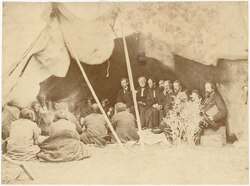
The Erosion of Peace and the Fort Laramie Treaties
For the first two decades of the 1800s, peace largely prevailed through trade. However, the opening of the Oregon Trail disrupted this stability. Emigrant cattle consumed vital prairie grasses and introduced diseases that decimated the buffalo herds, the cornerstone of Lakota prosperity. In 1846, the Oglála and Sičháŋğu wrote to the U.S. President invoking iglúwašte (reciprocity), demanding compensation as equal partners.
In 1851, the U.S. government convened a council at Horse Creek, leading to the Fort Laramie Treaty. This agreement recognized Lakota title to nearly 100,000 square miles of land in exchange for allowing military posts and roads along the Platte River.
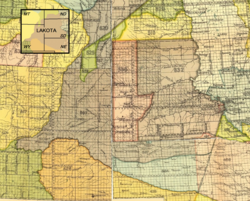
Despite the legal language, the two parties viewed the treaty differently. U.S. agents saw it as a tool for legal sovereignty, while the Lakota viewed it primarily as a distribution of goods, maintaining their right to hunt and use resources wherever necessary.
Escalation and the "Butcher"
The fragile peace shattered in 1855 when General William S. Harney attacked a village of Sicangu, Oglala, Miniconjou, and Cheyenne at Blue Water Creek. Despite pleas for peace from leader Little Thunder, Harney's forces killed at least 86 people and captured 70 women and children. Harney's subsequent coercive tactics earned him the Lakota nicknames "The Butcher" and "Woman Killer." This violence forced many tribes to retreat further into their homelands, leading to a decade of relative peace during the U.S. Civil War.
The Struggle for the Black Hills
The Black Hills, sacred to the Lakota, became a flashpoint for conflict when the U.S. attempted to secure the Bozeman Trail. This led to Red Cloud's War (1866–1868), which ended in a Lakota victory. The 1868 Fort Laramie Treaty closed the Bozeman Trail and established the Great Sioux Reservation in western South Dakota.
However, the discovery of gold in 1874 by Lieutenant Colonel George Armstrong Custer triggered a new wave of illegal prospecting. To force the Lakota into submission, General Philip Sheridan encouraged the systematic destruction of the buffalo to starve the population.
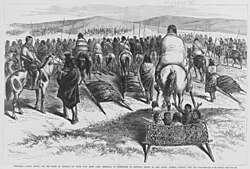
The Great Plains Wars: Rosebud and Little Bighorn
In June 1876, combined forces of Lakota, Arapaho, and Northern Cheyenne achieved two major tactical victories. First, they defeated General George Crook at the Battle of the Rosebud. A week later, under the leadership of Sitting Bull and Crazy Horse, they annihilated Custer's command at the Battle of the Little Bighorn. Custer lost 12 officers, 247 soldiers, and three Arikara scouts.
While a massive military victory, the aftermath was grim. The U.S. Army responded with a brutal winter campaign. Crazy Horse surrendered in May 1877 and was killed later that year; Sitting Bull surrendered in 1881 after fleeing to Canada. By 1877, some bands were forced to cede the Black Hills under a disputed treaty.

The Ghost Dance and the Wounded Knee Massacre
By 1890, drought and inadequate federal rations left the Lakota in despair. This environment fostered the Ghost Dance movement, a spiritual revival promising the return of the old world. U.S. officials misread the dance as a preparation for war, leading to a military buildup in the region.
The tension culminated in December 1890. After Sitting Bull was killed by Indian police, a band of Miniconjous led by Spotted Elk (Big Foot) was intercepted by the army. On December 29, at Wounded Knee Creek, the 7th Cavalry opened fire on the camp using Hotchkiss guns. At least 270 Lakota died, including approximately 170 women and children. The massacre remains the enduring symbol of the violence inherent in U.S. Indian policy.
Key Facts
- First Contact: Occurred in 1804 with the Lewis and Clark Expedition in Sicangu territory.
- Fort Laramie Treaty (1851): Recognized Lakota title to nearly 100,000 square miles of land.
- Red Cloud's War: Resulted in the 1868 treaty that closed the Bozeman Trail and created the Great Sioux Reservation.
- Battle of the Little Bighorn: The greatest indigenous military victory of the Plains wars, occurring on June 25, 1876.
- Wounded Knee Massacre: Occurred on December 29, 1890, resulting in at least 270 Lakota deaths.
| Year | Event | Outcome/Significance |
|---|---|---|
| 1804 | Lewis & Clark Expedition | Initial contact; established Lakota regional dominance. |
| 1851 | Fort Laramie Treaty | Large territorial recognition vs. U.S. claims of sovereignty. |
| 1855 | Battle of Blue Water Creek | Severe Lakota defeat; General Harney labeled "The Butcher." |
| 1868 | Fort Laramie Treaty | Created Great Sioux Reservation; closed Bozeman Trail. |
| 1876 | Battle of Little Bighorn | Total defeat of Custer's command by Lakota and Cheyenne. |
| 1890 | Wounded Knee Massacre | Mass killing of Lakota; end of armed resistance. |
Frequently Asked Questions
Why was the 1851 Fort Laramie Treaty misunderstood?
The U.S. government viewed the treaty as a legal instrument to establish sovereignty over the West. In contrast, the Lakota viewed it as a diplomatic agreement involving the distribution of goods, believing it did not supersede their inherent right to use the land for hunting.
What was the significance of the Black Hills to the Lakota?
The Black Hills were sacred lands. The Lakota strongly opposed mining in the region, and the U.S. violation of the 1868 treaty to allow gold prospectors into the hills was a primary cause of renewed conflict.
Who were the "Long Knives"?
"Long Knives" was a term used by the Lakota to describe U.S. soldiers, referring to their blue coats and the swords and bayonets they carried.
What was the Ghost Dance movement?
The Ghost Dance was a messianic spiritual movement that spread among the Lakota in 1890. It promised the resurrection of the traditional world and the disappearance of white settlers, though U.S. agents mistakenly interpreted it as a call to war.
What happened at the Wounded Knee Massacre?
On December 29, 1890, the 7th Cavalry attacked a camp of Lakota under Spotted Elk. Using rifles and Hotchkiss guns, they killed at least 270 people, the majority of whom were women and children.