Kurd Mountain
Kurd Mountain, known locally as Kurd Dagh (Turkish) or Çîyayê Kurmênc (Kurdish), is a prominent highland region spanning the border between northwestern Syria and southeastern Turkey. Situated within Syria's Aleppo Governorate and Turkey's Kilis Province, this region is a vital geographical and cultural landmark for the Kurmanji-speaking Kurdish population.
It is important to distinguish this region from the similarly named Jabal al-Akrad located further southwest in the Latakia Governorate.
Key Facts
- Location: Northwestern Syria (Aleppo Governorate) and Southeastern Turkey (Kilis Province).
- Primary Town: Afrin, Syria.
- Geology: Part of the Limestone Massif, characterized by limestone rock.
- Economy: Renowned for charcoal production and olive cultivation.
- Etymology: Named after the Kurmanji-speaking Kurdish people.
Geography and Geology
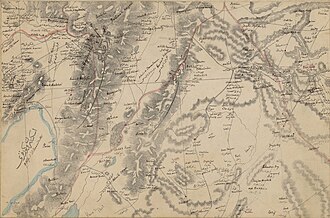
Kurd Mountain is a highland area that forms part of the broader Limestone Massif of northwestern Syria. Geologically, it serves as a southern extension of the highlands found on the western Aintab plateau, continuing into the Aleppo plateau.
The region is defined by its natural borders. To the east and south, the valley of the River Afrin surrounds the mountain, separating it from Mount Simeon and the plain of Aʻzāz to the east, and Mount Harim to the south. To the west, the valley of the River Aswad creates a natural boundary between Kurd Mountain and Mount Amanus.
Regional Summary
| Feature | Details |
|---|---|
| Parent Range | Limestone Massif |
| Rock Type | Limestone |
| Borders | Aintab plateau, Mount Harim, Mount Amanus, Aleppo plateau |
| Coordinates | 36°40′N 36°46′E |
History and Demographics
The region has a long history of Kurdish settlement. In a 1922 census of the State of Aleppo, the district (Kaza) of Kurd Dagh recorded a population of 21,823, consisting of 10,434 males and 11,389 females.
During the period of French administration, the area was home to several Kurdish tribes. Migration patterns from the 1800s saw many residents move from Kurd Dagh to the city of Aleppo. Additionally, in the 1930s, Kurdish Alevis settled in Mabeta after fleeing persecution during the Dersim Massacre carried out by the Turkish Armed Forces.
Religion and Culture
The religious landscape of Kurd Mountain is diverse. While most Syrian Kurds follow the Sunni Shafiite school of Islam, the majority of the population in the Kurd-Dagh region are Sunni Hanafi-Muslims. The region is also home to Yazidi communities.
Prior to the Syrian Civil War, the area—particularly around Afrin—was a significant center for Sufism, with a strong presence of the Rifa'iyya order.
Etymology and Naming
The name Çîyayê Kurmênc translates to "Mountain of the Kurmanj," referring to the Kurmanji dialect of the Kurdish language spoken in the region.
The naming of the mountain has shifted frequently due to political changes:
- Ottoman Era: Translated into Ottoman Turkish as Kurd Dağ (Kurd Mountain).
- French Era: The name Kurd Dagh remained in official use.
- Syrian Independence: The government initially reverted to the Arabic Jabal al-Akrad.
- 1977 Decree: Under decree 15801, which banned Kurdish names, it was renamed Jabal al-`Uruba ("Mountain of Arabism") and later "Mount Aleppo."
- Turkish Territory: The Turkish portion was officially renamed Kurt Dağı ("Wolf Mountain"), a pun on the Turkish words for Kurd (Kürt) and wolf (kurt).
Frequently Asked Questions
What is the main economic activity in Kurd Mountain?
The region is particularly well-known for its olive growing and the production of charcoal.
How does Kurd Mountain differ from Jabal al-Akrad in Latakia?
Although they share similar names meaning "Kurd Mountain," they are distinct geographical entities; Kurd Mountain is in the Aleppo Governorate, while the other Jabal al-Akrad is located further southwest in the Latakia Governorate.
What is the significance of the name "Kurt Dağı" in Turkey?
The name "Kurt Dağı" translates to "Wolf Mountain." This was an official renaming that utilized a pun on the Turkish words for "Kurd" (Kürt) and "wolf" (kurt).
Which religious groups inhabit the region?
The population primarily consists of Sunni Hanafi-Muslims, with a presence of Yazidis and a historical community of Sufis.
What is the geological composition of the mountain?
Kurd Mountain is a highland region composed primarily of limestone, forming part of the larger Limestone Massif of northwestern Syria.