Korean War History: From Post-WWII Division to Global Conflict
The military involvement of the United States in Korea is a complex chapter of 20th-century history, rooted in the aftermath of World War II. Following the defeat of Japan, the Korean peninsula—which had been under Japanese occupation since 1910—was divided into two distinct zones. The Soviet Union occupied the northern region, while the United States oversaw the south. What began as a temporary administrative arrangement to facilitate disarmament eventually solidified into two separate nations: the Republic of Korea (South Korea) in August 1948 and the Democratic People's Republic of Korea (North Korea) in September 1948.
Tensions between these two governments escalated as each claimed sole legitimacy. While South Korea sought military support from President Harry S. Truman, the United States, weary from World War II, declined to provide significant weapons or troops. Conversely, North Korea secured military support from Joseph Stalin and the Soviet Union. This imbalance of power culminated on June 25, 1950, when North Korean forces invaded across the 38th parallel, igniting the Korean War.
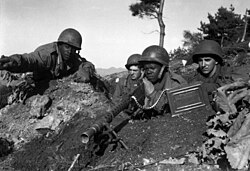
Key Facts
- Conflict Start: June 25, 1950, following a North Korean invasion.
- Dividing Line: The 38th parallel.
- U.S. Leadership: President Harry S. Truman led the entry; Dwight D. Eisenhower led the end of the war.
- U.N. Command: General Douglas MacArthur served as the supreme commander of U.N. forces.
- U.S. Casualties: Approximately 36,574 deaths and 103,284 wounded.
The Initial U.S. and U.N. Response
In response to the invasion, the United Nations demanded an immediate North Korean withdrawal. The United States deployed Task Force Smith, consisting of officers and regiments from the 24th Infantry Division stationed in Japan. However, the task force was under-trained, poorly supplied, and heavily outnumbered. The 24th Infantry Division offered minimal resistance, and by late July 1950, Task Force Smith was overrun in the city of Taejon.
Despite the deployment of the 25th Infantry Division to establish new lines, North Korean forces continued their rapid southward advance, pushing both American and South Korean troops toward the southern tip of the peninsula.
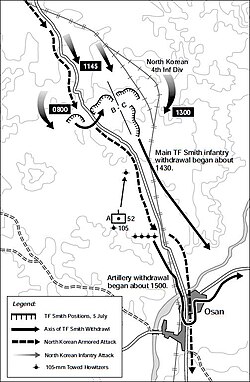
Major Military Engagements
The war was characterized by several intense and pivotal battles that shifted the momentum of the conflict:
The Battle of Inchon
On September 15, 1950, General MacArthur executed a high-stakes amphibious landing at the port city of Incheon. Despite the 5,000-to-1 odds cited by MacArthur, the 1st Marine Division successfully landed, taking advantage of specific tidal conditions that allowed for the 29-foot draft of American LSTs (Landing Ship, Tanks). This maneuver took the North Korean defenders by surprise and allowed U.N. forces to reclaim a third of Incheon in a single night.
Other Significant Battles
- Battle of Osan: July 5, 1950.
- Battle of the Kum River and Battle of Taejon: July 13–20, 1950.
- Battle of Pusan Perimeter: August 4 – September 18, 1950.
- Great Naktong Offensive: September 1–15, 1950.
- Battle of Chosin Reservoir: November 27 – December 13, 1950.
- Operation Thunderbolt: January 25 – February 20, 1951.
- Battle of the Punchbowl: August 31 – September 21, 1951.
- Battle of Heartbreak Ridge: September 13 – October 15, 1951.
- Operation Commando: October 3–12, 1951.
- Battle of Triangle Hill: October 14 – November 25, 1952.
- First Battle of the Hook: October 2–28, 1952.
- Battle for Outpost Vegas: March 26–30, 1953.
- Battle of Pork Chop Hill: April 16–18 and July 6–11, 1953.
War Statistics and Impact
The human cost of the conflict was significant. The following table summarizes the recorded American casualties and personnel data.
| Category | Recorded Figure |
|---|---|
| Total Americans Served | 1,789,000 |
| Total Deaths (as of 2021) | 36,574 |
| Total Wounded | 103,284 |
| Total POWs and MIAs (as of 2014) | 8,176 |
| Unaccounted Remains (as of 2023) | 7,428 |
The Role of Women and Regional Impact
Women in Service
During the Korean War, most American women served as nurses. While women served in separate branches from men, the Women's Army Corps saw an increase in numbers between 1950 and 1951. Although there was an initial 2% cap on women in each branch, this was later lifted. However, as the war progressed, the number of women enlisting began to decline due to post-WWII social trends.
Economic Impact on Japan
The war had a significant economic effect on Japan. While the country was devastated following World War II, the demand for U.S. military equipment—specifically uniforms and clothing—stimulated Japanese manufacturing. Additionally, Japan served as a strategic base for the U.S. Air Force, hosting aircraft such as the B-29 Superfortress bombers.
Frequently Asked Questions
Who were the primary supporters of the opposing sides?
The South was supported by the United States and the United Nations, while the North received support from China and the Soviet Union.
How did the war affect the United States presidency?
The war was a major issue in the November 1952 presidential election, which helped secure the victory of Dwight D. Eisenhower.
What was the significance of the Battle of Inchon?
It was a critical military move that allowed U.N. forces to land at a coastal port, surprising North Korean defenders and pushing the invaders back.
How did the U.S. military relationship with South Korea change?
Between 1946 and 1960, the U.S. provided extensive training to the Republic of Korea (ROK) army, transforming it from an inefficient organization into a dominant national institution.
What happened to the women serving in the military?
Many served as nurses in the Women's Army Corps. While enlistment increased early in the war, it eventually declined as the conflict continued.