Kimberella: The Ancient Precursor to Modern Molluscs
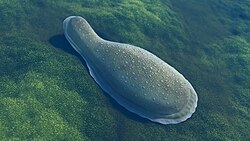
Long before the famous Cambrian explosion of life, the oceans were home to strange and enigmatic creatures. Among the most significant of these is Kimberella, an extinct genus of marine bilaterian—animals with bilateral symmetry—that lived during the Ediacaran period. Resembling a modern slug, Kimberella provides critical clues about the early evolution of complex animals and the timeline of biological diversification on Earth.
First discovered in Australia's Ediacara Hills, the most detailed research has since shifted to the White Sea region of Russia. These finds date back to between 558 and 555.3 million years ago, offering a window into a world of microbial mats and primitive sea-floor dwellers.
Key Facts
- Temporal Range: Ediacaran period, approximately 558 to 555.3 million years ago.
- Classification: Generally accepted as a bilaterian; strongly suspected to be a stem-group mollusc or protostome.
- Physical Form: A slug-like body with a non-mineralized "soft shell" reaching up to 15 cm in length.
- Diet: Grazed on benthic bacteria and algae found in microbial mats.
- Global Presence: Fossils found in Russia, Australia, Iran, Ukraine, Canada, and previously reported (though disputed) in Brazil.
Anatomy and Physical Characteristics
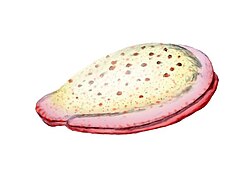
Kimberella possessed a dorsal covering described as a non-mineralized "soft shell." While some specimens were as small as 2–3 mm, larger adults could reach 15 cm in length, 5–7 cm in width, and 3–4 cm in height. One of its most distinctive features was a frilled fringe extending beyond the shell, which scientists believe functioned as a respiratory system, similar to gills.
The presence of this large fringe suggests two possibilities: either the respiratory system was relatively inefficient and required a vast surface area to function, or the animal faced very few predators, meaning the shell served primarily as a muscle platform rather than a defensive shield.
Ecology and Feeding Behavior
Kimberella inhabited shallow, well-oxygenated waters, sharing the sea floor with other Ediacaran organisms such as Dickinsonia, Tribrachidium, and Charniodiscus. It lived atop microbial mats—thick layers of photosynthetic bacteria and algae.
Evidence suggests Kimberella was a grazer. Fossilized gut contents confirm a diet of benthic bacteria and algae. Paleontologists have observed fans of grooves radiating from the animal's head, indicating that Kimberella stayed in one place and raked the surface of the microbial mat toward its mouth using two "teeth." Some research suggests it may have used a retractable proboscis with hook-like organs.
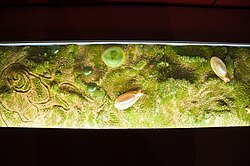
Interestingly, the movement of Kimberella is a point of academic debate. Some researchers believe it moved "backwards," destroying its own trail as it fed, while others argue it moved "forwards." Regardless of direction, evidence shows that Kimberella exhibited complex sensory behavior, as some specimens appear to have actively avoided their own previous grazing traces.
![Kimberichnus teruzzii grazing traces left by Kimberella while it fed[23]](/images/b4/1b/b41b05141374ac964f6f93c379ca9a6daf9c1f42e4e712872ce68f86e96db643.jpg)
Preservation and Discovery
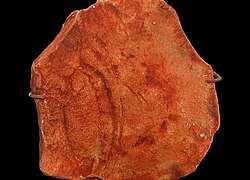
Because Kimberella lacked a mineralized skeleton, its preservation is a result of specific geological conditions. Fossils are typically found as depressions in the base of sandy beds overlying clay-rich layers. As the soft tissues decayed, the mud beneath was squeezed upward into the shell, preserving the organism's external shape.
The genus was named in honor of John Kimber, a teacher and collector who died during a 1964 expedition to Central Australia. Originally named Kimberia, the name was changed to Kimberella in 1972 by Mary Wade to avoid confusion with an existing subgenus of gastropods.
Scientific Importance and Classification
The classification of Kimberella is central to understanding the Cambrian explosion—the rapid diversification of animal body plans. Initially thought to be a type of jellyfish (cubozoan), research since 1997 has reclassified it as a triploblastic bilaterian (an animal with three germ layers and bilateral symmetry).
Many scientists view Kimberella as a stem-group mollusc. This is based on its shell-like body and the presence of Radulichnus and Kimberichnus—scratch marks in the sediment that resemble those made by a radula (the toothed tongue of modern molluscs). However, some paleontologists argue that the grazing patterns differ too much from modern molluscs to place it within the crown group.
| Feature | Description |
|---|---|
| Body Type | Slug-like, Bilaterian |
| Estimated Age | 558–555.3 Ma (Million years ago) |
| Primary Habitat | Shallow marine microbial mats |
| Key Anatomical Feature | Non-mineralized dorsal shell and respiratory fringe |
| Feeding Method | Surface scratching/grazing |
If Kimberella was indeed a protostome (a lineage including molluscs and annelids), it implies that the split between protostomes and deuterostomes occurred well before 555 million years ago, significantly predating the start of the Cambrian period.
Frequently Asked Questions
Was Kimberella a mollusc?
While it is widely considered a stem-group mollusc due to its body shape and grazing traces, some scientists dispute this, noting that its feeding mechanism differs from the typical radula found in modern molluscs.
Where have Kimberella fossils been found?
The most abundant fossils are from the White Sea region of Russia, but they have also been found in Australia, Iran, Ukraine, and Canada.
How did Kimberella eat?
It grazed on microbial mats of bacteria and algae, using a mouthpart to scrape food from the sediment toward its body, leaving behind distinct scratch marks.
Why is Kimberella important to evolutionary biology?
Its existence proves that complex, bilateral animals were diversifying millions of years before the Cambrian explosion, pushing back the timeline for the evolution of major animal lineages.
How did it breathe?
It is believed that the frilled fringe extending from its body acted as a respiratory system, functioning similarly to gills to extract oxygen from the water.