Kessock Bridge: A Landmark of Scottish Engineering in Inverness
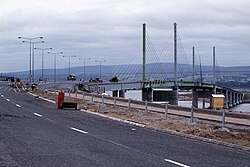
The Kessock Bridge (Scottish Gaelic: Drochaid Cheasaig) is a vital transport link in the Scottish Highlands, carrying the A9 trunk road across the Beauly Firth. Connecting the city of Inverness with the village of North Kessock, this impressive structure has fundamentally changed road transport in the region, serving as the southernmost of the "Three Firths" crossings, alongside the Cromarty and Dornoch crossings.
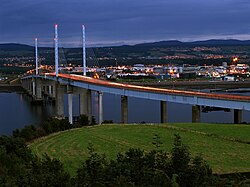
Beyond its utility, the bridge is a striking architectural feature of the Inverness skyline. Its four towering masts are illuminated at night, making it a recognizable beacon for residents and visitors alike.
Key Facts
- Official Name: Drochaid Ceasaig, Inbhir Nis / Kessock Bridge, Inverness.
- Design: Cable-stayed bridge designed by Hellmut Homberg and built by Cleveland Bridge.
- Dimensions: Total length of 1,056 metres (3,465 ft) with a main span of 240 metres (787 ft).
- Opening Date: 6 August 1982, opened by The Queen Mother.
- Heritage Status: Category B listed building since 25 September 2019.
- Traffic Volume: Estimated at 30,000 vehicles per day as of 2012.
Engineering and Design
The Kessock Bridge is a cable-stayed bridge, a design where the bridge deck is supported by cables connected directly to one or more towers. This specific design was led by German engineer Hellmut Homberg and shares similarities with a bridge crossing the Rhine between Rees and Kalkar. Because the Beauly Firth is a navigable waterway, the bridge was constructed high above sea level to allow ships to pass underneath.
Seismic Protection
Due to its proximity to the Great Glen Fault—a major geological fault line—the bridge was engineered to withstand potential seismic activity. To achieve this, engineers installed seismic buffers at the north abutment and longitudinal restraints at Pier 7 (the south main pier). Each buffer weighs approximately 2.5 tonnes and measures just over 3 metres in length.
History and Cultural Impact
Before the bridge opened in 1982, travelers heading north from Inverness had to rely on the Kessock Ferry or take a 20-mile detour via Beauly. The contract for the bridge was awarded to Cleveland Bridge in 1975 for £17.5 million (approximately £135.9 million in 2025 values). Construction began in 1978, and the project was recognized for its excellence with the Saltire Society 1982 Civil Engineering Award in 1983.
The bridge's significance is reflected in Scottish culture and finance; since 2007, it has been featured on the obverse of the Bank of Scotland's £100 note, which celebrates great Scottish engineering achievements alongside the Forth Bridge and Glenfinnan Viaduct.
Maintenance and Upgrades
To ensure longevity, the bridge underwent significant resurfacing between 2013 and 2014. Stirling Lloyd Construction Limited utilized an "Eliminator" waterproofing system and Gussasphalt (an impermeable surfacing material) to protect the deck. This work was estimated to extend the bridge's lifespan by 10 to 20 years beyond the initial 10-year guarantee.
Bridge Specifications Summary
| Feature | Detail |
|---|---|
| Total Length | 1,056 metres (3,465 ft) |
| Longest Span | 240 metres (787 ft) |
| Bridge Type | Cable-stayed |
| Designer | Hellmut Homberg / Cleveland Bridge |
| Listed Status | Category B |
| Primary Route | A9 Trunk Road |
Safety and Incidents
In recent years, the bridge has been the site of numerous mental health crises. Police callouts for people at risk of harm reached a five-year peak in 2022 with 203 incidents, compared to 120 in 2021, 85 in 2019, and 78 in 2018. These incidents frequently lead to bridge closures, causing significant traffic congestion as vehicles are diverted through local routes like Beauly. Consequently, there have been ongoing calls for safety improvements to prevent such occurrences.
Frequently Asked Questions
Who opened the Kessock Bridge?
The bridge was officially opened by The Queen Mother on 6 August 1982.
Why does the bridge have seismic buffers?
The buffers are installed to protect the structure against potential earthquake activity associated with the Great Glen Fault.
What is the bridge's role in the local economy?
By providing a direct link across the Beauly Firth, the bridge has been a key factor in the growth of Inverness and has transformed road transport in the Highlands.
Is the Kessock Bridge a protected building?
Yes, it was awarded Category B listed status by Historic Environment Scotland on 25 September 2019.
Where can the Kessock Bridge be seen on currency?
The bridge is featured on the obverse of the Bank of Scotland's £100 note as part of a series commemorating Scottish engineering.