The Epic Legend of Jumong: A South Korean Historical Masterpiece
In the landscape of South Korean television, few series have achieved the legendary status of Jumong. Originally produced as a special series to celebrate the 45th anniversary of MBC, this epic historical drama captured the hearts of millions, leading to an extension from its planned 60 episodes to a massive 81-episode saga. The series tells the sweeping story of King Dongmyeong, the foundational figure of the Goguryeo kingdom.
Blending elements of romance, action, and intense political intrigue, Jumong (also known as Prince of Legend) is more than just a period piece; it is a cinematic journey through a pivotal era of ancient history.

Key Facts
- Genre: Epic, Historical, Romance, and Action.
- Total Episodes: 81 episodes.
- Original Run: 15 May 2006 – 6 March 2007 on MBC TV.
- Lead Actor: Song Il-kook, who achieved superstar status internationally.
- Historical Focus: The life and rise of King Dongmyeong, founder of Goguryeo.
- Global Impact: Broadcast in numerous countries, including Iran, where viewership exceeded 90%.
The Story of a King: Plot Overview
The Struggle for Survival
The narrative begins in the wake of the conquest of Gojoseon by Han China in 108 BCE. As the Han forces rule the northern Korean Peninsula and Manchuria with an iron fist, local tribes struggle for survival. The story follows Haemosu, a leader of the resistance known as the Damul Army, and his alliance with Prince Geumwa of Buyeo. Amidst the chaos, a forbidden romance blossoms between Haemosu and Lady Yuhwa, leading to the birth of a son, Jumong.
A Prince in Exile
Raised in the Buyeo palace under the assumption that he is the son of King Geumwa, the young Jumong faces constant scorn and assassination attempts from his half-brothers, Daeso and Youngpo. Forced to flee the palace, Jumong undergoes a transformation. Under the covert guidance of the elderly, blind Haemosu—unaware of their true biological connection—Jumong masters the art of combat.
The Rise of Goguryeo
Following a series of betrayals, deaths, and political shifts, Jumong emerges as a formidable leader. By forming strategic alliances—most notably with Lady Soseono of the Gyeru trading clan—he unites various local tribes and the Damul Army. This powerful coalition eventually conquers the Xuantu Commandery, leading to the establishment of the mighty Kingdom of Goguryeo. The series concludes with the consolidation of his realm and the passing of the crown to his son, Yuri.
Production and Critical Acclaim
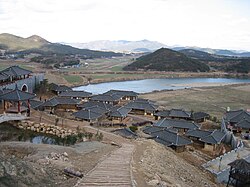
To achieve the grand scale required for such an epic, the production was filmed on location at Yongin Daejanggeum Park in Gyeonggi Province. This site is renowned for hosting major period dramas, providing the authentic atmosphere necessary for historical storytelling.
The series was a massive commercial and critical success. It held the highest viewership ratings of any Korean drama in 2006, with its finale reaching a staggering 51.9% nationwide rating. The accolades followed, with the show winning numerous prestigious awards:
- MBC Drama Awards: Grand Prize (Daesang) for Song Il-kook and Director of the Year for Lee Joo-hwan.
- Baeksang Arts Awards: Grand Prize (Daesang) for the series itself and Best Screenplay.
- Korea Drama Awards: Best Drama.
Series Summary
| Category | Details |
|---|---|
| Original Title | Samhanji: jumongpyeon (삼한지: 주몽편) |
| Directors | Lee Joo-hwan |
| Writers | Choi Wan-kyu, Jung Hyung-soo |
| Main Cast | Song Il-kook, Han Hye-jin, Kim Seung-soo, Jun Kwang-ryul, Oh Yeon-soo |
| Running Time | Approximately 65 minutes per episode |
| Production Companies | Chorokbaem Media, Olive9 |
Global Reach and Controversy
Jumong became a global phenomenon, with broadcast rights sold to dozens of countries across Asia, Europe, and the Americas. In Iran, the show's popularity was unprecedented, with peak viewership surpassing 90%, turning lead actor Song Il-kook into a household name.
However, the international distribution was not without friction. In Hong Kong, the broadcast by Asia Television (ATV) sparked significant controversy regarding translation choices. Debates arose over the translation of historical terms—such as referring to the Han Dynasty as the "heavenly dynasty" and changing "nation" to "tribe"—reflecting deeper historical interpretations regarding the relationship between the Goguryeo and Han eras.
Frequently Asked Questions
Why was the number of episodes increased from 60 to 81?
The series was originally planned for 60 episodes, but due to its overwhelming popularity and high viewership ratings, MBC decided to extend the production by an additional 21 episodes.
What is the historical significance of the series?
The series dramatizes the life of King Dongmyeong, the legendary founder of the Goguryeo kingdom, set against the backdrop of the power struggles following the fall of Gojoseon.
Where was the drama filmed?
The production utilized the Yongin Daejanggeum Park in the Cheoin District of Yongin, Gyeonggi Province, a famous location for high-quality Korean period dramas.
How successful was the show in terms of ratings?
Jumong was the highest-rated Korean drama of 2006. It maintained consistently high viewership, with its final episode reaching a nationwide rating of 51.9%.
Did the show win any major awards?
Yes, the series and its cast won numerous awards, including the Grand Prize (Daesang) at the MBC Drama Awards for Song Il-kook and the Grand Prize at the Baeksang Arts Awards for the series itself.