Four Commanderies of Han: Chinese Administration in Ancient Korea
The Four Commanderies of Han were administrative districts established by the Han dynasty in the north of the Korean Peninsula and parts of the Liaodong Peninsula. Spanning from the late 2nd century BCE to the early 4th century CE, these commanderies served as the primary mechanism for Chinese control over the territories of the former Old Chosŏn (Gojoseon) state.
Established by Emperor Wu following the conquest of Wiman Chosŏn, these districts functioned as colonial outposts that facilitated cultural and economic exchange between China and the indigenous populations of the peninsula. While most of the commanderies were short-lived, the Lelang Commandery remained a dominant regional power for four centuries, profoundly influencing the social fabric of the region before being absorbed by the rising state of Goguryeo.
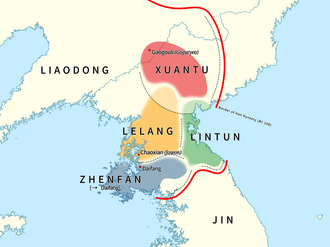
Key Facts
- Established: Early 2nd century BCE by Emperor Wu of the Han dynasty.
- Purpose: To govern the former territories of Old Chosŏn (Gojoseon).
- Core Center: Lelang Commandery, located near present-day Pyongyang.
- Duration: From 108 BCE until the early 4th century CE.
- Ultimate Fate: Conquered and absorbed by the kingdom of Goguryeo.
The Structure of the Commanderies
The administrative landscape evolved significantly over several centuries. Initially, the Han dynasty established three commanderies—Lelang, Lintun, and Zhenfan—following the defeat of Old Chosŏn in 108 BCE. Shortly after, in 107 BCE, Xuantu Commandery was created to govern the territory of the Yemaek, an ally of Gojoseon.
The Primary Districts
- Lelang Commandery (108 BCE–313 CE): The most enduring district, serving as a hub for officials, merchants, and colonists. By 2 CE, it comprised 25 prefectures with a population of 406,748.
- Xuantu Commandery (107 BCE–319 CE): A significant northern district that, by 2 CE, had 3 prefectures and a population of 221,845.
- Lintun Commandery (107–82 BCE): A shorter-lived district eventually absorbed into Xuantu.
- Zhenfan Commandery (107–82 BCE): A short-lived district eventually absorbed into Lelang.
Later in its history, the Daifang Commandery (204–315 CE) was separated from Lelang to manage specific regional interests.
| Commandery | Period | Key Statistics (c. 2 CE) | Outcome |
|---|---|---|---|
| Lelang | 108 BCE – 313 CE | 406,748 people; 25 prefectures | Conquered by Goguryeo |
| Xuantu | 107 BCE – 319 CE | 221,845 people; 3 prefectures | Conquered by Goguryeo |
| Lintun | 107 – 82 BCE | N/A | Absorbed into Xuantu |
| Zhenfan | 107 – 82 BCE | N/A | Absorbed into Lelang |
Political Evolution and the Gongsun Regime
The governance of these regions shifted as the central Han authority weakened. In the late 2nd century, Gongsun Du rose to power as the Administrator of Liaodong. Known for his hostility toward the landowning elite, Du expanded his influence into Goguryeo and Wuhuan territories, eventually proclaiming himself king.
His successor, Gongsun Kang, further expanded the territory and created the Daifang Commandery in 204 CE. The Gongsun family maintained a semi-independent regime until 238 CE, when Sima Yi invaded and annexed the territory. This power vacuum allowed Goguryeo to re-establish itself and begin reclaiming its ancestral lands.
The Rise of Goguryeo and the Fall of the Commanderies
Goguryeo, founded in 37 BCE, spent centuries gradually eroding Chinese control. Despite a severe setback in the 240s CE—when the Cao Wei general Guanqiu Jian sacked the Goguryeo capital of Hwando—the kingdom eventually recovered.
By the early 4th century, the Jin dynasty was crippled by civil war and could no longer govern its northern Korean territories. In 313 CE, Goguryeo attacked and annexed Lelang. This was followed by the conquest of Daifang (314–315 CE) and Xuantu (319 CE). To consolidate power, Goguryeo welcomed Chinese émigrés, integrating their administrative knowledge into the growing state.
Modern Historical Debates and Revisionism
The location and nature of the commanderies remain subjects of intense academic debate. While mainstream historians in the US, China, and Japan agree that Lelang was located near Pyongyang, some scholars in North Korea and South Korea propose a revisionist theory.
Revisionists argue that the commanderies were located entirely outside the Korean Peninsula, specifically in the Liaodong Peninsula of modern-day China. They suggest that archaeological finds in Pyongyang—such as Han-style lacquerware and jewelry—were the result of trade rather than direct colonial administration. This debate often intersects with national identity and the interpretation of colonial-era Japanese research.
Frequently Asked Questions
Who established the Four Commanderies of Han?
They were established by Emperor Wu of the Han dynasty in the early 2nd century BCE following the conquest of Wiman Chosŏn.
Which was the most important of the four commanderies?
Lelang Commandery was the most significant, serving as the administrative, economic, and cultural center for four centuries.
How did the commanderies affect the local population?
The administration introduced Chinese culture, goods (such as mirrors), and urban planning, which eroded the traditional fabric of Old Chosŏn society and created a unique cultural hybrid.
What happened to the commanderies in the 4th century?
They were systematically conquered by the kingdom of Goguryeo, with Lelang falling in 313 CE, Daifang in 314–315 CE, and Xuantu in 319 CE.
Why is there a dispute about their location today?
Some revisionist scholars argue the commanderies were located in the Liaodong Peninsula (China) rather than the Korean Peninsula to challenge the narrative of early Chinese colonial influence in Korea.