John Witherspoon: The Scottish Minister Who Shaped American Independence
John Witherspoon was a multifaceted figure of the 18th century—a Scottish-American Presbyterian minister, educator, and farmer who rose to become a Founding Father of the United States. As the 6th President of the College of New Jersey (now Princeton University), Witherspoon did more than lead an academic institution; he helped forge the intellectual and civic character of a nascent nation.
His influence spanned theology, philosophy, and politics. He is uniquely remembered as the only active clergyman and the only college president to sign the Declaration of Independence, bridging the gap between spiritual leadership and revolutionary governance.
Key Facts
- Role: 6th President of Princeton University (1768–1794).
- Political Achievement: Signatory of the Declaration of Independence and the Articles of Confederation.
- Philosophy: Proponent of Scottish common sense realism, emphasizing a practical approach to knowledge and morality.
- Academic Legacy: Taught future leaders including James Madison and Aaron Burr.
- Religious Leadership: Convening moderator of the First General Assembly of the Presbyterian Church in the U.S.A. (1789).
Early Life and Ministry in Scotland
Born on February 5, 1723, in Yester, Scotland, John Witherspoon was the eldest son of the Reverend James Alexander Witherspoon and Anne Walker. He received a rigorous education, earning a Master of Arts from the University of Edinburgh in 1739 and later an honorary doctoral degree in divinity from the University of St Andrews in 1764.
Witherspoon's early career was defined by his service as a Presbyterian minister, first at Beith, Ayrshire (1745–1758), and later at the Laigh Kirk in Paisley (1758–1768). During this time, he emerged as a prominent Evangelical voice, opposing the Moderate Party within the Church of Scotland. He authored several theological works, including the 1753 satire Ecclesiastical Characteristics, which challenged the philosophical influence of Francis Hutcheson.
The Transformation of Princeton
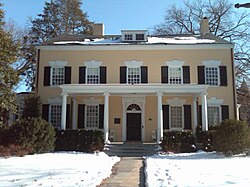
In 1768, at the urging of Benjamin Rush and Richard Stockton, Witherspoon emigrated to New Jersey to serve as the president and head professor of the College of New Jersey. Under his leadership, the institution evolved from a narrow seminary for training clergymen into a comprehensive school designed to equip the future leaders of a new republic.
The impact of his pedagogy was profound. His students included James Madison, Aaron Burr, and Philip Freneau. The long-term academic output of his tenure was staggering: 49 U.S. Congressmen, 28 U.S. Senators, 12 members of the Continental Congress, 10 Cabinet officers, and 37 judges (including three U.S. Supreme Court justices) passed through his classrooms.
A Complex Legacy
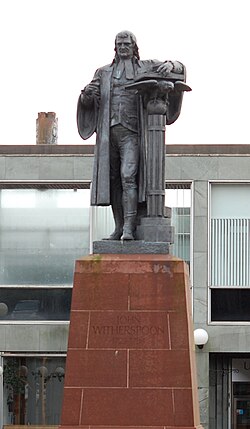
While celebrated for his academic and civic contributions, Witherspoon's legacy is subject to modern scrutiny due to his ties to slavery. Records indicate he owned enslaved people, and in 1790, as chairman of a New Jersey legislative committee on the abolition of slavery, he advised against immediate action. This history has led to contemporary petitions at Princeton University to remove his statue from Firestone Plaza, suggesting it be replaced with an informational plaque detailing both the positive and negative aspects of his life.
Role in the American Revolution
Witherspoon's political awakening was driven by his opposition to the British Crown's centralization of power and its interference in colonial affairs. He viewed the establishment of episcopacy authority (the rule of bishops) as a threat to liberty, drawing parallels to the struggles of the Scottish Covenanters.
By 1774, he had joined the New Jersey Committee of Correspondence and Safety. Elected to the Continental Congress in 1776, he served as the congressional chaplain and voted for independence. When some argued the colonies were not yet ready for such a drastic step, Witherspoon famously remarked that the country was not only ripe for the measure but "in danger of rotting for the want of it."
![In Declaration of Independence by John Trumbull (1818), Witherspoon is the second seated figure from the (viewer's) right among those shown in the background facing the large table.[23]](/images/5a/94/5a94f9077be788aac52519cb577b87c43fc11565704281db787b38494c7a95fb.jpg)
Beyond the Declaration, Witherspoon was a legislative workhorse, serving on over 100 committees. He helped draft the Articles of Confederation, organized executive departments, and strongly advocated for the ratification of the U.S. Constitution.
Personal Life, Death, and Burial
Witherspoon's personal life was marked by both tragedy and resilience. His first wife, Elizabeth Montgomery, bore him ten children, though only five survived to adulthood. His eldest son, James, was killed at the Battle of Germantown in 1777. In his later years, at age 68, he married a 24-year-old widow and had two more children.
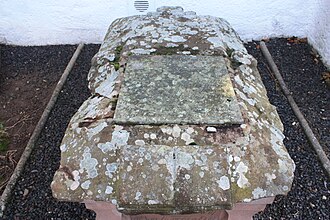
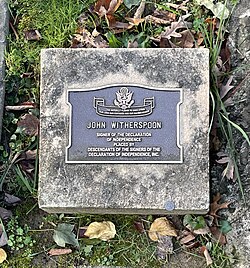
By 1792, Witherspoon had become blind due to eye injuries. He passed away on November 15, 1794, at his farm, Tusculum, in Princeton. An inventory of his estate at the time of his death listed two enslaved people valued at one hundred dollars each.
Summary of John Witherspoon's Life
| Category | Details |
|---|---|
| Lifespan | February 5, 1723 – November 15, 1794 |
| Education | University of Edinburgh (MA), University of St Andrews (Hon. DD) |
| Primary Roles | President of Princeton University, Member of Continental Congress |
| Key Documents Signed | Declaration of Independence, Articles of Confederation |
| Theological Influence | Presbyterianism, Calvinism, Scottish Common Sense Realism |
| Resting Place | Princeton Cemetery, New Jersey |
Frequently Asked Questions
What was John Witherspoon's contribution to the Declaration of Independence?
John Witherspoon was a delegate from New Jersey to the Second Continental Congress and a signatory of the Declaration of Independence. He was the only active clergyman and the only college president to sign the document.
How did Witherspoon influence the students at Princeton?
He shifted the college's focus from purely training clergy to preparing citizens for leadership in a new nation. His students included James Madison and Aaron Burr, and his alumni went on to fill hundreds of high-ranking judicial and legislative positions in the early U.S. government.
What is Scottish common sense realism?
It is a philosophical approach that Witherspoon embraced, which emphasizes that certain fundamental truths are intuitive and can be understood through common sense and observation, rather than solely through complex abstract reasoning.
Why is there controversy surrounding his statue at Princeton?
The controversy stems from Witherspoon's history as a slave owner and his 1790 legislative report advising against the immediate abolition of slavery in New Jersey, which some community members find incompatible with the university's current mission.
What was his view on tyranny and government?
Influenced by the traditions of John Calvin and John Knox, Witherspoon believed that resistance to tyranny was an act of obedience to God, a conviction that fueled his support for the American Revolution.