Massachusetts: History, Geography, and Culture of the Bay State
Known officially as the Commonwealth of Massachusetts, this New England state is a cornerstone of American history and a modern leader in economic prosperity. From the arrival of the Pilgrims to its pivotal role in the American Revolution and the Industrial Revolution, Massachusetts has consistently shaped the trajectory of the United States. Today, it is recognized not only for its rich heritage but also for its high median household income and diverse population.
Key Facts
- Capital: Boston (also the largest city).
- Admission to Union: February 6, 1788 (6th state).
- Population: Approximately 7,154,084 (2025 estimate).
- Economic Standing: Ranked 1st in median household income ($99,900 in 2023).
- Highest Point: Mount Greylock (3,489 ft).
- Official Motto: Ense petit placidam sub libertate quietem ("By the sword we seek peace, but peace only under liberty").
A Legacy of History
Colonial Foundations and Early Industry
The colonial era began in 1620 when the Pilgrims founded Plymouth. This period of early settlement laid the groundwork for the state's religious and social structures.

As the colony grew, it expanded into early industrialization. In 1646, John Winthrop the Younger established the Saugus Iron Works, the first integrated ironworks in North America, featuring a blast furnace and a quarter-ton trip hammer.

Cultural milestones of this era include the printing of the Mamusse Wunneetupanatamwe Up-Biblum God, also known as the Eliot Indian Bible, which was the first Bible printed in British North America.

The American Revolution
Massachusetts was the epicenter of the struggle for American independence. The first shots of the American Revolution were fired on Lexington Green, specifically in front of the Buckman Tavern.


The state produced influential leaders such as John Adams, who served as the 2nd President of the United States from 1797 to 1801.

During the conflict, the state issued its own currency, including five-shilling notes in 1779, to support the war effort.

Economic Evolution and the Industrial Revolution
In the 18th and 19th centuries, Massachusetts leveraged its coastline for lucrative trade. Salem became a major port, particularly in the spice trade, leading to the highest per capita income in the U.S. during the early 1800s. The Friendship, an East Indiaman ship, symbolizes this era of maritime wealth.

The state later transitioned into a manufacturing powerhouse. Textile mills in cities like Lowell established Massachusetts as a leader in the Industrial Revolution, shifting the economy from maritime trade to large-scale production.

Modern Era and Political Influence
In the 20th century, Massachusetts continued to produce national leaders, including John F. Kennedy, a native of the state and the 35th President of the United States (1961–1963).

The state has also been a site of significant modern events, such as the Boston Marathon bombing, and a pioneer in civil rights, becoming the first U.S. state to legalize same-sex marriage in 2004.

Geography and Climate
Massachusetts features a varied landscape, from the coastal plains of Cape Cod to the highlands of the west. The north-central Pioneer Valley is a prominent geographic feature, particularly around South Deerfield.

The state's climate is categorized by various Koppen climate types, resulting in distinct seasonal changes. Coastal cities like Boston and Plymouth experience more moderate temperatures than inland cities like Worcester or Springfield.

Population density is highest in the eastern part of the state, with major centers of settlement in Boston, Worcester, Springfield, and Pittsfield.

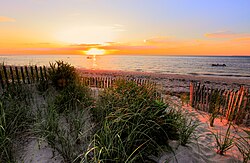
The scenic beauty of the state is epitomized by the coastlines of Cape Cod Bay, where sunsets over Brewster provide a glimpse of the region's natural appeal.
Demographics and Society
The population of Massachusetts has grown steadily from roughly 378,000 in 1790 to over 7 million by 2025. The state is ethnically diverse, with significant populations of White (non-Hispanic), Hispanic or Latino, Asian, and African American residents.

![Largest alone or in any combination ethnic origin by county in Massachusetts, per the 2020 census [199]](/images/1b/e1/1be151dbb1f472c64f2025222b2bc381af4833facae34ab9c874880f62b494c6.jpg)
This diversity is visible in urban centers; for example, Boston's Chinatown is a vibrant hub for Chinese and Vietnamese communities.

The state is also known for its inclusive culture, highlighted by the annual gay pride march in Boston.


Education is a high priority in the Commonwealth, with various municipalities showing high combined mean SAT scores in public high school districts.
![Towns in Massachusetts by combined mean SAT of their public high school district for the 2015–2016 academic year[242]](/images/8d/65/8d655186d62a311e524e7d5d7c1c0a2a1e76a61e63eb8007323e623d1bee52ce.png)
Infrastructure and Government
Transportation
The Massachusetts Bay Transportation Authority (MBTA) provides essential transit for Greater Boston, while Logan International Airport serves as the largest passenger volume airport in New England.


The state's road network connects its major cities and towns, facilitating the movement of goods and people across the region.

Government and Politics
The state is governed by the executive branch, currently led by Governor Maura Healey. The legislative body, known as the General Court, consists of the Senate and the House of Representatives.


Politically, a large portion of the electorate is unenrolled (64.75%), though the Democratic Party remains the largest registered political party.

Healthcare and social services are key components of state administration, with Medicare reimbursement rates varying by county.
![The average Medicare reimbursement per enrollee for the counties is mapped.[448]](/images/52/8f/528fa66ea6e02584614127f97756643ab1556274d48c67b8119dd1bbd79d2e74.png)
Culture and Recreation
Massachusetts is a hub for sports and entertainment. Gillette Stadium in Foxborough is the home of the NFL's New England Patriots and the MLS's New England Revolution.

The state also celebrates a wide array of symbols, from the Black-capped chickadee (state bird) and the Cod (state fish) to the Boston cream pie and chocolate chip cookie (state desserts).
| Category | Symbol |
|---|---|
| Bird | Black-capped chickadee, Wild turkey |
| Fish | Cod |
| Flower | Mayflower |
| Mammal | Right whale, Morgan horse, Tabby cat, Boston Terrier |
| Food/Dessert | Cranberry, Boston cream pie, Chocolate chip cookie |
| Tree | American elm |
Frequently Asked Questions
What is the official nickname of Massachusetts?
The official nickname for the state is the Bay Stater, though "Masshole" is used colloquially.
Which city is the capital of Massachusetts?
Boston is both the capital and the largest city in the state.
When did Massachusetts join the Union?
Massachusetts was admitted to the Union on February 6, 1788, becoming the 6th state.
What is the highest point in Massachusetts?
The highest elevation in the state is Mount Greylock, reaching 3,489 feet.
What is the state's economic ranking regarding income?
Massachusetts ranks 1st in the United States for median household income, which was $99,900 in 2023.