Introgression: How Genetic Exchange Shapes Species Evolution
In the complex tapestry of biological evolution, species are often viewed as distinct, isolated lineages. However, the reality is frequently more fluid. Through a process known as introgression, or introgressive hybridization, genetic material can move from one species into the gene pool of another. This is not a simple one-time event but a long-term process involving the repeated backcrossing of an interspecific hybrid with one of its parent species.
While simple hybridization—such as that seen in mules—results in a relatively even mixture of two parental species, introgression is far more nuanced. It produces a complex, highly variable mixture of genes and may involve only a minimal percentage of the donor genome. Unlike standard gene flow, which occurs between populations of the same species, introgression represents a bridge between two different taxa.

Key Facts
- Definition: The incorporation of novel genes or alleles from one taxon into the gene pool of a second, distinct taxon.
- Mechanism: Occurs via hybridization followed by repeated backcrossing.
- Adaptive Introgression: When genetic transfer increases the overall fitness of the recipient taxon.
- Ghost Introgression: Traces of extinct species left in present-day genomes.
- Distinction: Differs from simple hybridization by creating a complex, non-uniform genetic mixture.
Sources of Genetic Variation
Introgression serves as a vital engine for genetic variation in natural populations. By introducing new alleles, it can drive adaptation and even contribute to adaptive radiation—the rapid diversification of a lineage into forms filling different ecological niches. This phenomenon is ubiquitous across the tree of life, affecting plants, animals, and even humans.
Evolution of Domesticated Species
Introgression has played a monumental role in the history of agriculture and animal husbandry. Rather than relying solely on independent domestication events, many researchers propose that introgression with wild relatives contributed significantly to the diversity of domestic animals. Similarly, in crops, introgression has provided essential genes that allow species to expand into new environments.
Notable examples include:
- Date Palms: North African domesticated varieties show 5–18% introgression from the wild Cretan palm, Phoenix theophrasti.
- Apples: The evolution of modern apples involved hybridization with the European crabapple.
- Rice: Indica rice likely arose when Chinese japonica rice hybridized with the wild O. nivara approximately 4,500 years ago, transferring key domestication genes.
In agricultural science, researchers use introgression lines (ILs)—crop varieties containing specific segments of DNA from a wild relative—to study quantitative trait loci and introduce desirable exotic traits into cultivated plants.
Introgression Across the Animal Kingdom
Humans and Primates
Modern human genetics contains clear evidence of ancient introgression. Our ancestors interbred with Neanderthals and Denisovans, leaving lasting traces in our genome. One specific example is the microcephalin D allele, which may have been introduced into the human lineage through such events.
Birds and Insects
In the avian world, the Mallard duck is a prolific hybridizer, often crossing with other species to the point of reducing the genetic identity of those species. In the insect world, the butterfly genus Heliconius demonstrates how introgression can influence mimicry. Studies using the ABBA/BABA test show that specific color pattern loci in certain subspecies are the result of non-random introgression, allowing species to share successful survival patterns.
Fish and Other Species
In aquatic environments, introgression can even restore lost traits. Research on Astroblepus fish suggests that introgression between surface-dwelling members and a cave-dwelling (troglomorphic) species resulted in offspring regaining distinct eyes and optic nerves.
Lineage Fusion: An Extreme Variant
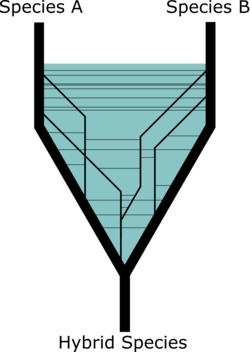
At its most extreme, introgression can lead to lineage fusion. This occurs when two distinct species or populations merge so completely that they form a single population, effectively displacing the original parental species in that region. This typically happens when there are few reproductive barriers between the diverging lineages.
Summary of Introgression Types and Examples
| Process | Primary Characteristic | Key Example |
|---|---|---|
| Simple Hybridization | Uniform mixture of parental genes | Mules |
| Introgression | Complex, variable transfer via backcrossing | Human-Neanderthal gene flow |
| Adaptive Introgression | Transfer increases recipient fitness | Rice domestication genes |
| Lineage Fusion | Merging of two species into one | Galápagos giant tortoises |
Frequently Asked Questions
How does introgression differ from genetic engineering?
Introgression is a natural biological process (though it can be facilitated by humans) involving breeding and backcrossing. It does not require the direct manipulation of DNA in a laboratory, which distinguishes it from genetic engineering.
What is "ghost introgression"?
Ghost introgression refers to the phenomenon where traces of an extinct species are discovered within the genomes of living species, even though the original donor species is no longer extant.
Can introgression be harmful to a species?
While the term "adaptive introgression" refers to beneficial changes, introgression can also lead to genetic erosion. For example, feral mallard populations have significantly reduced the wild populations of Pacific black ducks through cross-breeding.
What are introgression lines in agriculture?
Introgression lines are specialized crop varieties created by repeatedly backcrossing a cultivated plant with a wild relative. These lines allow scientists to map specific traits and introduce beneficial wild genes into modern crops.
Is introgression the same as gene flow?
Not exactly. While related, standard gene flow typically occurs between populations of the same species. Introgression specifically refers to the movement of genes between two different, distinct species.