Inanna-Ishtar: The Mesopotamian Goddess of Love and War
In the ancient landscapes of Mesopotamia, few figures loom as large or as paradoxical as Inanna (known in Akkadian as Ishtar). As the Queen of Heaven, she presided over the contradictory realms of love, fertility, and war. Her influence spanned millennia, evolving from the early Sumerian city-states to the vast Akkadian and Assyrian empires, eventually leaving an indelible mark on the deities of the Mediterranean world.
Inanna was not a traditional mother goddess; instead, she embodied the raw, unpredictable forces of desire and conflict. Her presence was felt in the political heart of Uruk, Agade, and Nineveh, where she was worshipped as a powerful patroness of both the bedroom and the battlefield.
Key Facts
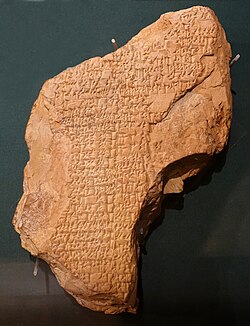
![Tablet of Lugal-kisalsi. The symbol for Inanna is in the 2nd column from the right. [33]](/images/da/93/da933ba1f0bdaafc7d9cdd5d4ac231899d7de39da014ace54eb8ccd63a9e60bb.jpg)
- Primary Domains: Love, war, fertility, and political power.
- Celestial Association: The planet Venus.
- Major Cult Centers: Uruk, Agade, and Nineveh.
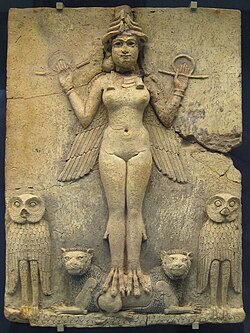
- Key Symbols: The eight-pointed star, the lion, the rose, and the hook-shaped knot of reeds.
- Family: Most commonly the daughter of Nanna and Ningal; twin sister to Utu (Shamash).
- Equivalents: Astarte (Canaanite), Aphrodite (Greek), and Venus (Roman).
Iconography and Symbols
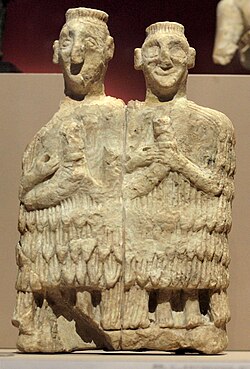
The visual representation of Inanna-Ishtar reflects her dual nature. In her aspect as a goddess of war, she is often depicted armed with a bow or standing atop a lion, symbolizing her dominance and ferocity.
![Ancient Akkadian cylinder seal depicting Inanna resting her foot on the back of a lion while Ninshubur stands in front of her paying obeisance, c. 2334–2154 BCE[97]](/images/8f/ba/8fba55149f01490aa6b9f9ded733bcc47030a79821bb8ec8424e53ff6bfc3c0c.jpg)
Conversely, her associations with love and fertility are linked to the rose and the dove. One of her most enduring symbols is the eight-pointed star, representing her connection to the planet Venus, the morning and evening star. In early Sumerian art, she was also identified by a hook-shaped knot of reeds.
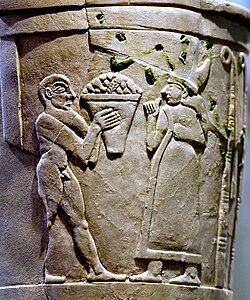
![The Uruk Vase (Warka Vase), depicting votive offerings to Inanna (3200–3000 BCE)[23]](/images/7d/69/7d69c63503d8e1da11762a02bba91fc12db020fee3d5efd286d26bb2a666dd27.jpg)
Mythology and Narrative
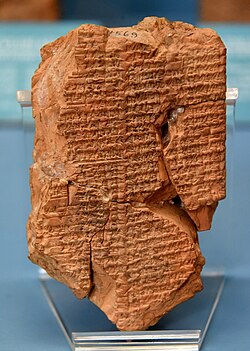
The stories of Inanna are characterized by ambition, passion, and a willingness to challenge the boundaries of life and death. Her narratives often involve the pursuit of power or the complexities of romantic desire.
The Descent into the Underworld
One of the most significant myths is Inanna's descent into the underworld, the realm of her older sister Ereshkigal. Two primary versions of this tale exist: a detailed Sumerian version from the Third Dynasty of Ur (c. 2112–2004 BCE) and a shorter, derivative Akkadian version from the second millennium BCE.
In the story, Inanna attempts to conquer the land of the dead, only to be stripped of her royal garments and powers at seven gates. After her temporary death and subsequent resurrection, the myth explains the cyclical nature of life and the seasons, often involving the substitution of her consort, Dumuzid, who is sent to the underworld in her place.
The Epic of Gilgamesh
Inanna-Ishtar also plays a pivotal role in the Epic of Gilgamesh. After being spurned by the hero Gilgamesh, she reacts with fury, convincing the gods to send the Bull of Heaven to devastate Uruk. This conflict highlights her volatile temperament and her role as a catalyst for divine retribution.
![Ancient Mesopotamian terracotta relief showing Gilgamesh slaying the Bull of Heaven, sent by Ishtar in Tablet VI of the Epic of Gilgamesh after he spurns her amorous advances[322]](/images/55/2b/552bfeadca60a2404dccbbe092cebfe6e1bfcb6dea1b1f0b223bce90f7e226ef.jpg)
Family and Divine Relations
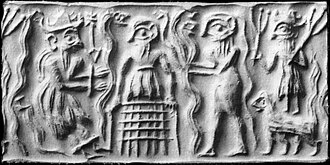
Inanna's genealogy varies across traditions, but she is most frequently cited as the daughter of the moon god Nanna and the goddess Ningal. Her relationship with her twin brother, Utu (the sun god), represents a celestial balance. Her romantic life was equally complex, with consorts including Dumuzid and the historical Sargon of Akkad.
Her influence extended beyond her immediate family through syncretism—the blending of different beliefs. Over time, her attributes merged with other deities such as Nanaya, Ninisina, and the Hurrian goddess Shaushka.
![Akkadian cylinder seal from c. 2300 BCE or thereabouts depicting the deities Inanna, Utu, Enki, and Isimud[212]](/images/9d/cc/9dcc2a60f4bcfae5c1e9e0e53aed117e596f7aeaaabf674dca07e0415b2fcbb2.jpg)
Historical Timeline and Influence
The worship of Inanna evolved over several distinct archaeological and historical periods, moving from local city-state devotion to an imperial cult.
| Period | Approximate Dates | Key Sources/Artifacts |
|---|---|---|
| Ubaid Period | c. 5300–4100 BCE | Early foundations |
| Uruk Period | c. 4100–2900 BCE | Uruk Vase |
| Early Dynastic Period | c. 2900–2334 BCE | Early temple structures |
| Akkadian Empire | c. 2334–2218 BCE | Writings of Enheduanna |
| Ur III Period | c. 2047–1940 BCE | Descent into the Underworld texts |
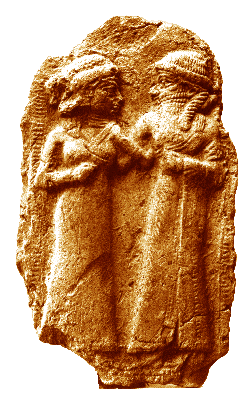
The legacy of Inanna-Ishtar traveled far beyond Mesopotamia. She is the precursor to the Phoenician Astarte and the Greek Aphrodite, whose myth of Adonis is a direct derivative of the Inanna and Dumuzid cycle.
![Altar from the Greek city of Taras in Magna Graecia, dating to c. 400 – c. 375 BCE, depicting Aphrodite and Adonis, whose myth is derived from the Mesopotamian myth of Inanna and Dumuzid[360][361]](/images/33/a0/33a03ce1f9b86d8b2a850bbb5504451b58ba97ac448428a8aa4acd965a2e6c93.jpg)
Frequently Asked Questions
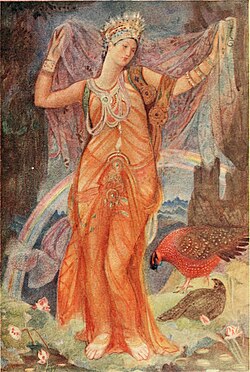
![Illustration of Ishtar's Midnight Courtship from Leonidas Le Cenci Hamilton's 1884 book-length poem Ishtar and Izdubar, loosely based on George Smith's recent translation of the Epic of Gilgamesh[383]](/images/3e/8a/3e8ab0adba45444b877d1c285c1a394b387b997b2ed133e2f18e3b7b1d141282.jpg)
Who was Inanna-Ishtar?
Inanna (Sumerian) and Ishtar (Akkadian) are the same deity, the Queen of Heaven and the goddess of love, war, and fertility in ancient Mesopotamia.
What planet is associated with Inanna?
Inanna is associated with the planet Venus, appearing as both the morning and evening star.
What is the significance of the Descent into the Underworld?
This myth explores themes of death, rebirth, and the limits of power, as Inanna journeys to the realm of the dead and is eventually resurrected.
How does Inanna differ from other goddesses?
Unlike many ancient goddesses, Inanna was not primarily a mother figure; she represented independent female power, sexual desire, and the aggression of war.
Which later goddesses were influenced by Ishtar?
The Canaanite Astarte, the Greek Aphrodite, and the Roman Venus all share roots and attributes with the Mesopotamian Ishtar.