Hydrostatic Skeletons: Mechanics, Structure, and Biological Functions
In the diverse world of animal anatomy, not every creature relies on a rigid frame of bone or chitin to maintain its shape. Many soft-bodied invertebrates utilize a hydrostatic skeleton (or hydroskeleton), a structural system supported by fluid pressure. From the humble earthworm to complex marine organisms, these fluid-filled systems allow for remarkable flexibility and specialized movement.
At its most basic level, being hydrostatic means being fluid-filled. While many organisms possess a full hydrostatic skeleton, others may have a hydrostatic organ—a specific structure that functions similarly to a skeleton but is limited to a particular part of the body.
Key Facts
- Mechanism: Uses incompressible fluid pressure to provide structural support and enable movement.
- Muscle Action: Relies on the interaction between longitudinal and circular muscles.
- Common Examples: Earthworms, jellyfish, sea anemones, and acorn worms.
- Vertebrate Application: Found in the mammalian penis and as "muscular hydrostats" in tongues and elephant trunks.
- Primary Advantage: Exceptional flexibility for burrowing, swimming, and squeezing through tight spaces.
How a Hydrostatic Skeleton Works
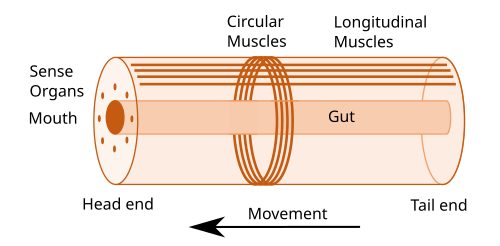
A hydrostatic skeleton typically functions as a cylinder containing a fluid-filled cavity, known as a coelom or pseudocoelom. Because the fluid within this cavity is resistant to changes in volume, it acts as a rigid base against which muscles can pull.
Movement is achieved through two primary mechanical units: the body wall and the muscle layers. These layers are organized into longitudinal muscles (running parallel to the body axis) and circular muscles (wrapping around the circumference). When circular muscles contract, the body becomes thinner and longer; conversely, when longitudinal muscles contract, the body shortens and thickens.
The Role of Connective Tissue
To prevent the body from simply twisting or collapsing, many hydrostatic skeletons are reinforced with collagenous connective fibers arranged in a helical shape. This helical structure allows the organism to elongate and shorten while remaining rigid enough to prevent torsion (twisting). As the animal changes shape, the pitch of this helix adjusts relative to the long axis of the body.
Advantages and Limitations
The fluid-based nature of these skeletons provides several evolutionary benefits. Organisms can easily navigate oddly shaped passages, hide from predators by burrowing, and generate significant force to pry open gaps in rocks. Furthermore, these animals often heal faster than those with hard skeletons; if the fluid cavity is breached, water or blood can be refilled relatively quickly. Some species, such as the common earthworm, can even regrow damaged body parts.
However, there are significant trade-offs. Hydrostatic skeletons offer very little protection for internal organs against external physical damage. They also provide limited attachment points for limbs, resulting in simpler body plans. Additionally, because they rely on fluid, these organisms must remain in environments where they can easily replenish their internal fluids, which is why they are so prevalent in marine ecosystems.
Hydrostatic Systems Across Species
| Organism/Structure | Type | Primary Function | Fluid Used |
|---|---|---|---|
| Earthworm | Skeleton | Locomotion/Burrowing | Water/Coelomic fluid |
| Sea Anemone | Skeleton (Head) | Feeding/Locomotion | Water |
| Acorn Worm | Skeleton | Tunneling/Anchoring | Water |
| Mammalian Penis | Organ | Physical Rigidity | Blood |
| Elephant Trunk | Muscular Hydrostat | Precise Manipulation | None (Muscle-based) |
Invertebrates
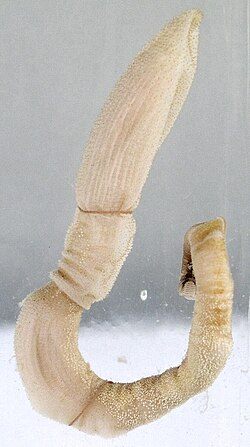
Invertebrates like jellyfish and sea anemones use hydrostatic pressure for basic survival. The sea anemone, for instance, utilizes a hydrostatic head to radiate its arms for feeding. Acorn worms (Enteropneusta), which are hemichordates, use their skeletons to anchor themselves into the ocean floor for defense and movement.
Vertebrates and Muscular Hydrostats
In vertebrates, the system is often modified. The mammalian penis is a hydrostatic organ that fills the corpora cavernosa with blood to maintain rigidity. Unlike invertebrate skeletons, it must resist bending; it achieves this through connective fibers arranged both parallel and perpendicular to the axis, rather than in a helix.
Some vertebrates possess a muscular hydrostat. Unlike a standard hydrostatic skeleton, these contain no fluid-filled cavity. Instead, they consist of densely packed muscle and connective fibers. Movement is generated by muscle contractions—when one area contracts and decreases in area, another must expand. This allows for high-precision movement in three dimensions, as seen in the tongues of mammals, reptiles, and amphibians, as well as the proboscises of tapirs and elephants.
Frequently Asked Questions
What is the difference between a hydrostatic skeleton and a muscular hydrostat?
A hydrostatic skeleton relies on a fluid-filled cavity (coelom) to create pressure and movement. A muscular hydrostat contains no fluid cavity and instead uses the displacement of muscle tissue itself to generate movement and shape changes.
How do earthworms move using a hydrostatic skeleton?
Earthworms use peristalsis, a process where circular and longitudinal muscles contract in alternating waves. This changes the body's shape and pushes the animal forward against its environment.
Why are hydrostatic skeletons more common in marine animals?
These skeletons require a constant supply of fluid to function and survive. Marine environments provide easy access to the water necessary to refill and maintain the pressure within their bodies.
Can a hydrostatic skeleton provide protection?
While it provides a cushion that protects internal organs from shock, it does not offer effective protection against external punctures or crushing forces compared to an exoskeleton or endoskeleton.
How does the mammalian penis differ from an invertebrate hydroskeleton?
While both use fluid pressure, the mammalian penis is a hydrostatic organ designed to resist bending rather than facilitate locomotion. It uses a specific arrangement of fibers in the corpus cavernosum instead of the helical fibers found in many worms.