Enterocoely: The Process of Coelom Formation in Deuterostomes
In the complex world of embryology, the way an animal develops its internal body cavity—known as the coelom—provides critical clues about its evolutionary lineage. One of the primary methods of this development is enterocoely. This biological process describes both the specific mechanism by which the body cavity forms and the origin of the cells that create it.
At its core, enterocoely is the process where the mesoderm (the middle germ layer) is formed from pouches that grow and eventually separate from the embryonic gut, or archenteron. Because the coelomic epithelium originates from these archenteral diverticula (outpocketings), the endoderm effectively gives rise to the mesodermal cells.
Key Facts
- Definition: Enterocoely is the formation of a coelom from pouches budding off the embryonic gut.
- Taxonomy: This process is characteristic of deuterostomes, who are also referred to as enterocoelomates.
- Cellular Origin: The mesoderm is derived from the endoderm.
- Contrast: It differs from schizocoely, the method of cavity formation typically found in protostomes.
- Etymology: Derived from the Greek énteron (intestine) and koilía (cavity).
The Etymology of Enterocoely
The term is rooted in Ancient Greek, combining énteron, meaning "intestine," and koilía, meaning "cavity." This linguistic origin directly describes the biological reality: fluid-filled body cavities that emerge from pockets related to the embryonic gut.
Taxonomic Distribution
Enterocoely is a defining stage of embryological development for deuterostomes. Animals that exhibit this specific type of coelom formation are classified as enterocoelomates. This distinguishes them from protostomes, in which the body cavity is frequently formed through a different process called schizocoely.
The Process of Embryonic Development
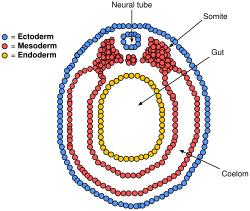
Enterocoelous development begins once the embryo reaches the gastrula phase. At this stage, the embryo consists of two primary cell layers: the ectoderm (the outermost layer) and the endoderm (the innermost layer).
The formation of the mesoderm occurs as the endoderm folds to create two "pockets" of tissue—one positioned above the endoderm and one below. As these pockets grow and extend toward one another, they eventually meet. This fusion creates a complete layer of tissue situated between the endoderm and ectoderm, which then leads to the development of the coelom.
As the archenteron (the primitive gut) forms, these pockets of migrating cells expand, establishing the middle layer and the resulting body cavity.
Comparison of Coelom Formation
To better understand how enterocoely fits into broader biological classifications, the following table compares it with the alternative method of coelom formation.
| Feature | Enterocoely | Schizocoely |
|---|---|---|
| Primary Group | Deuterostomes (Enterocoelomates) | Protostomes |
| Origin of Coelom | Pouches budding from the archenteron | Splitting of solid mesoderm masses |
| Mesoderm Source | Derived from endoderm | Derived from blast cells |
Frequently Asked Questions
What is the difference between enterocoely and schizocoely?
Enterocoely involves the coelom forming from pouches that bud off the embryonic gut (archenteron), whereas schizocoely involves the body cavity forming by the splitting of solid masses of mesoderm.
Which animals undergo enterocoelous development?
Enterocoely occurs in deuterostomes, a group of animals that includes vertebrates and other enterocoelomates.
What is the archenteron?
The archenteron is the embryonic gut or primitive digestive tract that forms during the gastrula stage of development.
How does the mesoderm form during enterocoely?
The mesoderm forms when the endoderm folds to create pockets of tissue that grow and eventually meet, creating a middle layer between the ectoderm and endoderm.
What does the word "enterocoely" literally mean?
Literally, it means "intestine cavity," coming from the Greek words énteron (intestine) and koilía (cavity).