Hippidion: The Prehensile-Lipped Horse of Ancient South America
Long before the modern horse roamed the plains of South America, a distinct and fascinating genus known as Hippidion dominated the landscape. Meaning "little horse" in Ancient Greek, Hippidion was an extinct equine that thrived from the Late Pliocene to the end of the Late Pleistocene, roughly between 2.5 million and 11,000 years ago.
Unlike the horses we recognize today, Hippidion possessed unique anatomical adaptations that allowed it to occupy a specific ecological niche. It arrived in South America as part of the Great American Interchange, a massive biological migration triggered by the formation of the Isthmus of Panama, which connected North and South America.
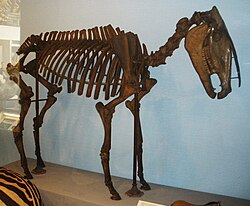
Key Facts
- Temporal Range: Late Pliocene to Holocene (~2.5 million to 11,000 years ago).
- Distinct Feature: A long nasal notch suggesting a prehensile (grasping) upper lip.
- Distribution: Widespread across South America, reaching as far south as Patagonia.
- Diet: Mixed feeders that browsed on woodland and wooded grassland vegetation.
- Extinction: Vanished during the end-Pleistocene megafauna extinction event.
Evolution and Taxonomy
The evolutionary history of Hippidion was once thought to be closely linked to the wild horse, Equus ferus. However, modern ancient DNA analysis has corrected this view. Researchers now identify Hippidion as an outgroup to all living equines, meaning it diverged from the ancestors of the genus Equus at least 6 million years ago.
The lineage began in North America during the Late Miocene before migrating south. While the hippidiform lineage eventually went extinct in North America during the Early Pleistocene, it flourished in the south. Taxonomically, the genus is traditionally divided into three species: H. principale, H. saldiasi, and H. devillei. Interestingly, a 2015 DNA study suggested that H. principale and H. saldiasi are genetically nested, while H. devillei remains clearly distinct.
Physical Description and Adaptations
Hippidion was built differently than modern horses. Its limb bones were short and robust, and its teeth morphology more closely resembled Pliohippus than the modern Equus. The most striking feature was the skull's long nasal notch, which separated the nasal bone from the rest of the cranium.
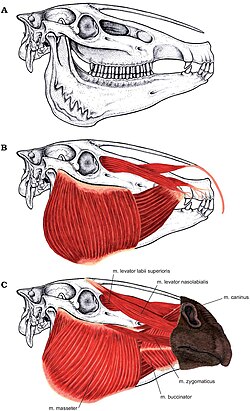
Paleontologists believe this nasal structure indicates the presence of a prehensile upper lip, a flexible lip capable of grasping vegetation, similar to that of a giraffe or a black rhino. This adaptation would have been highly advantageous for browsing in diverse environments.
Size and Weight Estimates
The size of Hippidion varied by species, with H. principale being the largest of the group.
| Species | Estimated Weight (kg) | Estimated Weight (lb) |
|---|---|---|
| H. principale | 252.7 – 468.6 | 557 – 1,033 |
| H. saldiasi | 252.7 – 326.4 | 557 – 720 |
| H. devillei | 227.3 – 366.5 | 501 – 808 |
Paleobiology and Distribution
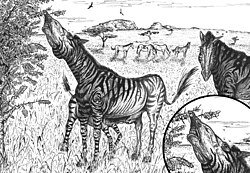
Isotopic evidence (specifically δC values) reveals that Hippidion lived in woodland and wooded grassland habitats. While the contemporary Equus neogeus was primarily a grazer (eating grass), H. principale was a mixed feeder, alternating between browsing on shrubs and grazing on grasses. Like modern horses, they likely lived in social herds.
Their distribution spanned the continent: H. principale was common in the Argentinian Pampas and possibly Peru and Ecuador; H. devillei inhabited the Pampas, the Peruvian central Andes, and possibly Venezuela; and H. saldiasi was native to the Southern Cone, including the southern Andes and Patagonia.
The Path to Extinction
Between 12,000 and 10,000 years ago, Hippidion vanished as part of the Late Pleistocene megafauna extinction. While climatic modeling shows a decline in their preferred habitats during the Holocene transition, this environmental shift alone does not fully explain their disappearance.
Evidence suggests a more direct cause: human predation. At sites such as Arroyo Seco 2 in Argentina, Piedra Museo in Patagonia, and Cueva del Medio in Chile, Hippidion remains have been found with cut marks and associated with Fishtail points (stone projectile points). This indicates that recently arrived humans hunted these animals, likely contributing significantly to their extinction.
Frequently Asked Questions
What made Hippidion different from modern horses?
The most significant difference was a long nasal notch in the skull, which suggests Hippidion had a prehensile upper lip for grasping plants, unlike the non-prehensile lips of the genus Equus. They also had shorter, more robust limb bones.
Where did Hippidion originate?
The lineage of Hippidion originated in North America during the Late Miocene before migrating to South America approximately 2.5 million years ago via the Isthmus of Panama.
What did Hippidion eat?
They were mixed feeders, meaning they consumed both grasses and shrubs. This allowed them to thrive in woodland and wooded grassland environments.
Why did Hippidion go extinct?
Their extinction was likely caused by a combination of habitat loss due to climatic changes and hunting by early humans, as evidenced by cut marks on fossils and the presence of stone tools at kill sites.
How many species of Hippidion were there?
Traditionally, three species are recognized: H. principale, H. saldiasi, and H. devillei, though DNA analysis suggests a closer genetic relationship between H. principale and H. saldiasi.