Pliocene Epoch: The Bridge to the Modern World
The Pliocene is a pivotal epoch in Earth's geologic history, spanning from approximately 5.33 to 2.58 million years ago (Ma). As the second and final epoch of the Neogene Period within the Cenozoic Era, it serves as a critical transition between the warmer Miocene and the ice-age cycles of the Pleistocene. This era witnessed profound changes in global geography, climate, and the evolution of early human ancestors.
Historically, the Pliocene included the Gelasian Stage (2.59 to 1.81 Ma). However, a 2009 revision of the geologic time scale moved this stage into the Pleistocene to ensure that the four most recent major glaciations were contained within a single epoch.
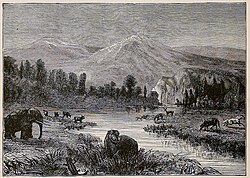
Key Facts
- Time Span: 5.33 ± 0.08 to 2.58 ± 0.04 million years ago.
- Placement: Follows the Miocene and precedes the Pleistocene.
- Subdivisions: Divided into the Zanclean (older) and Piacenzian (younger) stages.
- Major Event: The formation of the Isthmus of Panama, connecting North and South America.
- Climate Shift: Transitioned from high-frequency oscillations to the high-amplitude glacial-interglacial cycles.
Chronology and Stratigraphy
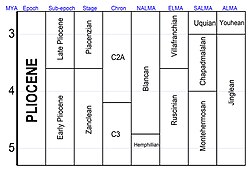
The Pliocene is formally defined by the International Commission on Stratigraphy (ICS). Its lower boundary is marked by the base of the Thvera magnetic event (C3n.4n), while the upper boundary is defined by the base of the magnetic polarity chronozone C2r (Matuyama) and the extinction of specific haptophytes, Discoaster pentaradiatus and Discoaster surculus.
Official Subdivisions
The epoch is split into two primary stages:
- Zanclean: 5.33 to 3.60 Ma
- Piacenzian: 3.60 to 2.58 Ma
Climate and Environmental Shifts
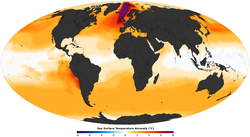
The Pliocene was characterized by a significant shift in the Earth's climate system. Initially, the climate was dominated by high-frequency, low-amplitude oscillations tied to the 41,000-year period of Earth's obliquity (the angle of Earth's axis). Over time, this shifted toward low-frequency, high-amplitude oscillations driven by the 100,000-year period of orbital eccentricity (the shape of Earth's orbit), which became the hallmark of the subsequent Pleistocene glacial cycles.
Paleogeography and the Great American Interchange
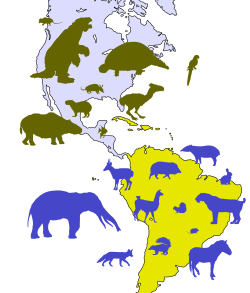
One of the most consequential events of the Pliocene was the closure of the Isthmus of Panama. This land bridge connected North and South America, fundamentally altering ocean currents and enabling the Great American Interchange. This biological event allowed species to migrate between the two continents, leading to new ecological dynamics and competition.
Biological Evolution
The Pliocene was a time of diversification and adaptation. In the oceans, a wide variety of marine life flourished, including gastropods like Oliva sayana and Turritella carinata, as well as various bivalves and corals such as Cladocora.
Terrestrial Fauna
On land, the era saw the rise of diverse mammals and birds. Notable creatures included the Titanis, a large flightless bird, and the expansion of North American prairies, which influenced the evolution of grazing animals.

Human Ancestry
The Pliocene is critical for paleoanthropology, as it encompasses the evolution of early hominins. Environmental changes in East Africa, including shifts in vegetation and climate, are hypothesized to have played a major role in the evolution of human ancestors during this time.
Pliocene Summary Table
| Feature | Details |
|---|---|
| Time Range | 5.33 Ma to 2.58 Ma |
| Period | Neogene |
| Era | Cenozoic |
| Stages | Zanclean, Piacenzian |
| Key Boundary | Monte San Nicola Section, Sicily (Upper GSSP) |
| Major Geographic Event | Formation of the Isthmus of Panama |
Frequently Asked Questions
What is the Pliocene epoch?
The Pliocene is a geologic epoch that lasted from 5.33 to 2.58 million years ago. It is the final epoch of the Neogene Period and serves as the transition between the Miocene and the Pleistocene.
How did the Pliocene climate differ from the Pleistocene?
The Pliocene began with climate oscillations driven by Earth's obliquity (41,000-year cycles). It eventually transitioned into the high-amplitude glacial-interglacial cycles driven by orbital eccentricity (100,000-year cycles) that defined the Pleistocene.
What was the Great American Interchange?
The Great American Interchange was the migration of animals between North and South America made possible by the formation of the Isthmus of Panama during the Pliocene.
Which stages make up the Pliocene?
According to the ICS, the Pliocene is divided into two stages: the older Zanclean (5.33–3.60 Ma) and the younger Piacenzian (3.60–2.58 Ma).
Why was the Gelasian Stage moved to the Pleistocene?
The Gelasian Stage (2.59 to 1.81 Ma) was moved to the Pleistocene in 2009 so that the four most recent major glaciations would be contained within a single epoch.