Herbarium Collections: Preserving the Botanical History of Our Planet
A herbarium is a specialized collection of preserved plant specimens and their associated scientific data. These collections serve as vital repositories for researchers, providing a physical record of plant life that can be studied across centuries. While most commonly associated with plants, the term is also used in other scientific contexts: a collection of fungi is known as a fungarium, a collection of wood specimens is a xylarium, and collections of horticultural material are sometimes called a hortorium.
By preserving whole plants or specific parts, herbaria allow scientists to study plant taxa (groups of organisms) and maintain a permanent reference for identifying species. Some of the most valuable specimens are known as types—the original specimens upon which the description of a new species was based.
![Herbarium book which dates from 1633. Made by the Flemish Bernardus Wynhouts.[1]](/images/88/79/8879faa7c4bb95f15d6ad1df2ce8c075631fdf874c46fc77bdf839848404b3f9.jpg)
Herbarium book which dates from 1633. Made by the Flemish Bernardus Wynhouts.
Key Facts
- Herbaria store dried plant specimens, often called exsiccata, mounted on paper sheets.
- The practice of creating "dry gardens" (hortus siccus) dates back to the 16th century.
- Specimens are used for plant taxonomy, DNA analysis, and tracking climate change.
- Large institutions use unique alphabetic codes to identify their collections in the Index Herbariorum.
- Modern herbaria serve as critical records for extinct or endangered species.
The Evolution of Botanical Preservation
The techniques used to create herbaria have remained remarkably consistent for over six centuries. This stability has helped transform botany from a subset of medicine into an independent scientific discipline, allowing researchers to access plant material from distant locations and different eras.
Historical Origins
The tradition of herbarium collections is rooted in Italy. The physician and botanist Luca Ghini (1490–1556) revolutionized the field by advocating for the study of actual plants rather than relying solely on ancient, often inaccurate classical texts. To make plant material available even during winter, he developed the Hortus siccus (dry garden). His method involved placing fresh plants between sheets of paper and applying pressure to flatten them and absorb moisture.
While early collections were often bound into books, the famous botanist Carl Linnaeus introduced the practice of maintaining specimens on free sheets. This innovation allowed for easy re-ordering within cabinets, a standard practice in modern collections.
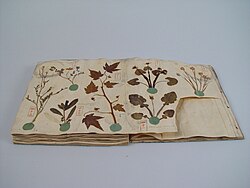
Herbarium book with Japanese plants, Siebold collection Leiden, 1825
How Specimens are Prepared and Stored
To ensure scientific accuracy, it is essential to include as much of the plant as possible, including roots, flowers, stems, leaves, seeds, and fruit. The preservation process follows a meticulous sequence:
- Arrangement: Plants are carefully spread flat between thin sheets called flimsies (similar to newsprint).
- Pressing: The flimsies are placed in a plant press between absorbent blotters to remove moisture while maintaining the plant's form.
- Mounting: Once dried, specimens are mounted onto stiff white paper.
- Labeling: Essential data is added, including the date, location, altitude, habitat conditions, and the collector's name.
- Protection: To prevent insect damage, specimens may be frozen or treated, and then placed in protective cases.
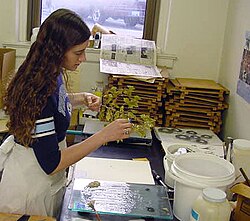
Preparing a plant for mounting
Not all botanical material can be pressed flat. Bulky items like conifer cones or palm fronds are often stored in labeled boxes, while three-dimensional structures like flowers may be preserved in formaldehyde. Smaller specimens, such as mosses or lichens, are typically air-dried and kept in small paper envelopes.
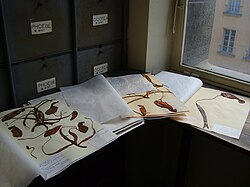
Herbarium specimens ("exsiccata") of various Nepenthes at the Museum National d'Histoire Naturelle in Paris, France
Scientific Importance and Modern Uses
Herbaria are far more than mere museums; they are active tools for modern science. Their uses include:
- Taxonomy and Identification: Helping scientists classify new species and create accurate field guides.
- Historical Records: Documenting changes in vegetation and tracking the impact of human activity and climate change.
- Genetic Research: Providing a source of plant DNA for molecular studies and monitoring genetic diversity.
- Voucher Specimens: Serving as physical proof of the exact plant used in a specific scientific study.
- Conservation: Acting as repositories for viable seeds of rare or endangered species.
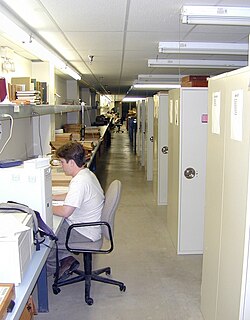
A large herbarium may have hundreds of cases filled with specimens.
Global Institutional Herbaria
Major universities, museums, and botanical gardens maintain these collections. Each institution is assigned a specific code in the Index Herbariorum. Some of the world's largest and most significant herbaria include:
| Institution Name | Location | Code |
|---|---|---|
| Muséum National d'Histoire Naturelle | Paris, France | P |
| New York Botanical Garden | New York, USA | NY |
| Kew Herbarium | Kew, UK | K |
| Naturalis Biodiversity Center | Leiden, Netherlands | AMD, L, U, WAG |
| Swedish Museum of Natural History | Stockholm, Sweden | S |

The Swedish Museum of Natural History (S), Stockholm, Sweden
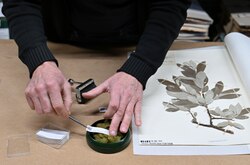
Labeling of herbarium specimens at the Museum of Natural History of Vienna
Frequently Asked Questions
What is the difference between a herbarium and an exsiccatum?
A herbarium is the entire collection of preserved specimens, whereas an exsiccatum (plural: exsiccata) refers to the individual dried specimens themselves, often distributed in published series.
How are specimens organized in a herbarium?
Specimens are typically organized by taxonomic hierarchy. Sheets are grouped by species, placed in folders by genus, and then sorted by family within large cabinets.
Why is the location of a specimen so important?
Detailed collection data—such as the date, altitude, and habitat—is crucial for scientists to understand geographic distributions and how plant populations change over time due to environmental shifts.
Can scientists get DNA from old herbarium specimens?
Yes, modern scientists use specimens housed in herbaria as a source of plant DNA for molecular systematic studies and to monitor genetic diversity in response to climate change.
What is a "type specimen"?
A type specimen is the original specimen used by a scientist to formally describe and name a new species. These are among the most scientifically valuable items in any herbarium.