Grouse: Biology, Behavior, and Evolution of the Tetraonini
Grouse are compact, heavily-built birds belonging to the order Galliformes and the family Phasianidae. Currently classified within the tribe Tetraonini—a designation supported by mitochondrial DNA sequence studies—these birds are found across the temperate and subarctic regions of the Northern Hemisphere. Their range is vast, extending from the arctic tundra of northern Greenland (83°N) down to Texas (28°N), and as far south as Belize (16°30'N) when including turkeys.
While traditionally viewed as a distinct group, modern phylogenomic analyses have shown that turkeys and the koklass pheasant are sister taxa to the traditionally defined grouse. Consequently, many recent scientific treatments include them as basal members of the Tetraonini tribe.
Key Facts
- Classification: Tribe Tetraonini, Family Phasianidae, Order Galliformes.
- Distribution: Northern Hemisphere, from arctic tundra to pine forests and moorlands.
- Diet: Primarily herbivorous, consisting of buds, catkins, leaves, and twigs.
- Social Structure: Varies from solitary forest species to highly social tundra species forming flocks of over 300.
- Reproduction: Mostly polygamous, often utilizing leks (communal display grounds) for courtship.
Physical Characteristics
True grouse (excluding turkeys) typically range from 31 to 115 cm in length and weigh between 0.3 and 6.5 kg. When including the wild turkey, the size increases significantly, with males reaching up to 130 cm and weighing as much as 10 kg. A notable feature of the group is sexual dimorphism, where males are significantly larger than females; in the western capercaillie, males can be twice as heavy as females.
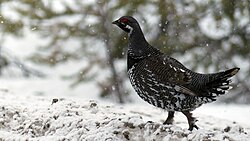
Males often possess elaborate ornamentation, including crests, fan-tails, and brightly colored, inflatable patches of bare skin. Many species have feathered nostrils, and ptarmigans have legs and toes covered in feathers—a critical adaptation for walking on and burrowing into snow for shelter. Unlike most other galliforms, grouse generally lack spurs, though turkeys and the koklass pheasant are exceptions.
Diet and Habitat
The diet of an adult grouse is over 95% vegetation, though this varies by season. While hatchlings rely heavily on insects and invertebrates, adults transition to buds, twigs, and leaves. Some forest-dwelling species are unique in their ability to consume large quantities of conifer needles, which are avoided by most other vertebrates.
To process this fibrous diet, grouse possess specialized digestive anatomy, including large crops, gizzards for grinding grit, and long intestines with well-developed caeca (blind-ended pouches) where symbiotic bacteria break down cellulose.
Social Behavior and Dispersal
Sociality varies by environment. Forest species are generally solitary, flocking only in winter. In contrast, prairie species are more social, and tundra species, such as ptarmigans, are the most gregarious, sometimes forming winter flocks of 1,000 individuals in the case of the willow grouse.
While most grouse remain within their breeding range, some undertake significant migrations. The rock ptarmigan, for example, has been known to cross the 300 km wide Denmark Strait from Greenland to Iceland.
Reproduction and Courtship
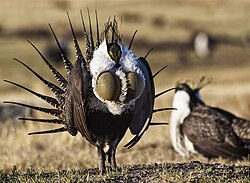
Most grouse species are polygamous. Males engage in elaborate courtship displays at dawn and dusk, often within leks. These displays involve the use of brightly colored combs, inflatable neck sacs, drumming, wing fluttering, and specific vocalizations.
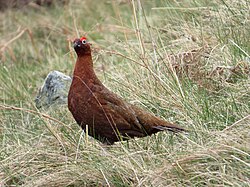
Exceptions to this pattern include the red grouse and willow ptarmigan, which are monogamous. Rock ptarmigans exhibit a mix of both systems, with polygamy becoming more common at higher latitudes.
Nests are simple scrapes on the ground with minimal lining. Females typically lay a clutch of five to 12 pale yellow, brown-spotted eggs. After an incubation period of 21 to 28 days, chicks hatch with dense down and are capable of flight within two to three weeks. They reach mature weight by their first autumn.
Evolution of Size and Mating Systems
The pronounced size difference between genders in grouse is driven by sexual selection. Because females can reproduce successfully regardless of size, but larger males have a significant advantage in competing for mates, evolution has favored larger males.
The degree of dimorphism correlates with the mating system:
- Territorial species: Males defend resources; these males are generally the smallest.
- Exploded lekking: Males display across expansive areas; these show moderate dimorphism.
- Typical lekking: Males defend small, concentrated territories; these species exhibit the greatest size dimorphism.
Conservation and Cultural Impact
Grouse are a vital part of the biomass in arctic and subarctic regions, serving as a primary food source for lynx, foxes, and martens. While tundra species remain stable, prairie and forest species have declined due to habitat loss. The Gunnison grouse is currently listed as endangered, while the greater and lesser prairie-chicken are vulnerable.
Culturally, grouse are prized as game birds. In the UK, driven grouse shooting is a common practice. Additionally, the tail feathers of the black grouse have traditionally been used as hat ornaments in the Alps and Scotland, and their lekking displays have inspired various folk dances.
| Genus | Common Representative Species | Notable Trait |
|---|---|---|
| Meleagris | Wild Turkey | Largest tetraonid; possesses spurs |
| Lagopus | Rock Ptarmigan, Red Grouse | Feathered legs for snow adaptation |
| Tetrao | Western Capercaillie | Significant sexual size dimorphism |
| Centrocercus | Sage Grouse | Inflatable neck sacs for display |
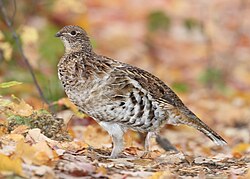
| Bonasa | Ruffed Grouse | Forest-dwelling game bird |
Frequently Asked Questions
Are turkeys considered a type of grouse?
Yes, modern phylogenomic analyses indicate that turkeys are sister to traditionally defined grouse and are now often classified as basal members of the tribe Tetraonini.
How do ptarmigans survive in the Arctic?
Ptarmigans have evolved legs and toes entirely covered in feathers, which allows them to walk on snow and burrow into it for shelter and warmth.
What is a lek?
A lek is a communal area where males gather to perform competitive courtship displays to attract females, who then choose a mate based on these traits.
Why are male grouse so much larger than females?
This is due to sexual selection. Larger males are more successful in competing for mates, particularly in species that utilize typical lekking behavior.
What do grouse eat?
Adults are primarily herbivores, eating buds, catkins, leaves, and twigs. Some species also eat conifer needles. Hatchlings, however, eat mostly insects and invertebrates.