Fowl: The Evolutionary Biology of Galliformes and Anseriformes
In the diverse world of avian biology, fowl refers to a specific clade of birds known scientifically as Galloanserae. This group is divided into two primary biological orders: the Galliformes (gamefowl or landfowl) and the Anseriformes (waterfowl). While these birds may seem vastly different—ranging from the domestic chicken to the mallard duck—anatomical, molecular, and DNA sequence data confirm they are close evolutionary relatives.
Key Facts
- Clade: Galloanserae, comprising Galliformes (landfowl) and Anseriformes (waterfowl).
- Origin: Estimated to have emerged approximately 85 million years ago during the Late Cretaceous.
- Reproduction: Highly prolific, often laying clutches of more than 5 to 10 eggs.
- Development: Young are precocial, meaning they are relatively mature and mobile immediately after hatching.
- Hybridization: Frequent interbreeding occurs even between distantly related genera within the clade.
Terminology: Fowl vs. Poultry
While often used interchangeably in casual conversation, there is a distinct difference between "fowl" and "poultry." Fowl is a biological term referring to the monophyletic group of Galloanserae. In contrast, poultry refers to any bird domesticated or captive-raised for meat, eggs, or feathers. For example, while an ostrich may be raised as poultry, it is biologically neither a gamefowl nor a waterfowl.
This linguistic distinction stems from Middle English. "Fowl" has Germanic origins (related to the German Vogel), while "poultry" derives from the Latin pullus (chicken) via Norman French.
Biological Characteristics
Despite their ecological diversity, members of the Galloanserae share several defining traits. One of the most notable is their reproductive strategy. Unlike birds of prey or pigeons, which typically lay only two eggs, fowl are prolific breeders, frequently producing large clutches.
Mating habits also vary significantly. While many birds are monogamous for a breeding season, many Galloanserae are polygynous (one male mating with multiple females) or polyandrous (one female mating with multiple males). This is evident in domestic chickens and certain dabbling ducks.
Furthermore, fowl are known for their high rate of hybridization. Genera that rarely interbreed in other bird groups often do so with ease in Galloanserae. For instance, guineafowl have successfully hybridized with domestic fowl and Indian peafowl.
The young of these birds are remarkably precocious. Anseriform hatchlings can swim and dive within hours of birth, while the young of mound-builders (megapodes) are fully feathered and capable of flight almost immediately upon emerging from the nest.
Anatomy and Adaptation
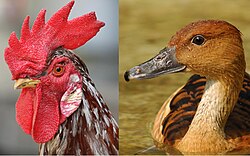
The physical differences between landfowl and waterfowl reflect their adaptation to different environments. The most immediate difference is found in the beak; waterfowl possess a flatter bill featuring a protrusion on the top surface known as the bean.
Hindlimb and Foot Structure
The skeletal structure of the legs differs based on lifestyle. Ducks have a lower center of gravity with legs set further back on the body to facilitate aquatic movement. Their tibiotarsal bones possess greater bending strength than those of chickens, though their overall leg bones are weaker, making them unsuitable for handling by the legs.
Feet are highly specialized for locomotion and survival. Waterfowl have webbed feet for swimming and a countercurrent heat exchange system. This system groups warm arterial blood near cool veins returning to the body, minimizing heat loss when standing on ice or cold ground.
Chickens are digitigrade, meaning they walk on their toes. Most possess four digits—three pointing forward and one backward—covered in reticulate scales made of overlapping keratin sheets.
Systematics and Evolution
Evidence suggests that Galloanserae were widespread by the end of the Cretaceous period. Molecular clocks and fossils, such as Vegavis, indicate that modern waterfowl lineages existed alongside non-avian dinosaurs. Following the mass extinction of the Enantiornithes and other dinosaurs, the Galloanserae became one of the first successful groups of modern birds.
While Galliformes have remained morphologically conservative, Anseriformes evolved specialized autapomorphies (unique derived traits) for filter-feeding. Because of these advanced feeding systems, some early scientists mistakenly grouped Anseriformes with shorebirds (Charadriiformes), but modern DNA evidence firmly places them within the fowl clade.
| Feature | Galliformes (Landfowl) | Anseriformes (Waterfowl) |
|---|---|---|
| Primary Habitat | Terrestrial / Ground-dwelling | Aquatic / Semi-aquatic |
| Beak Shape | Pointed / Conical | Flat with a 'bean' protrusion |
| Foot Type | Digitigrade / Scaled | Webbed / Thermoregulated |
| Feeding Style | Generalist / Foraging | Filter-feeding / Aquatic prey |
Human Relationship and Cultural Significance
Fowl have played a central role in human civilization. Economically, they are the most farmed birds globally, with chickens being the most consumed for meat and eggs, followed by ducks, geese, turkeys, and quail. They are also prized as game birds; pheasants, for example, were introduced from Asia to Europe and North America for sport and food.
Beyond utility, fowl hold spiritual significance. In Hinduism and various Pagan cultures, birds like the peacock symbolize truth, beauty, honor, and strength, often regarded as good omens in dreams.
Frequently Asked Questions
What is the difference between fowl and poultry?
Fowl is a biological classification (Galloanserae) including both landfowl and waterfowl. Poultry is a commercial term for any bird raised for food or feathers, regardless of its biological order.
Why are fowl considered precocial?
They are precocial because their young are born in an advanced state, capable of moving, feeding themselves, and in some cases, flying shortly after hatching.
How do waterfowl survive in freezing water?
They use a countercurrent heat exchange system in their webbed feet, where warm blood from the body warms the cool blood returning from the extremities, reducing energy loss.
When did the fowl clade first appear?
Based on a combination of fossil evidence and molecular clocks, the Galloanserae are estimated to have originated approximately 85 million years ago.
Can different species of fowl interbreed?
Yes, hybridization is extremely frequent within the Galloanserae clade, even between genera that are not closely related, such as guineafowl and domestic chickens.