Gross Domestic Product (GDP): Measuring Economic Activity and Its Limitations
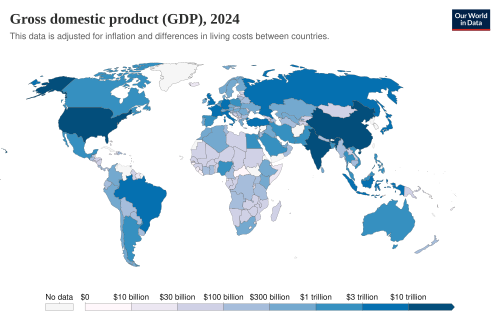
Gross domestic product (GDP) is a monetary measure of the total market value of all final goods and services produced and rendered within a country or region during a specific period, typically one year. It serves as a primary statistical indicator of national development, economic activity, and broad economic progress.
While GDP is a powerful tool for international comparisons, it is important to note that it does not measure the overall standard of living or human well-being. Because it does not account for how income is distributed among a population, a country can exhibit high GDP growth while still experiencing "jobless growth" depending on its economic strategies.
Key Facts
- Core Components: GDP is driven by consumption, investment, government spending, and net exports (exports minus imports).
- Standardization: The international standard for measurement is the System of National Accounts 2008 (SNA2008), developed by the IMF, EU, OECD, UN, and World Bank.
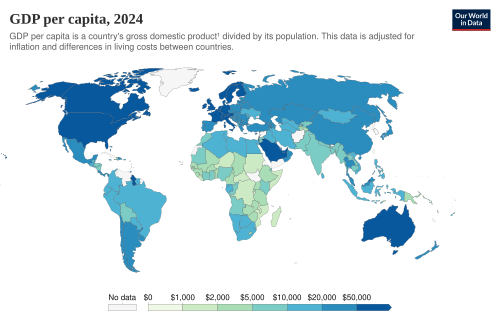
- GDP per Capita: Calculated by dividing total GDP by the population to provide a rough measure of average economic output per person.
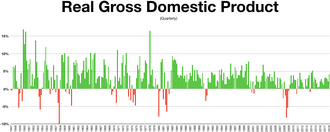
- Real vs. Nominal: Nominal GDP uses current market prices, while Real GDP is adjusted for inflation to allow for accurate comparisons over time.
- PPP Adjustment: Purchasing Power Parity (PPP) adjusts GDP figures for differences in the cost of living between countries.
How GDP is Calculated
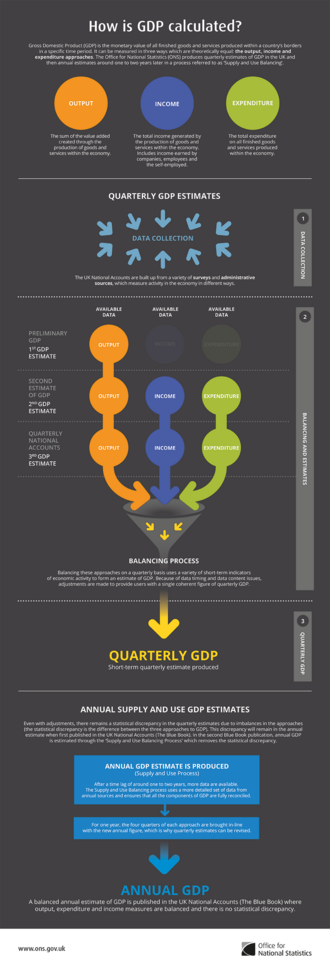
Economists use three primary methodologies to determine the GDP of a nation. Depending on the data available, these approaches should theoretically yield the same total value.
The Production Approach
This method estimates the gross value of domestic output across various economic activities. It is calculated by multiplying the output of each sector by its respective market price and summing them, or by aggregating gross sales and inventories from corporate records.
The Income Approach
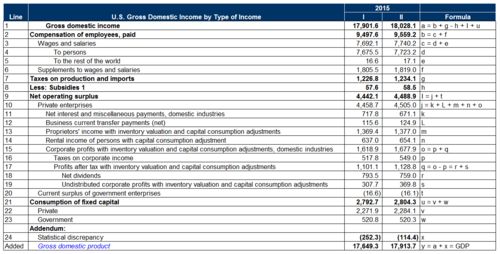
The income approach sums all incomes earned by factors of production. In the United States, the National Income and Product Accounts categorize these into five areas: wages and salaries, corporate profits, interest and investment income, income from sole proprietors (including housing), and net income from business transfer payments.
The Expenditure Approach
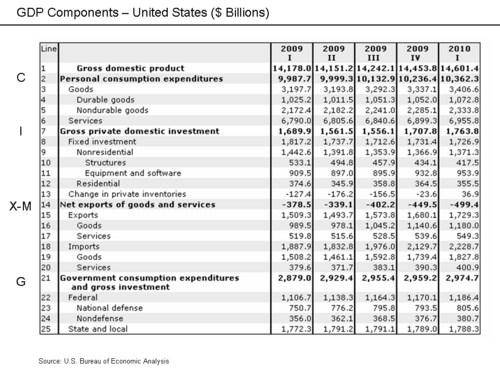
The expenditure approach calculates GDP by summing all spending in the economy. This is represented by the formula: Y = C + I + G + (X − M), where Y is GDP, C is consumption, I is investment, G is government spending, and (X - M) represents net exports.
Comparing Economies: Nominal, Real, and PPP
To make GDP data useful for analysis, economists apply different adjustments based on the goal of the comparison.
- Nominal GDP: Uses current exchange rates and prices; best for comparing national economies on the current international market.
- Real GDP: Adjusts for inflation, making it the essential metric for tracking economic growth over time.
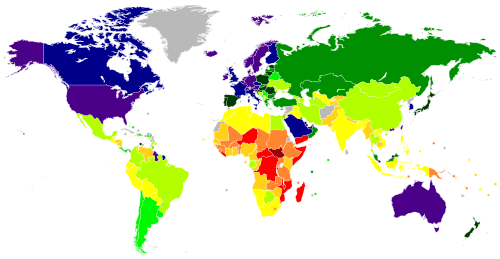
- GDP (PPP): Adjusts for the cost of living. GDP per capita at purchasing power parity is often the most useful metric for comparing actual living standards between different nations.
![Real GDP per capita growth in % (2025)[28] Below -3 -3 to -2 -2 to -1 -1 to 0 0 to 1 1 to 2 2 to 3 3 to 4 4 to 5 above 5 No data](/images/d1/db/d1dbc474a68e9009f072816e68a4f34b1c10412d64f5161f47dfeb172f872ede.webp)
Limitations and Criticisms of GDP
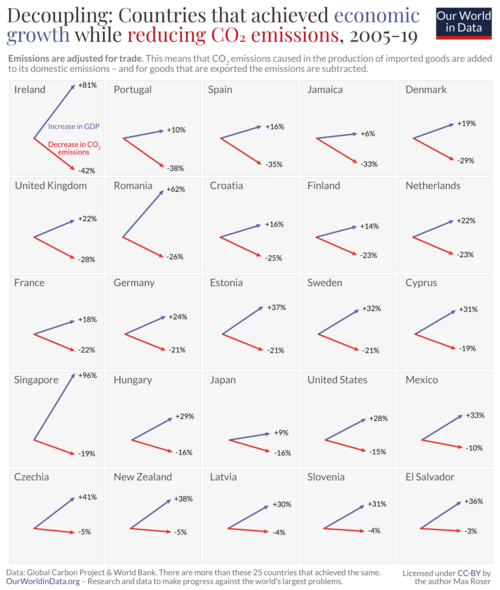
Despite its ubiquity, GDP has significant blind spots. It focuses on market transactions and ignores several factors that influence the quality of life and the sustainability of the planet.
Externalities and Unpaid Work
GDP fails to account for externalities—side effects of production that aren't reflected in market prices. This includes environmental degradation, resource extraction, and the impact of climate change. Furthermore, it ignores unpaid domestic work and caregiving, which provide immense value to society but no monetary transaction.
Well-being and Distribution
As noted by economist Simon Kuznets in 1962, GDP is not a comprehensive measure of quality. It does not reflect income inequality or the distribution of wealth. Consequently, alternative indicators have emerged to better measure human development, such as the Human Development Index (HDI), the Better Life Index, and the framework of doughnut economics.
Summary of GDP Metrics
| Metric | Adjustment | Primary Use Case |
|---|---|---|
| Nominal GDP | None (Current Prices) | International market comparisons |
| Real GDP | Inflation-adjusted | Tracking growth over time |
| GDP (PPP) | Cost of living adjusted | Comparing living standards across borders |
| GDP per Capita | Divided by population | Average economic output per person |
Frequently Asked Questions
What is the difference between Nominal and Real GDP?
Nominal GDP is measured using current market prices, meaning it can increase simply because prices rose (inflation). Real GDP is adjusted for inflation, providing a more accurate picture of whether the actual volume of goods and services produced has increased.
Why is PPP used in GDP calculations?
Purchasing Power Parity (PPP) is used to account for the fact that the same amount of money can buy more goods in some countries than in others. By adjusting for the cost of living, PPP allows for a fairer comparison of living standards between nations.
Does a high GDP mean a high standard of living?
Not necessarily. GDP measures total economic output, not how that wealth is distributed. A country can have a high GDP but suffer from extreme income inequality, poor health outcomes, or significant environmental damage.
What are the main components of the expenditure approach?
The expenditure approach sums four main components: private consumption (C), business investment (I), government spending (G), and net exports (X minus M).
What is the SNA2008?
The System of National Accounts 2008 (SNA2008) is the international standard for measuring GDP, created by a coalition of global organizations including the IMF, World Bank, and United Nations to ensure consistency in economic reporting.