Göttingen State and University Library
The Göttingen State and University Library (known in German as the Niedersächsische Staats- und Universitätsbibliothek Göttingen or SUB Göttingen) serves as a critical intellectual pillar for the University of Göttingen and the Göttingen Academy of Sciences. Beyond its academic role, it functions as the official state library for the German state of Lower Saxony.
Recognized as one of Germany's largest academic libraries, the SUB Göttingen is more than a repository of books; it is a leader in international librarianship and the development of modern research infrastructure. Its commitment to excellence was formally recognized in 2002 when it was named the German Library of the Year (Bibliothek des Jahres). The institution is currently led by directors Thomas Kaufmann, Bela Gipp (Scientific Director), and Kathrin Brannemann (Administrative Director).
Key Facts
- Total Collection: Approximately 8 million media units.
- Rare Treasure: Houses one of only four known perfect vellum copies of the Gutenberg Bible.
- Founded: 1734, predating the university by three years.
- Scope: Serves as both an academic library and a regional state library for Lower Saxony.
- Digital Leadership: Operates the Göttingen Center for Retrospective Digitization (GDZ) and the Göttingen University Press.
Library Structure and Facilities
The SUB Göttingen utilizes a dispersed system to manage its vast resources, ensuring that specialized materials are accessible where they are most needed. The system consists of a Central Library, completed in 1992 on the main campus, and six branch libraries located within various academic departments.
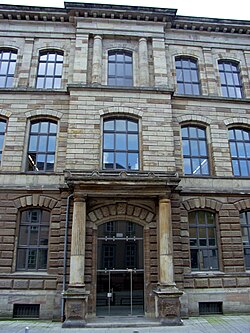
The Historical Library Building, located in the city center, is dedicated to special collections. This facility houses rare books, maps, and manuscripts, as well as a significant collection focused on the history of science. A notable example of adaptive reuse is the original core of the building, the SS. Peter and Paul's Church, which has been transformed into a center for lectures and exhibitions.
Collection Overview
As of December 2016, the library's holdings are diverse and expansive, spanning traditional print and modern digital formats. The collection includes a vast array of incunabula (books printed before 1501) and Nachlässe (literary remains or personal archives of authors).
| Media Type | Quantity |
|---|---|
| Total Media Units | 8 million |
| Volumes | 5.9 million |
| Microforms | 1.6 million |
| Maps | 327,000 |
| Licensed Electronic Journals | 50,000 |
| Digital Media | 126,000 |
| Manuscripts | 14,000+ |
| Incunabula | 3,100 |
| Literary Remains (Nachlässe) | 400 |
Research, Digitization, and Innovation
The SUB Göttingen is at the forefront of the digital transition in academia. Since 1997, it has maintained the Göttingen Center for Retrospective Digitization (GDZ), and since 2003, it has operated the Göttingen University Press, which adheres to the Open Access principle—making research freely available to the public.
The Department for Research and Development, established in 2004, focuses on creating virtual research environments and scientific data infrastructures. Furthermore, the library coordinates the DARIAH-DE project and supports global open access initiatives such as OpenAIRE 2020 and COAR.
Specialized Information Services
Through the Specialised Information Services Programme funded by the German Research Foundation (DFG), the library provides expert resources in several key fields:
- Mathematics: Operated since 2015 in partnership with TIB Hannover.
- Anglo-American Culture: Operated since 2016 with the J. F. Kennedy Institute of the Free University of Berlin.
- Geosciences of the Solid Earth: Operated since 2016 with GFZ Potsdam. This includes the GEO-LEO online collection in cooperation with the TU Bergakademie Freiberg.
- Finno-Ugric / Uralic Languages, Literature and Culture: Operated since 2017.
Historical Evolution
Founded in 1734, the library's early success was driven by its first director, Johann Matthias Gesner, and later by Christian Gottlob Heyne (1763–1812), who established the library as a premier research institution and pioneer in cataloging systems. The library's prestige was such that it attracted the attention of literary giants like Johann Wolfgang von Goethe and Heinrich Heine.
After a period of financial decline, the library experienced a resurgence in 1866 under Prussian sponsorship. This growth eventually led to the construction of the modern Central Library in 1992, allowing the original buildings to be repurposed for the preservation of rare and historical materials.
Frequently Asked Questions
What is the most famous item in the SUB Göttingen collection?
The library possesses a Gutenberg Bible, which is one of only four perfect vellum copies known to exist in the world.
How is the library organized geographically?
The library uses a dispersed system consisting of a Central Library on the main campus, a Historical Building in the city center for special collections, and six branch libraries located within various academic departments.
What is the role of the Göttingen University Press?
Founded in 2003, the press is committed to the Open Access principle, ensuring that scholarly publications are accessible to a wide audience without paywalls.
Which specialized research fields does the library support?
The library provides specialized information services for Mathematics, Anglo-American Culture, Geosciences of the Solid Earth, and Finno-Ugric/Uralic Languages, Literature, and Culture.
When was the library founded?
The library was founded in 1734, which was three years before the establishment of the university itself.