Master of the Playing Cards: The Pioneer of European Engraving
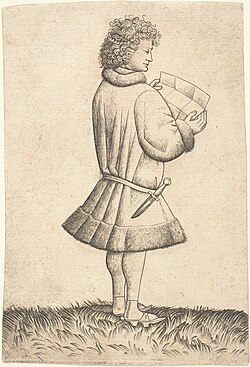
In the history of European art, few figures are as influential yet mysterious as the Master of the Playing Cards (German: Meister der Spielkarten). Active between the 1430s and 1450s, this German or Swiss engraver is widely regarded as the first major personality in the history of engraving. While his true identity remains a subject of academic debate, his technical mastery transformed printmaking from a crude craft into a sophisticated art form.
Operating likely in Alsace, southwestern Germany, the Master was not merely a technician but a trained artist. Unlike many of his contemporaries who emerged from the traditions of goldsmithing or armor-making, the Master's work reflects a background in painting and drawing. This distinction is evident in his ability to conceive forms in three dimensions and his delicate approach to modeling figures.
Key Facts
- Active Period: Approximately 1430s to 1450s.
- Region: Southwestern Germany, likely Alsace.
- Known Works: 106 engravings, including a famous set of five-suit playing cards.
- Technical Innovation: Used parallel vertical lines for shading; avoided cross-hatching.
- Legacy: Considered the first significant artist to master European printmaking.
Artistic Style and Technique
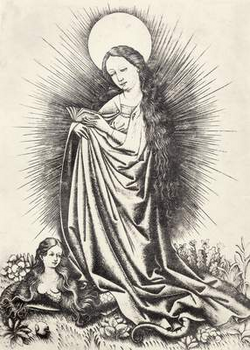
The Master's style is closely aligned with the paintings of southwestern Germany and Switzerland from 1430–1450, most notably the work of Konrad Witz. A recurring botanical detail in his engravings is the Alpine cyclamen, a flowering plant native to that specific region, which further supports the geographical placement of his workshop.
Technically, the Master departed from the conventions of early engravers like Master E. S. or Israhel van Meckenem. Rather than the rigid lines typical of goldsmiths, his work mimics the fluidity of drawing. He primarily employed parallel vertical lines for shading, making cross-hatching a rarity in his oeuvre.
Chronology and Influence
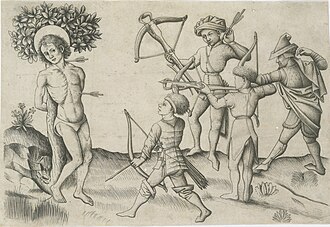
Dating the Master's career is challenging because his works are rarely signed. However, a dated print from 1446 by a presumed pupil, known as the "Master of 1446," suggests that the Master had already been active for many years by that time to have produced a mature student.
His influence extended beyond prints. Compositional elements from his engravings appear in the miniatures of the Giant Bible of Mainz (1452–3) and an illuminated copy of the Gutenberg Bible held at Princeton University. While it is debated whether he personally painted these miniatures, it is likely they shared a common manuscript model-book.
The Famous Playing Cards
The Master takes his name from a set of playing cards featuring five suits: flowers, birds, deer, beasts of prey, and wild men. These cards differ significantly from modern decks; each symbol, or pip, is unique, requiring an immense amount of engraving effort for a single set.
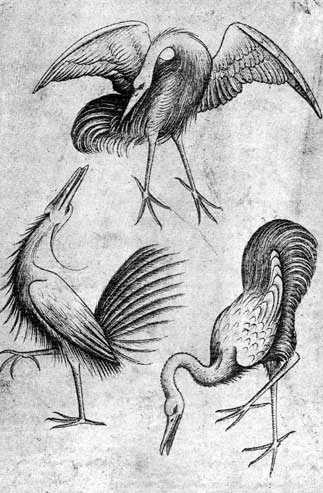
Because these were engraved on copper rather than carved from wood (woodcut), they were far more expensive and produced in smaller quantities. Some cards utilized a "multiple-plate" technique, where individual pips were engraved on separate small copper plates and held together in a frame for printing. This modular approach suggests a possible influence from Johannes Gutenberg's invention of movable type in Mainz.
![The 9 of Beasts from the playing cards. The central climbing bear also appears in an illuminated copy of the Gutenberg Bible. This is a "multiple-plate card", where each animal is on a separate small copper plate, several of which are reused on other cards.[1]](/images/2f/a2/2fa240627448e8687e28337f7b98aaf8c07034b94980ce7cc9848d762ad6ea8c.png)
| Feature | Description |
|---|---|
| Number of Suits | 5 (Flowers, Birds, Deer, Beasts of Prey, Wild Men) |
| Material | Engraved Copper Plates |
| Pip Design | Unique illustrations for every pip; no numbers |
| Printing Method | Single-plate and multiple-plate techniques |
| Primary Locations | Kupferstich-Kabinett (Dresden) and Bibliothèque nationale de France (Paris) |
Place in Printmaking History
While the Master of the Playing Cards did not invent engraving, he was the first to elevate it to a high artistic standard. Before his emergence, woodcuts were the dominant medium, but they were often crudely executed and limited to religious imagery or simple cards.
His work paved the way for future engravers who blended the skills of the artist and the craftsman. Beyond cards, he produced religious prints intended as illustrations for manuscript devotional books. Many of his designs have been lost over time or survive only through copies made by his pupils, such as the "Master of the Nuremberg Passion" and the "Master of the Banderoles." Today, his work is highly prized; for example, the print Queen of Flowers sold at Christie's in 2006 for approximately $450,000.
Frequently Asked Questions
Who was the Master of the Playing Cards?
He was an anonymous German or Swiss engraver and painter active between the 1430s and 1450s, recognized as the first major master of European printmaking.
What makes his playing cards unique?
Unlike modern cards, his set featured five suits with unique, hand-engraved illustrations for every single pip, rather than repeating symbols or using numbers.
How did his technique differ from other early engravers?
Most early engravers were trained as goldsmiths or armorers, but the Master was trained as an artist. This resulted in a style more closely related to drawing, with three-dimensional modeling and a preference for parallel vertical shading over cross-hatching.
Is there a connection between the Master and Johannes Gutenberg?
Some historians suggest a connection because the Master used a multiple-plate system for some cards, which mirrors the modular logic of Gutenberg's movable type, and both were linked to the city of Mainz.
Where can his works be found today?
The majority of his surviving impressions are held in the Kupferstich-Kabinett in Dresden and the Bibliothèque nationale de France in Paris, with some pieces in the Metropolitan Museum of Art.