German Reichstag: The Parliamentary Evolution of the German Empire (1871–1918)
The Reichstag (German for "Diet of the Realm") served as the national parliament of the German Empire from its establishment on January 18, 1871, until its dissolution on October 26, 1918. As a central pillar of the imperial government, the Reichstag represented the democratic element of the state, balancing the federalism of the Bundesrat (the federal council representing the states) and the monarchic authority of the Emperor and his appointed Reich chancellor.
While the Emperor initially held significant sway, the Reichstag's influence grew over time. It shared legislative power with the Bundesrat and held critical authority over the national budget, providing a public forum for debate and a mechanism for overseeing the executive branch.
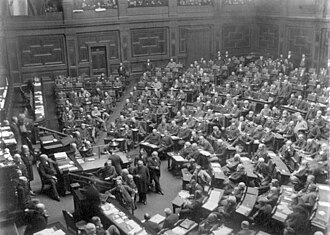
Key Facts
- Active Period: 1871 to 1918.
- Voting Rights: Universal male suffrage for citizens aged 25 and older.
- Total Seats: 397 at the time of dissolution.
- Legislative Role: Shared power with the Bundesrat; held primary authority over the budget.
- Successor: The Weimar National Assembly.
Electoral System and Franchise
The Reichstag was characterized by one of the most progressive electoral laws of its era. It utilized a two-round system with universal male suffrage, meaning all male citizens aged 25 and older could vote secretly and equally in direct elections.
However, certain restrictions applied. Men in active military service were denied the vote to prevent the politicization of the army. Additionally, those dependent on public poor relief, individuals facing bankruptcy or insolvency, and those declared legally incapacitated were ineligible. Despite these limits, the franchise was broad; by 1912, 22.2% of the population (14.442 million men) were eligible to vote, surpassing the percentages in Great Britain (16%) but trailing the United States (28%).
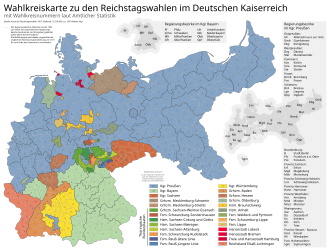
Runoff Elections
Deputies were elected from single-member districts via an absolute majority. If no candidate won a majority in the first round, a runoff election occurred between the top two candidates. These runoffs became increasingly common: only 11.6% of districts required them in 1874, compared to 47.9% by 1912.
District Boundaries and Disparities
Initially, districts were drawn to include roughly 100,000 people. However, because boundaries were based on state borders and the 1864 census, they were never updated to reflect population shifts. This led to massive disparities by 1912, where some districts had fewer than 75,000 residents while the Potsdam district (District 10) swelled to 1,282,000. This stagnation disadvantaged urban-based political parties.
Composition and Function
The Reichstag's membership reflected the federal structure of the Empire. Prussia held the dominant share of seats, while smaller states were guaranteed representation regardless of their population size to maintain federal balance.
| State | Seats |
|---|---|
| Prussia | 236 |
| Bavaria | 48 |
| Saxony | 23 |
| Württemberg | 17 |
| Baden | 14 |
| Alsace–Lorraine | 15 |
| Other States (Thuringian, Hesse, etc.) | 44 |
| Total | 397 |
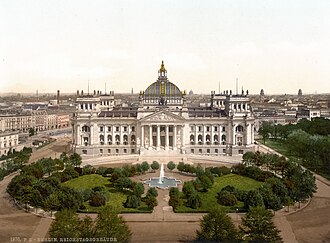
The Professionalization of Politics
Being a deputy was not always a paid profession. While a government expense allowance of 3,000 marks was introduced in 1906, it was insufficient for living. Consequently, deputies relied on party funding or interest groups. For example, the Social Democratic Party (SPD) paid salaries to its members starting in 1876, while the German Agrarian League supported conservative members in exchange for political loyalty.
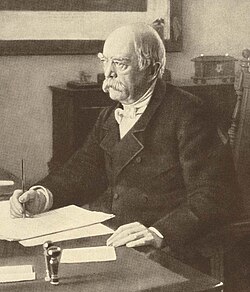
Powers and Political Influence
The Reichstag's most potent tool was its budgetary authority. Under the leadership of Otto von Bismarck, the government attempted to pass budgets covering three years, but the Reichstag insisted on annual budgets. By debating expenditures item by item, the parliament turned budget discussions into a comprehensive critique of government policy.
Despite this, the government often maintained control by playing a fragmented multi-party system against itself. The Bundesrat could dissolve the Reichstag with the Emperor's consent, a threat that often pressured parties into compliance. Between 1871 and 1918, the Reichstag was dissolved only four times (1878, 1887, 1893, and 1906).
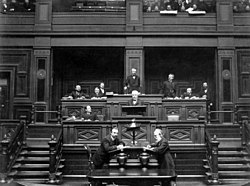
The Fall of the Empire
As World War I neared its end in October 1918, the Reichstag attempted desperate constitutional reforms to secure better peace terms from the Allies. These reforms aimed to make the chancellor accountable to the parliament rather than the Emperor and required parliamentary approval for war and peace. However, these changes were insufficient to stop the German Revolution of 1918–1919, which ultimately ended the Imperial Reichstag and paved the way for the Weimar National Assembly.
Frequently Asked Questions
Who was eligible to vote in the Reichstag elections?
All male citizens aged 25 and older were generally eligible to vote via secret ballot. Exceptions included active military personnel, those receiving public poor relief, and individuals declared legally incapacitated or bankrupt.
How did the Reichstag influence the government's spending?
The Reichstag held the power to approve the national budget. By insisting on annual budgets and debating specific expenditure items, they could effectively challenge and control the executive branch's actions.
What was the relationship between the Reichstag and the Bundesrat?
They shared legislative power. While the Reichstag represented the democratic will of the people, the Bundesrat represented the federal states. The Bundesrat also had the power to dissolve the Reichstag with the Emperor's consent.
Why were some electoral districts much larger than others?
District boundaries were based on the 1864 census and were never updated. As people migrated to industrial cities, urban districts grew massively in population while rural districts remained small, leading to unequal representation.
What happened to the Reichstag after 1918?
The Imperial Reichstag ended during the German Revolution of 1918–1919. It was succeeded by the Weimar National Assembly in February 1919, which eventually led to the creation of the Reichstag of the Weimar Republic in 1920.