Frock Coats: The History and Etiquette of Victorian Formal Wear
The frock coat stands as a symbol of 19th-century elegance, once serving as the gold standard for daytime formal attire for gentlemen. Defined by its knee-length skirt and structured silhouette, it bridged the gap between the rigid formality of the court and the emerging needs of professional business life. While it has largely been supplanted by the morning coat in modern dress codes, the frock coat remains a prized garment for those seeking a Victorian aesthetic at weddings or historical reenactments.
Historically, the frock coat was the centerpiece of "morning dress"—a term that, prior to 1900, referred specifically to the frock coat before evolving to include the modern cut-away style. To maintain proper etiquette, these coats were worn exclusively for daytime events, typically before 5 p.m. and no later than 7 p.m.
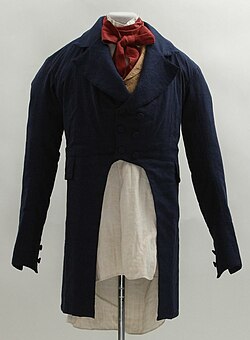
Key Facts
- Primary Use: Daytime formal wear, including weddings, garden parties, and receptions.
- Silhouette: An hourglass shape achieved through a precise waist seam and bespoke tailoring.
- Standard Color: Solid black, with charcoal grey and midnight blue as rarer alternatives.
- Key Feature: A distinct lack of external side pockets to maintain a clean line.
- Modern Status: Now primarily used as a historical alternative to the morning coat.
Materials and Color Palette
The construction of a frock coat relied on "heavy wools," specifically broadcloth and duffel. These weaves originated from 11th-century Flemish cloth processes. While wool was the standard, luxury versions utilized vicuña.
For civilian wear, black was the dominant color. During the Victorian era, charcoal grey and midnight blue emerged as acceptable, though less common, options. To add a touch of formality for festive or business occasions, the revers (lapels) were often lined with black silk in either satin or grosgrain. In contrast, funeral attire demanded a black frock coat without silk facings, paired with a matching black waistcoat.
Military versions diverged from civilian norms, introducing a broader spectrum of colors, including "navy blue" and "cadet grey."
The Art of the Cut
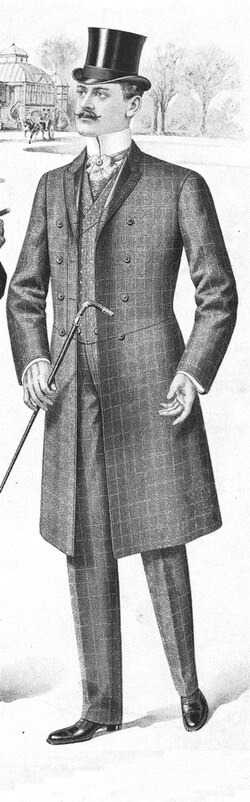
The frock coat was designed to flatter the natural elegance of the male figure, drawing inspiration from Neoclassicism and the idealized proportions of Greco-Roman sculpture. This resulted in a signature hourglass silhouette, characterized by strong waist suppression.
Because these garments were bespoke (individually custom-made), tailors could precisely place the waist seam to elongate the figure. In the 1830s and 1840s, some coats even included padding in the chest to enhance the masculine form. This contrasts sharply with the modern "drape cut" popularized by Frederick Scholte in the early 20th century, which emphasizes fullness over a tight, sculpted waist.
Distinguishing Details
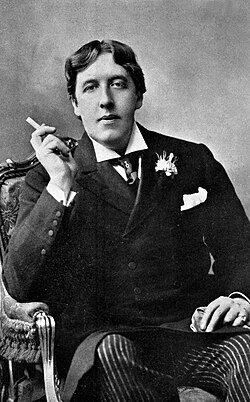
One of the most defining characteristics of the frock coat was the absence of outer side pockets; storage was instead provided by internal chest or tail pockets. While the dandy Oscar Wilde was known to wear a chest pocket for a pocket square, this was considered a flamboyant rarity and was frowned upon by traditionalists.
Other technical details included:
- Buttons: Covered in cloth to match the silk revers or featuring woven snowflake/check patterns.
- Lapels: In the Victorian era, lapels were sewn on separately to create a more elegant roll.
- Cuffs: Standard sleeves featured turn-back cuffs with two buttons.
- Braiding: Rare decorative braiding was sometimes applied to the cuffs and lapel edges.
Accessories and Coordination
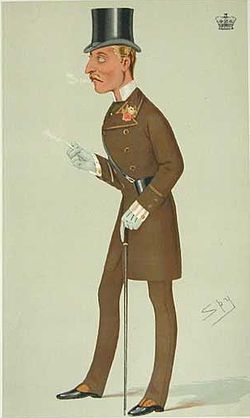
A frock coat was never worn in isolation; it required a specific set of accessories to be considered "correct." The headwear of choice was a non-collapsible top hat, as the Homburg was deemed too informal for strict morning dress.
Footwear evolved over time. Early morning dress featured patent leather dress boots, though this practice eventually shifted exclusively to evening wear. By the Edwardian era, button boots with a single row of punching across the toe were common, often accompanied by a walking cane.
The neckwear was equally precise. Gentlemen wore white shirts with detachable standing collars (either "imperial" or wingtips). The cravat was the standard, tied in either an Ascot knot or a Ruche knot and secured with a decorative pin. While long neckties became more common after 1900, bow ties were eventually relegated strictly to evening attire.
The Role of the Waistcoat and Trousers
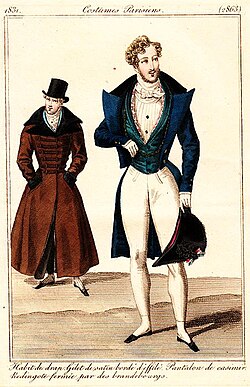
Trousers were typically uncuffed and held up by braces to ensure the waistband remained hidden beneath the waistcoat. For formal outings, cashmere striped trousers (a muted palette of black, silver, and charcoal) were preferred. Muted checks were used for less formal settings, while matching black trousers were considered a less formal alternative.
The waistcoat (vest) varied by occasion: black for solemn ceremonies, light grey for festive events, and white or buff linen for the summer. Some gentlemen, such as Charles Dickens, were known to wear colorful silk waistcoats during the early Victorian period.
Informal Variations
Before the rise of the modern lounge suit, a less formal version of the frock coat served as "smart casual" wear. These versions often featured striped or checked fabrics and matching or "odd" waistcoats. Single-breasted versions were often referred to as morning coats in this context. For business use, these were paired with a four-in-hand tie and a softer Derby or Homburg hat rather than the formal top hat.
| Feature | Formal Frock Coat | Informal Frock Suit |
|---|---|---|
| Color/Fabric | Solid Black / Broadcloth | Striped or Checked / Lighter Wool |
| Trousers | Cashmere Striped | Matching or Checked |
| Neckwear | Formal Cravat (Ascot/Ruche) | Four-in-hand Tie |
| Headwear | Top Hat | Derby or Homburg |
| Waistcoat | Black, Grey, or White Linen | Matching or Odd Color |
Frequently Asked Questions
What is the difference between a frock coat and a morning coat?
A frock coat has a full skirt that extends all the way around to the knees, whereas a modern morning coat is "cut-away" at the front. Historically, the term "morning dress" applied to both, but the cut-away style eventually became the standard for daytime formality.
Why did frock coats lack outer pockets?
The absence of side pockets was a design choice intended to maintain the clean, streamlined hourglass silhouette of the garment, preventing the hips from appearing bulky.
Can a frock coat be worn with a bow tie?
While bow ties were used in earlier periods, by the late Victorian and Edwardian eras, they were relegated to evening wear. Formal daytime wear shifted toward the cravat and later the long necktie.
What are "cashmere stripes" in the context of morning trousers?
Despite the name, "cashmere stripes" refers to a specific muted color pattern of black, silver, and charcoal grey, rather than the actual fiber of the cloth.
When is the appropriate time of day to wear a frock coat?
Frock coats are strictly daytime garments. They should be worn for formal events before 5 p.m. and generally no later than 7 p.m.