French Opera House: The Lost Landmark of New Orleans
For sixty years, the French Opera House (or Théâtre de l'Opéra) served as the beating heart of high society in New Orleans. Located at the corner of Bourbon and Toulouse Streets in the historic French Quarter, this architectural colossus was more than just a venue for music; it was the epicenter of the city's social rituals and cultural prestige from its opening in 1859 until its tragic destruction by fire in 1919.
The theater was born out of a professional dispute. Charles Boudousquié, then director of the opera company, had previously operated out of the Théâtre d'Orléans. Following a disagreement with the Orléans' new owners, Boudousquié sought to establish a grander, independent home for French opera. He commissioned architect James Gallier Jr. to design a structure that would reflect the ambition of the city's elite.
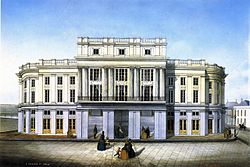
Key Facts
- Location: 541 Bourbon Street, New Orleans, Louisiana.
- Lifespan: Opened in 1859 and demolished/destroyed in 1919.
- Architect: Designed by James Gallier Jr.
- Cost: Built in less than a year for $118,500.
- Architecture: Italian order of architecture, reaching approximately 80 feet in height.
- Current Site: Now occupied by the Four Points by Sheraton French Quarter.
A Center of Social Prestige
The French Opera House was designed to be a dominant presence in the neighborhood, featuring a front of 166 feet on Bourbon Street and 187 feet on Toulouse Street. Beyond the opera, the venue hosted a variety of elite gatherings, including Carnival balls, debuts, receptions, concerts, and benefit events.
For the New Orleans elite, the opera season dictated the social calendar. The opening night of the season effectively launched the city's social year. The most prominent and oldest families maintained their status by owning seats in the Loges Grilles (screened boxes), which allowed them to see and be seen according to strict social traditions.
War, Recovery, and Final Days
The theater's operations were interrupted by the US Civil War. After Union forces captured New Orleans by April 25, 1862, performances ceased. However, the building remained a site of significance; in 1864, the wife of Union General Nathaniel P. Banks hosted a ball there to honor George Washington's birthday. Following the war, the house reopened and became a vital venue for American operatic premieres.
The early 20th century brought financial instability, and by 1913, the house entered receivership. It was saved by an anonymous donor, later revealed to be William Ratcliffe Irby, who purchased the building and donated it to Tulane University. Under the leadership of French tenor Agustarello Affre, the theater attempted a revival.
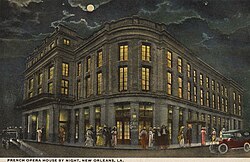
The era of the French Opera House came to an abrupt end on the night of December 4, 1919, when the building was destroyed by fire. The final performance held at the venue was Giacomo Meyerbeer's Les Huguenots, a piece particularly beloved by the old family Creoles.
Legacy of American Premieres
The French Opera House was instrumental in introducing European works to American audiences. Over several decades, it hosted the American premieres of numerous masterpieces, particularly those by Jules Massenet and Charles Gounod.
| Year | Opera Title | Composer |
|---|---|---|
| 1860 | Martha (French Version) | Friedrich von Flotow |
| 1885 | Mireille | Charles Gounod |
| 1893 | Samson et Dalila | Camille Saint-Saëns |
| 1902 | Cendrillon | Jules Massenet |
| 1912 | Don Quichotte | Jules Massenet |
Frequently Asked Questions
Where was the French Opera House located?
It was located at 541 Bourbon Street, at the corner of Bourbon and Toulouse Streets in the French Quarter of New Orleans, Louisiana.
Who designed the building?
The opera house was designed by architect James Gallier Jr. and commissioned by Charles Boudousquié.
What happened to the French Opera House?
After a period of financial struggle and a subsequent donation to Tulane University, the building was destroyed by a fire on December 4, 1919.
What is on the site today?
The site where the opera house once stood is currently occupied by the Four Points by Sheraton French Quarter hotel.
What were "Loges Grilles"?
Loges Grilles were screened boxes in the theater owned by the most prominent and oldest families of New Orleans, serving as symbols of social status.