Fraxinus: The Evolutionary History and Taxonomy of Ash Trees
The genus Fraxinus, commonly known as ash trees, represents a significant group of woody plants with a deep evolutionary lineage and a complex taxonomic structure. From their ancient fossil records to their current classification within the olive family, these trees provide a fascinating glimpse into botanical evolution across the Northern Hemisphere.
Key Facts
- Oldest Fossils: Date back to the Middle Eocene (49–39 million years ago) in southeast North America.
- Family Classification: Part of the Oleaceae (olive family) within the order Lamiales.
- Naming: Formally described by Carl Linnaeus in 1753.
- Diversity: Organized into several phylogenetic sections including Dipetalae, Fraxinus, Melioides, Ornus, Pauciflorae, and Sciadanthus.
Fossil History and Evolution
The evolutionary journey of Fraxinus is documented through a series of global fossil finds. The earliest evidence of the genus appears in the Middle Eocene, approximately 49 to 39 million years ago, in southeast North America, where the extinct species F. wilcoxiana was identified.
Further evidence of the genus's spread is found in the Middle Miocene of Korea, where winged fruits of F. oishii were discovered. Additionally, fossil pollen from F. angustifolia has been identified in Europe dating back to the Upper Miocene, roughly 12 million years ago.
Taxonomy and Nomenclature
Carl Linnaeus first described the genus Fraxinus in 1753, a designation that remains the accepted standard among taxonomists today. However, the history of ash tree classification is marked by numerous synonymous names proposed by various botanists over the centuries.
Between 1760 and 1914, several other genera were described that are now considered synonyms of Fraxinus. These include Ornus (Boehmer, 1760), Fraxinoides (Medikus, 1791), Mannaphorus (Rafinesque, 1818), and Calycomelia (Kosteletzky, 1834). Other synonyms include Leptalix, Ornanthes, Samarpsea, Samarpses, Apilia, and Aplilia (all Rafinesque, 1838), as well as Meliopsis (Reichenbach, 1841) and Petlomelia (Nieuwland, 1914).
Phylogenetic Classification
The Angiosperm Phylogeny Group classifies Fraxinus within the order Lamiales (the mint order, known for aromatic herbs) and the family Oleaceae (the olive family of flowering woody plants). Within the Oleaceae family, Fraxinus is grouped alongside other genera such as Olea (the olive).
Internally, the genus is divided into sections based on clades—groups of organisms evolved from a common ancestor—identified through phylogenetic analysis.
Major Sections of Fraxinus
- Section Dipetalae: Includes species such as the singleleaf ash (F. anomala), California ash (F. dipetala), and blue ash (F. quadrangulata).
- Section Fraxinus: Contains the European ash (F. excelsior), black ash (F. nigra), and narrow-leaved ash (F. angustifolia).
- Section Melioides: Divided into sensu lato (broad sense) and sensu stricto (strict sense). The latter includes the white ash (F. americana) and green ash (F. pennsylvanica).
- Section Ornus: Features the manna ash (F. ornus) and various Asian species like the Chinese ash (F. chinensis).
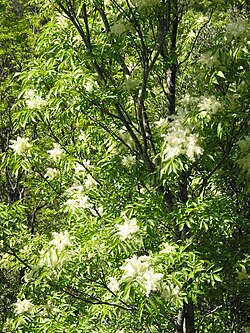
Summary of Fraxinus Sections and Representative Species
| Section | Representative Species | Common Name |
|---|---|---|
| Dipetalae | F. dipetala | California ash |
| Fraxinus | F. excelsior | European ash |
| Melioides | F. americana | White ash |
| Ornus | F. ornus | Manna ash |
| Pauciflorae | F. gooddingii | Goodding's ash |
| Sciadanthus | F. xanthoxyloides | Afghan ash |
Frequently Asked Questions
When were the first ash tree fossils discovered?
The oldest fossils clearly identified as Fraxinus date back to the Middle Eocene, between 49 and 39 million years ago, and were found in southeast North America.
Which plant family does the Fraxinus genus belong to?
Fraxinus belongs to the Oleaceae family, which is the olive family of flowering woody plants, situated within the order Lamiales.
Who first described the genus Fraxinus?
The genus was formally described by Carl Linnaeus in 1753.
What are some of the common names for species in the Ornus section?
Species in the Ornus section include the manna ash or flowering ash (F. ornus), the Chinese or Korean ash (F. chinensis), and the Japanese flowering ash (F. sieboldiana).
What is the difference between Melioides sensu lato and sensu stricto?
These terms refer to the "broad sense" and "strict sense" of the section's classification. Melioides sensu stricto includes species like the white ash (F. americana) and green ash (F. pennsylvanica), while sensu lato includes species such as the fragrant ash (F. cuspidata).