Frank-Walter Steinmeier: The Political Journey of Germany's President
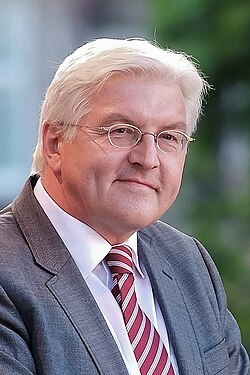
Frank-Walter Steinmeier has spent decades at the heart of German power, transitioning from a behind-the-scenes strategist to the highest ceremonial office in the land. As the President of Germany since 2017, Steinmeier represents the federal republic both domestically and internationally, bringing with him an extensive background in law, diplomacy, and party leadership.
A member of the Social Democratic Party (SPD), Steinmeier's career is defined by his versatility, having served as a career civil servant, a two-time Foreign Minister, and the Vice-Chancellor. His trajectory reflects a deep integration into the machinery of the German state, moving from regional administration in Lower Saxony to the global stage.
Key Facts
- Current Role: President of Germany (assumed office March 19, 2017).
- Previous Major Roles: Minister for Foreign Affairs (2005–2009, 2013–2017) and Vice-Chancellor (2007–2009).
- Political Affiliation: Social Democratic Party of Germany (SPD).
- Education: Doctorate in law from the University of Giessen.
- Military Service: Served in the German Air Force (Bundeswehr) from 1974 to 1976.
Early Career and Rise to Power
Steinmeier's political ascent began in the 1990s through his close association with Gerhard Schröder. Starting as an adviser for communication media law in 1991, he quickly rose to become the director of the Personal Office for the prime minister of Lower Saxony. By 1996, he was appointed Secretary of State and head of the State Chancellery of Lower Saxony.
When Gerhard Schröder became Chancellor of Germany in 1998, Steinmeier moved to the federal level. He initially served as the Under-Secretary of State in the German Chancellery, where he was the Commissioner for the Federal Intelligence Services. From 1999 to 2005, he held the pivotal role of Chief of Staff of the Chancellery.
Diplomatic Leadership and Foreign Affairs
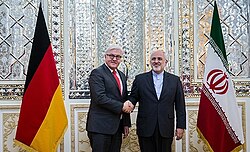
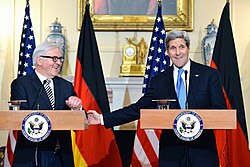
Steinmeier is perhaps most recognized for his tenure as the Minister for Foreign Affairs. He first held this position from 2005 to 2009 under Chancellor Angela Merkel, and later returned to the role from 2013 to 2017. During these periods, he managed critical international relations and served as the Chairman-in-Office of the Organization for Security and Co-operation in Europe (OSCE) in 2016.
His diplomatic portfolio included navigating complex relations with Russia, the United States, and Iran. Notably, he was among the diplomats from the P5+1 countries and the EU who agreed upon the Iran nuclear deal in 2015.
![Steinmeier among diplomats from the P5+1 countries, the European Union and Iran after agreeing on the Iran nuclear deal, Lausanne, Switzerland on 2 April 2015.[128]](/images/c2/bb/c2bb6541f6f195dc0a959c8fe10255a6e65c254c39eca2c5dd888e773558a38f.jpg)
International Relations and Milestones
Throughout his diplomatic career, Steinmeier focused on European integration and human rights. In recent years, as President, he has addressed historical grievances, such as stating in 2024 that it was "high time" for Germany to apologize to Namibia for the Herero and Nama genocide (1904–1908).
The German Presidency
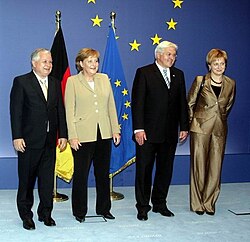
On February 12, 2017, the 16th Federal Convention elected Steinmeier as President on the first ballot. He took office on March 19, 2017, succeeding Joachim Gauck. While the presidency is largely ceremonial, Steinmeier has used the platform to influence national discourse and maintain international ties.
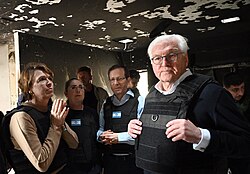
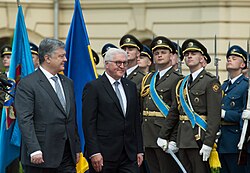
His presidency has not been without challenges, including controversies regarding visits to Ukraine and relations with Poland. Despite these, he has remained a central figure in German public life, continuing to engage with global leaders to maintain stability and cooperation.
Summary of Political Offices
| Role | Period | Key Superior/Context |
|---|---|---|
| Head of State Chancellery (Lower Saxony) | 1996–1998 | Gerhard Schröder |
| Chief of Staff of the Chancellery | 1999–2005 | Gerhard Schröder |
| Minister for Foreign Affairs (1st Term) | 2005–2009 | Angela Merkel |
| Vice-Chancellor of Germany | 2007–2009 | Angela Merkel |
| Leader of the Opposition (Bundestag) | 2009–2013 | SPD Leadership |
| Minister for Foreign Affairs (2nd Term) | 2013–2017 | Angela Merkel |
| President of Germany | 2017–Present | Incumbent |
Frequently Asked Questions
What is Frank-Walter Steinmeier's political party?
He is a member of the Social Democratic Party of Germany (SPD).
How did Steinmeier enter the federal government?
He rose through the ranks as a close aide to Gerhard Schröder, serving as his chief of staff in Lower Saxony before becoming the Chief of Staff of the Chancellery in Berlin from 1999 to 2005.
What was Steinmeier's role in the Iran nuclear deal?
As Minister for Foreign Affairs, he was one of the key diplomats from the P5+1 countries and the European Union who helped negotiate and agree upon the deal in April 2015.
Has Steinmeier faced any major controversies?
Yes, he has faced scrutiny over the imprisonment of Murat Kurnaz in Guantánamo Bay during his time as chief of staff, as well as allegations regarding plagiarism in his doctoral dissertation.
What is his stance on Germany's colonial history in Namibia?
In February 2024, President Steinmeier stated that it was "high time" for Germany to tender an apology to Namibia for the Herero and Nama genocide that occurred between 1904 and 1908.