Fogbows: The Science Behind the White Rainbow
While most of us are familiar with the vibrant spectrum of a traditional rainbow, nature occasionally produces a more subtle, ethereal version known as a fogbow. Often referred to as a "white rainbow," this atmospheric phenomenon shares similarities with the rainbow but differs significantly in its appearance and the physics that create it.
Unlike rainbows, which form during rainfall, fogbows appear within fog. The primary difference lies in the size of the water droplets involved. Fog consists of droplets smaller than 0.05 millimeters (0.0020 inches), which are significantly smaller than the raindrops that create a standard rainbow.
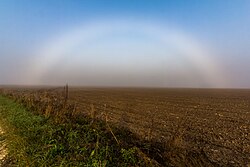
How Fogbows Form
The distinct look of a fogbow is caused by the way light interacts with these tiny droplets. In a standard rainbow, refraction and reflection create a clear separation of colors. However, in a fogbow, the small size of the droplets triggers a diffraction effect—the bending of light waves around the edges of the droplets.
This diffraction smears the colors together, resulting in a bow that appears mostly white. In some instances, very weak colors remain visible, typically manifesting as a red outer edge and a bluish inner edge.

Supernumeraries and Variations
Under specific conditions, a fogbow can exhibit more complex patterns. If the water droplets are almost identical in size, the bow may develop supernumeraries. These are multiple inner rings that often display stronger colors than the primary bow itself.
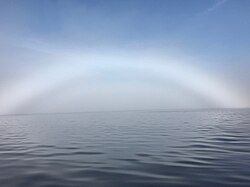
Depending on where they are observed, these phenomena go by different names. When viewed from an aircraft looking down into clouds, the effect is called a cloud bow. In maritime environments, sailors historically referred to these sightings as sea-dogs.
Key Facts
- Droplet Size: Formed by water droplets smaller than 0.05 mm.
- Primary Cause: Light is smeared by the diffraction effect of small droplets.
- Appearance: Generally white, sometimes with a red outer edge and blue inner edge.
- Alternative Names: Also known as white rainbows, cloud bows (in clouds), or sea-dogs (at sea).
- Distinction: Larger angular size and lack of color distinguish it from a glory.
Comparison of Atmospheric Bows
| Feature | Fogbow | Rainbow | Glory |
|---|---|---|---|
| Medium | Fog/Cloud droplets | Raindrops | Small droplets |
| Coloration | Mostly white/Pale | Vibrant spectrum | Multiple pale rings |
| Primary Physics | Diffraction | Refraction/Reflection | Diffraction |
| Angular Size | Larger | Standard | Smaller/Concentrated |
Frequently Asked Questions
What is the difference between a fogbow and a rainbow?
The main difference is the size of the water droplets. Fogbows are created by droplets smaller than 0.05 mm, which causes light to diffract and smear, resulting in a white appearance, whereas rainbows are created by larger raindrops that refract light into distinct colors.
Why are fogbows usually white?
They appear white because the diffraction effect of the tiny fog droplets smears the colors together, removing the sharp spectral separation seen in rainbows.
What are supernumeraries in a fogbow?
Supernumeraries are additional inner rings that can appear when the water droplets in the fog are nearly uniform in size. These rings often have more intense coloring than the main bow.
How is a fogbow different from a glory?
A fogbow is distinguished from a glory by its larger angular size and its general lack of color, whereas a glory consists of multiple pale-colored rings.
What is a cloud bow?
A cloud bow is simply a fogbow that is observed within clouds, most commonly seen by passengers in an aircraft looking downward.