Rainbow Variations and Rare Atmospheric Optical Phenomena
While most people are familiar with the classic multi-colored arc appearing after a rain shower, the science of atmospheric optics reveals a vast array of rainbow variations. These phenomena occur when light interacts with water droplets, ice crystals, or other materials through refraction and reflection, creating a spectrum of visual wonders that range from the common to the incredibly rare.
Key Facts
- Double Rainbows: Occur when sunlight reflects twice inside water droplets, creating a fainter secondary bow with reversed colors.
- Supernumerary Bows: Faint, pastel bands inside the primary bow caused by light interference rather than simple geometric optics.
- Full-Circle Rainbows: Every rainbow is technically a circle, though the horizon usually hides the bottom half unless viewed from a high altitude.
- Moonbows: Rare rainbows created by moonlight, often appearing white to the human eye due to low light sensitivity.
- Non-Water Rainbows: Sleetbows form from ice pellets, while halos and arcs form from hexagonal ice crystals.
Double and Twinned Rainbows
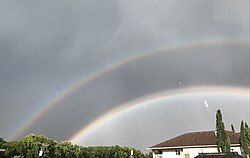
A double rainbow occurs when a primary bow is accompanied by a secondary bow at a greater angle. This secondary arc is caused by a double reflection of sunlight inside the water droplets. Because of this second reflection, the colors are reversed, and the bow is fainter as more light escapes the droplet. The dark region of the sky located between these two bows is known as Alexander's band.

In contrast to the concentric arcs of a double rainbow, a twinned rainbow is a rare phenomenon where two arcs split from a single base. Unlike secondary bows, the colors in a twinned rainbow follow the same order as the primary bow. This is believed to be caused by the presence of two different sizes of raindrops falling simultaneously; for example, a mixture of 0.40 mm and 0.45 mm droplets can create this effect due to differences in how the drops flatten as they fall.
The Geometry of Full-Circle Rainbows
Although we typically see an arc, every rainbow is actually a full circle centered on the antisolar point (the point diametrically opposite the sun). From the ground, the horizon usually blocks the lower half. However, from an aircraft or a high building, the full circle becomes visible. You can also simulate this on the ground by using a garden hose to create a water mist while facing away from the sun.
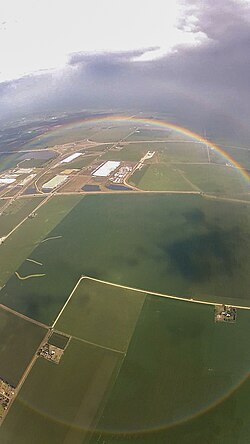
It is important to distinguish a circular rainbow from a glory (a smaller diameter phenomenon) or a 22° halo, which is caused by ice crystals and appears around the sun or moon rather than opposite to it.
Supernumerary Rainbows and Wave Optics
Supernumerary rainbows are narrow, pastel-colored bands (typically pink, purple, and green) found inside the primary bow. These cannot be explained by classical geometric optics; instead, they are the result of interference. This occurs when light rays following slightly different paths within a droplet reinforce or cancel each other out.
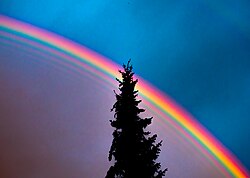
These bands are most prominent when water droplets are small (1 mm or less) and uniform in size. Historically, the observation of supernumerary bows provided early evidence for the wave nature of light, first explained by Thomas Young in 1804.
Reflected and Monochrome Rainbows
When rainbows occur over water, two distinct types of mirror bows can appear. A reflected rainbow appears below the horizon because sunlight is deflected by raindrops and then reflects off the water's surface. A reflection rainbow appears above the horizon when sunlight reflects off a large, calm body of water before hitting the raindrops.
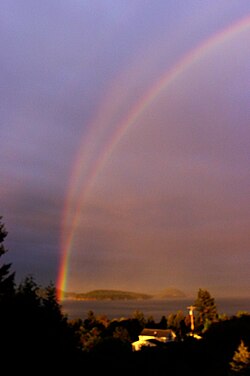
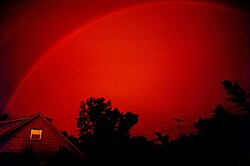
In rare instances during sunrise or sunset, shorter wavelengths (blue and green) are scattered away by the atmosphere. This results in a monochrome rainbow, which appears dramatic and red.
Higher-Order Rainbows
The "order" of a rainbow is defined by the number of internal reflections within the droplet. The primary bow is first-order (one reflection) and the secondary is second-order (two reflections). Theoretically, rainbows can exist to an infinite order, but they become progressively dimmer and harder to see.
- Tertiary (3rd order) and Quaternary (4th order): These are located in the direction of the sun, making them difficult to spot due to glare.
- Quinary (5th order): Extremely faint and located partially in the gap between primary and secondary bows.
While rarely seen in nature, laboratory settings using lasers have produced rainbows up to the 200th order.
Specialized Atmospheric Bows
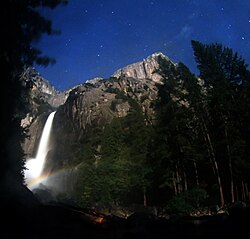
Not all "rainbows" are formed by liquid rain. Moonbows (lunar rainbows) are created by moonlight; they are much dimmer and often appear white because the human eye lacks the sensitivity to perceive their colors in low light.
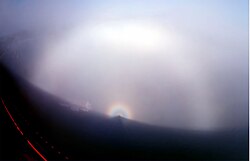
Fogbows are formed by much smaller droplets that diffract light, resulting in a broad, nearly white arc. These often appear alongside a glory or a Brocken spectre.
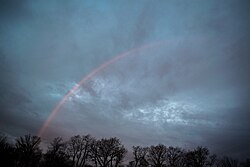
Sleetbows occur when light passes through falling ice pellets (sleet) rather than liquid water, a phenomenon documented in various parts of the United States.
Ice Halos and Arcs
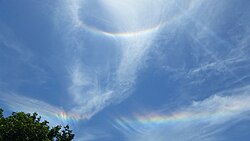
The circumhorizontal arc (sometimes called a "fire rainbow") and the circumzenithal arc are not true rainbows because they are caused by refraction through hexagonal ice crystals. The circumzenithal arc appears high overhead and is convex-down, while the circumhorizontal arc is straighter and appears closer to the horizon.
Material Influence and Extraterrestrial Possibilities
The angle of a rainbow depends on the refractive index of the material. Salt water, for example, has a higher refractive index than fresh water, slightly altering the bow's radius. If a material's refractive index exceeds 2 (like diamond, which is 2.4), a first-order rainbow cannot form, and the sequence begins with the second order.
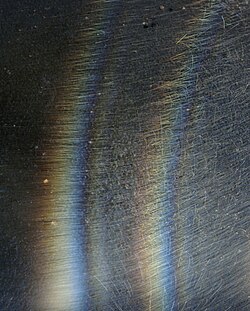
Scientists suggest that rainbows may exist on Saturn's moon Titan. Because Titan's atmosphere contains methane rather than water, the radius of a Titan rainbow would be approximately 49° instead of the Earthly 42°.
| Type | Cause/Material | Key Characteristic | Rarity |
|---|---|---|---|
| Primary Rainbow | Water droplets (1 reflection) | Standard spectrum | Common |
| Secondary Rainbow | Water droplets (2 reflections) | Reversed colors, fainter | Common |
| Supernumerary | Small droplets (<1mm) | Pastel bands inside primary | Occasional |
| Moonbow | Moonlight + Water | Often appears white | Rare |
| Fogbow | Tiny fog droplets | Broad, white/pale arc | Occasional |
| Sleetbow | Ice pellets | Refraction through ice | Very Rare |
| Circumhorizontal Arc | Hexagonal ice crystals | Straight, near horizon | Rare |
Frequently Asked Questions
What is the difference between a double rainbow and a twinned rainbow?
A double rainbow consists of two concentric arcs where the outer (secondary) bow has reversed colors. A twinned rainbow features two arcs splitting from a single base, both maintaining the same color order as the primary bow.
Why do some rainbows look white?
Moonbows often look white because the light is too dim for the human eye to detect individual colors. Fogbows appear white because their droplets are so small that the colors overlap and blur together.
Can you see a full-circle rainbow from the ground?
Generally, no, because the ground blocks the necessary water droplets and sunlight. However, you can see a full circle if you are in an aircraft or if you create a localized mist with a garden hose.
What causes the dark band between two rainbows?
This is called Alexander's band. It is a region of the sky that remains unlit because the angles of refraction and reflection for the primary and secondary bows do not direct light into that specific area.
Are "fire rainbows" actually rainbows?
No. The circumhorizontal arc (often called a fire rainbow) is a member of the halo family. It is caused by light refracting through ice crystals in cirrus clouds, not by liquid water droplets.