Light Scattering Approximation Methods
When light or other electromagnetic radiation encounters a particle, it scatters. Predicting exactly how this happens requires complex calculations, but scientists use various approximation methods to simplify the process. The choice of method depends primarily on the size of the particle relative to the wavelength of the light and the refractive index—a measure of how much light bends when entering a material.
Key Facts
- Rayleigh scattering occurs when particles are significantly smaller than the wavelength of light.
- Geometric optics is used when particles are much larger than the wavelength of light.
- The size parameter (x) is the critical factor in determining which scattering model to apply.
- Ray tracing can simulate complex atmospheric phenomena like rainbows and halos.
Foundational Concepts of Scattering
To determine the correct approximation method, physicists look at the size parameter (x) and the refractive index (m). The size parameter describes the ratio of the particle's dimensions to the wavelength of the incident light. When the size parameter is very small, the particle behaves differently than when it is very large.
Rayleigh Scattering
Rayleigh scattering is the regime used when particles are much smaller than the wavelength of the light (defined as x ≪ 1). In this state, the scattering is highly dependent on the wavelength, which is why certain colors of light scatter more than others.
Geometric Optics and Ray Tracing
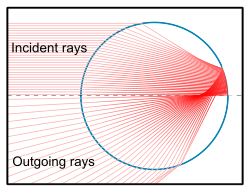
When the size and critical dimensions of a particle are much larger than the wavelength of light, geometric optics (or ray tracing) is employed. In this model, light is treated as a collection of rays. These rays are wider than the wavelength but small compared to the particle itself.
As a ray hits a particle, it may undergo partial reflection or refraction. The power of the incident ray is then divided among the exiting rays. By statistically combining the results from many randomly positioned and oriented scatterers, researchers can model atmospheric optical phenomena. For example, water droplets create rainbows, while ice crystals create halos.
Comparison of Approximation Methods
Depending on the specific values of the refractive index (m) and the size parameter (x), different mathematical theories are applied to ensure accuracy.
| Method | Size Parameter (x) | Refractive Index (m) Condition |
|---|---|---|
| Rayleigh Scattering | Very small (x ≪ 1) | abs(mx) is very small |
| Anomalous Diffraction Theory | Large | abs(m-1) is very small |
| Complex Angular Momentum | Large | Moderate m |
| Geometric Optics | Very large | N/A |
Frequently Asked Questions
What is the size parameter in light scattering?
The size parameter (x) is a dimensionless value that compares the size of a scattering particle to the wavelength of the light hitting it.
When is Rayleigh scattering applicable?
Rayleigh scattering is used when the particles are much smaller than the wavelength of the light, specifically in the regime where x ≪ 1.
How does ray tracing simulate rainbows?
Ray tracing calculates how light rays reflect off the back of water droplets and refract as they enter and exit, combining these results statistically to describe the resulting optical phenomenon.
What is the difference between Geometric Optics and Anomalous Diffraction Theory?
Geometric optics is used for very large particles regardless of the refractive index, whereas Anomalous Diffraction Theory is used for large particles specifically when the refractive index is very close to 1 (abs(m-1) is very small).
What causes atmospheric halos?
Atmospheric halos are caused by the scattering of light by ice crystals, which can be modeled using ray-tracing techniques.