Flying Wing Aircraft: The Evolution of Tailless Aerodynamic Design
In the world of aviation, most aircraft follow a familiar silhouette: a central fuselage with wings extending from the sides and a tail at the rear for stability. However, a unique class of aircraft challenges this convention. A flying wing is a tailless, fixed-wing aircraft that lacks a definite fuselage. Instead, the crew, payload, fuel, and equipment are all housed directly within the main wing structure. While they may feature small additions like pods, nacelles, or vertical stabilizers, the core design is a single, cohesive lifting surface.
Theoretically, the flying wing represents the lowest-drag configuration possible for a fixed-wing aircraft. However, this efficiency comes with a significant engineering trade-off: the lack of conventional stabilizing surfaces makes these aircraft inherently unstable and difficult to control. Despite these challenges, the pursuit of the perfect aerodynamic shape has driven decades of innovation, from early gliders to modern stealth bombers.
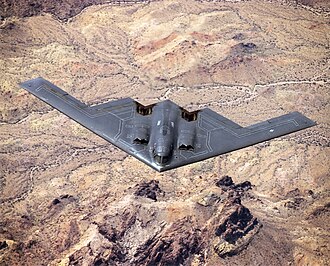
Key Facts
- Core Concept: A tailless design where the wing serves as the entire body of the aircraft.
- Primary Advantage: Extremely low aerodynamic drag due to the absence of a fuselage and tail.
- Primary Challenge: Natural instability and difficulty in directional control.
- Modern Application: Highly effective for stealth technology, as seen in the B-2 Spirit.
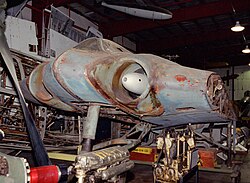
- Historical Milestone: The Horten Ho 229 was the first pure flying wing to use jet engines.
Engineering and Design Principles
To overcome the inherent instability of a tailless design, engineers utilize several sophisticated techniques. One common method is wash-out, which involves twisting the wing so that the angle of attack is reduced toward the wing tips. When combined with a swept-back wing planform, this helps manage lift and stability.
This approach creates what Ludwig Prandtl described in 1933 as a bell-shaped lift distribution. By reducing lift at the tips, designers can optimize the aircraft's weight and drag for a specific amount of lift, creating a more efficient flight profile.
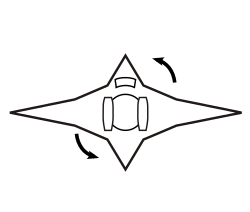
Distinguishing Flying Wings from Similar Designs
It is important to distinguish true flying wings from other aerodynamic shapes that are often confused with them:
- Blended Wing Body (BWB): These aircraft possess a fuselage that transitions smoothly into the wings.
- Lifting Body: These designs feature a fuselage that generates lift but lack the distinct, wide-spanning wings of a true flying wing.
A History of Innovation
Early Research and Pioneers
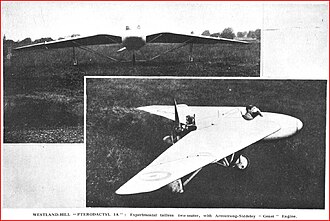
The concept dates back to 1876, when French engineers Alphonse Pénaud and Paul Gauchot patented a propeller-powered aircraft with flying wing characteristics. The early 20th century saw significant experimentation, notably by British pioneer J.W. Dunne, whose swept-wing designs influenced later developers like G.T.R. Hill. Hill's Westland-Hill Pterodactyl series was a notable attempt at tailless flight during the 1920s and 30s.
In Germany, Hugo Junkers envisioned the flying wing as the ultimate solution for large-scale air transport. He believed the high internal volume and low drag would allow massive aircraft to cross the Atlantic. While his "Giant" JG1 design was destroyed after WWI, his ideas influenced later developments like the Junkers G.38, which utilized a thick-chord wing to house passengers and fuel.
Simultaneously, Soviet designers like Boris Ivanovich Cheranovsky were testing tailless gliders. These efforts eventually led to motorized gliders such as the BICh-11, which competed in glider competitions in the 1930s.
World War II and the Jet Age
The Second World War accelerated flying wing research as nations sought ways to extend the range of aircraft. In Germany, the Horten brothers utilized Prandtl's bell-shaped lift distribution to develop advanced gliders and jet prototypes. Their most famous creation, the Horten Ho 229, was the first pure flying wing to be powered by twin jet engines.

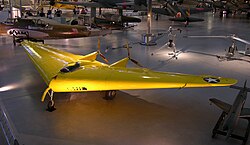
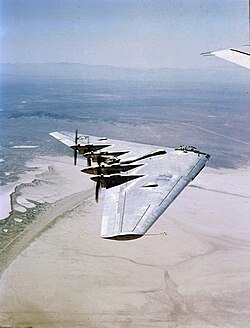
In the United States, Jack Northrop became a central figure in flying wing development. His work began with the N-1M scale prototype and progressed to the massive YB-35 bomber. During the war, the YB-35 was a significant step toward long-range heavy bombers, though it faced various developmental hurdles.
Postwar Development and Modern Stealth
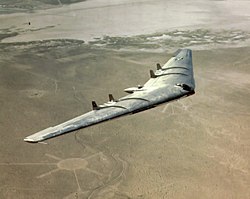
Following the war, the Northrop YB-35 was evolved into the jet-powered YB-49. In 1949, the YB-49 set a transcontinental speed record, flying from California to Washington, D.C., in just over four hours. However, lateral stability issues and the emergence of larger aircraft like the B-36 "Peacemaker" led to the cancellation of the bomber program.
The interest in flying wings saw a massive resurgence in the 1980s. The unique shape of the flying wing is ideal for stealth technology, as it minimizes the radar cross-section by reducing the number of vertical surfaces and sharp angles. This breakthrough culminated in the production of the Northrop Grumman B-2 Spirit, the world's premier stealth bomber.
Today, the flying wing concept is widely used in Unmanned Aerial Vehicles (UAVs) for reconnaissance and combat, such as the Lockheed Martin RQ-170 Sentinel. While commercial airlines like Boeing and McDonnell Douglas have studied flying wing designs for large cargo and passenger transport, no such airliner has yet entered service.
Summary of Key Aircraft Types
| Aircraft Name | Era | Primary Feature/Role |
|---|---|---|
| Westland-Hill Pterodactyl | 1920s-1930s | Experimental tailless series |
| Horten Ho 229 | WWII | First jet-powered pure flying wing |
| Northrop YB-35 | WWII | Large 4-engine bomber prototype |
| Northrop YB-49 | Post-WWII | Jet-powered transcontinental record holder |
| Northrop Grumman B-2 Spirit | Modern | Stealth bomber utilizing flying wing design |
Frequently Asked Questions
What is the main difference between a flying wing and a standard airplane?
A standard airplane has a distinct fuselage and a tail section for stability. A flying wing lacks these, housing all components—including the crew and fuel—within the wing structure itself.
Why are flying wings used for stealth aircraft?
The flying wing design lacks the vertical stabilizers and complex angles found on traditional aircraft, which helps reduce the radar cross-section, making the plane harder to detect.
Why don't we see flying wing passenger airliners today?
While they offer great efficiency and low drag, the inherent instability of the design makes them difficult to control. While companies like Boeing have studied them, they have not yet been implemented for commercial use.
What is "wash-out" in aircraft design?
Wash-out is a technique where the wing is twisted so that the angle of attack is lower at the wing tips than at the root. This helps improve stability and control in tailless aircraft.
Are flying wings only used for military purposes?
No. While they are prominent in military stealth and UAV technology, the concept is also being explored for civilian uses, such as atmospheric satellites and large-scale cargo transport.