Floral Diagrams: Mapping the Architecture of Flowers
In the study of botany, understanding the complex structure of a flower is essential for both identification and evolutionary research. While a photograph captures the beauty of a bloom, a floral diagram provides a scientific blueprint. A floral diagram is a graphic, schematic representation of a flower's structure, acting as a projection perpendicular to the flower's axis. It reveals the number, arrangement, and fusion of various floral organs, providing a clear view of the plant's reproductive morphology.
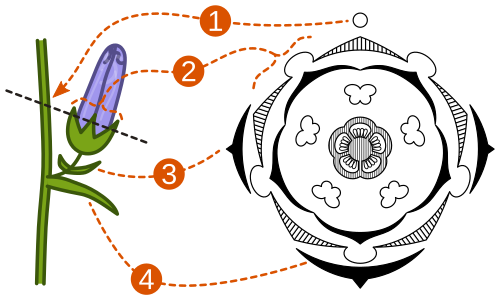
These diagrams are often used in conjunction with a floral formula—a textual shorthand used to describe a flower's characteristics. Together, they create an "identikit" of a plant, allowing scientists to study angiosperm (flowering plant) evolution and compare different taxa with precision.
Key Facts
- Purpose: Used for flower identification, studying morphology, and understanding evolutionary relationships.
- Origin: Introduced in the late 19th century, largely attributed to the work of A. W. Eichler.
- Components: Represents organs like the perianth, androecium, and gynoecium using specific symbols.
- Complementary Use: Works alongside floral formulae to provide a complete morphological description.
- Versatility: Can represent individual flowers, partial inflorescences, or generalized structures of an entire taxon.
Historical Development
The 19th century saw a divergence in botanical description: the rise of textual floral formulae and the development of pictorial floral diagrams. The latter is credited to A. W. Eichler, whose seminal works, Blüthendiagramme (1875, 1878), established a foundation for floral morphology that influenced generations of botanists, including John Henry Schaffner.
Over the decades, various scholars have refined these methods. Arthur Church included diagrams in his 1908 work Types of Floral Mechanism, and more contemporary experts like Ronse De Craene have updated these approaches to align with the APG II (Angiosperm Phylogeny Group) classification system.
Anatomy and Orientation
A floral diagram is essentially a schematic cross-section of a young flower. To maintain scientific consistency, diagrams follow specific orientation rules:
- The Axis: Usually positioned above the flower in the median line, representing the main stem relative to a lateral flower.
- Bracts and Bracteoles: The subtending bract (a leaf-like structure at the base of a flower) is typically drawn below the flower, while bracteoles (smaller bracts) are placed on the sides.
Decoding the Symbols
Because there is no single universal standard for drawing diagrams, symbols can vary between authors. However, most diagrams categorize organs into several key groups:
The Perianth
The perianth consists of the non-reproductive parts of the flower, such as sepals and petals. In many diagrams, these are represented by arcs. Depending on the author, they may be color-coded or hatched to distinguish between sepals (outer protective layers) and petals (often colorful attractants). In cases where the distinction is unclear, they are referred to as tepals.
The Androecium and Gynoecium
The reproductive organs are the heart of the diagram:
- Androecium: This represents the male parts. Stamens are typically shown as cross-sections of anthers. If a stamen is sterile, it is called a staminode and is often marked with a small black circle.
- Gynoecium: This represents the female parts, specifically the pistil. The diagram shows a sectional view of the ovary, and advanced diagrams may even illustrate ovule morphology or the position of stigmatic lobes.
Additional Details: Nectaries and Fusion
Beyond the primary organs, diagrams can communicate complex biological data:
- Nectaries: Glands that produce nectar, often indicated by specific shading or hatching.
- Fusion: If floral parts are joined together, full connecting lines are used to show this connection.
- Symmetry and Movement: Arrows may be used to indicate monosymmetry (bilateral symmetry) or resupination (the twisting of a flower during development).
- Lost Organs: A star symbol (✶) or dashed lines can indicate organs that are present in the lineage but lost in the specific specimen.
Summary of Floral Diagram Components
| Organ Group | Common Representation | Key Details Shown |
|---|---|---|
| Bracts/Bracteoles | Arcs | Position relative to the flower axis |
| Perianth | Arcs (colored or hatched) | Sepals, petals, or tepals; estivation patterns |
| Androecium | Cross-sections or circles | Stamens and staminodes |
| Gynoecium | Sectional view of ovary | Ovary position (superior/inferior) and ovules |
| Nectaries | Shaded or hatched areas | Location of nectar-producing tissue |
Frequently Asked Questions
What is the difference between a floral diagram and a floral formula?
A floral diagram is a visual, pictorial representation showing the size and relative position of organs, whereas a floral formula is a symbolic, textual shorthand. They are complementary; used together, they provide a complete morphological description.
Why do different botanical authors use different symbols?
There is currently no single global agreement on how floral diagrams should be drawn. Some authors prefer simple, rough representations, while others include highly detailed structural information. This leads to variations in how axes, nectaries, and perianth parts are depicted.
How can a floral diagram help paleontologists?
Paleontologists use floral diagrams to assist in the reconstruction of fossil flowers, allowing them to interpret the structural characteristics of ancient plant species from limited physical evidence.
What does it mean if a diagram shows "fusion"?
Fusion refers to the physical joining of different floral organs (such as petals being fused into a tube). In a diagram, this is typically represented by solid connecting lines between the symbols of the respective organs.
What is a staminode?
A staminode is a stamen that has become sterile and does not produce pollen. In a floral diagram, it is often distinguished from a functional stamen by a small black circle or by being filled in black.