Fish Farming: Methods, Global Impact, and Sustainability Challenges
Fish farming, also known as pisciculture, is the commercial breeding of fish in controlled environments such as tanks or artificial enclosures. As a specialized branch of aquaculture—the broader cultivation of aquatic animals including crustaceans and molluscs—pisciculture has become a critical component of the global food system. While some facilities, known as fish hatcheries, focus on releasing juvenile fish into the wild to support recreational fishing or conservation, most commercial operations aim to meet the rising global demand for dietary protein.
The shift toward farmed fish is largely driven by the depletion of wild fish stocks due to overfishing. By creating artificial colonies, farmers can provide consistent feeding, protection from predators, and veterinary care, reducing the direct pressure on wild populations. This industry has seen explosive growth; between 2000 and 2018, aquaculture production rose from 32.4 to 82.1 million tonnes, averaging an annual growth rate of 5.3%.
![Global capture fishery yield in red and aquaculture production in orange, 2023.[11]](/images/ce/39/ce393d5aa0b280a5bc420185dc130de144c5a4f7b76310c692ad6836b3556a0a.webp)
Key Facts
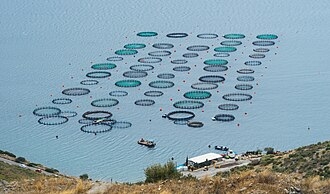
- Global Leadership: China produces 62% of the world's farmed fish.
- Market Share: As of 2016, aquaculture accounted for more than 50% of all seafood produced.
- Primary Species: The most significant species produced globally include carp, catfish, salmon, and tilapia.
- Environmental Trade-off: While reducing some wild fishing pressure, carnivorous species like salmon often require fishmeal derived from wild forage fish.
Major Farmed Species and Economic Value
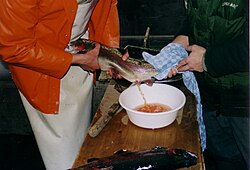
Different species are suited to various environments, ranging from freshwater ponds to marine cages. The economic value and tonnage vary significantly across these species, with Atlantic salmon commanding high market value despite lower tonnage compared to carp species.
| Species | Environment | Tonnage (Millions) | Value (US$ Billions) |
|---|---|---|---|
| Grass carp | Freshwater | 5.23 | 6.69 |
| Silver carp | Freshwater | 4.59 | 6.13 |
| Common carp | Freshwater | 3.76 | 5.19 |
| Nile tilapia | Freshwater | 3.26 | 5.39 |
| Atlantic salmon | Marine | 2.07 | 10.10 |
| Rainbow trout | Fresh/Brackish/Marine | 0.88 | 3.80 |
Farming Systems and Infrastructure
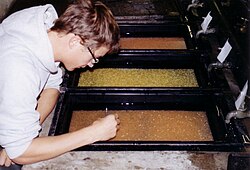
Fish farming is generally categorized into extensive aquaculture (lower density, more natural) and intensive aquaculture (high density, high input). The choice of infrastructure depends on the species and the available environment.
Cage and Pen Systems
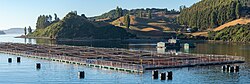
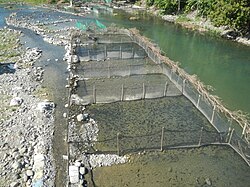
Cage farming in open seas and lakes is increasingly popular. These systems use mesh-wire frames and nets to contain fish in natural bodies of water. However, cage failures can lead to massive escapes of non-native species, which may endanger local ecosystems. For example, a 2017 failure in Washington state released nearly 300,000 Atlantic salmon into the Puget Sound, risking the native Pacific salmon population.
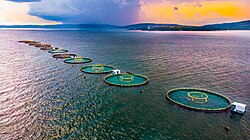
To combat these issues, semi-submersible technology is being deployed. Norway's Ocean Farm 1, a US$300 million project, utilizes a massive 61-meter high pen designed to disperse waste more effectively than coastal farms, allowing for higher packing densities.
Pond and Ditch Systems
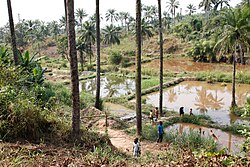
Pond systems are often considered easier to manage and start than cages. These can range from small cooperative projects in rural villages to large-scale industrial ponds. In some regions, integrated recycling systems and composite fish culture are used to maximize efficiency.
Water Quality Management
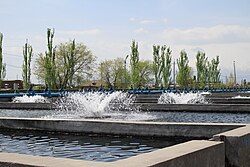
Maintaining optimal water chemistry is vital for fish health. Key parameters include a pH between 6 and 9, dissolved oxygen levels (6 mg/L for coldwater fish and 4 mg/L for warmwater fish), and strict limits on toxins like ammonia (< 0.02 mg/L) and mercury (< 0.0002 mg/L).
Environmental and Welfare Concerns
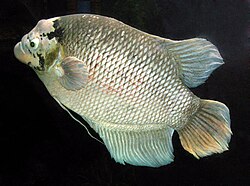
Despite its benefits, fish farming introduces several negative externalities. Organic waste is a primary concern; a single salmon farm in Scotland can produce organic waste equivalent to a town of 10,000 to 20,000 people annually.
Ecosystem Impacts
- Pollution: Excess feed and waste lead to eutrophying emissions.
- Disease Spread: Parasites and diseases can transfer from farmed populations to wild fish.
- Invasive Species: Escaped farmed fish can outcompete or hybridize with native species.
![A North American lake trout fishing farm on Lake Titicaca near Copacabana, Bolivia. Since their introduction in the 1930s, trout have been an invasive species endangering the local fish population.[86]](/images/4a/33/4a33ea771b6c83bf5b4fc21d6b18696f1d014b82547d5065769df8986e82e83c.jpg)
Animal Welfare
High stocking densities—sometimes reaching 50,000 fish in a 2-acre area—can cause stress, injuries, and disease. While many farmed species are naturally schooling fish, exceeding the social density limit can decrease growth rates and increase the feed conversion ratio (the amount of feed required per kg of fish produced).
Labeling and Regulation
As consumers become more conscious of sustainability, labeling has become a point of contention. In the European Union, labeling regarding species, origin, and production method has been mandatory since 2002. In the United States, the National Organic Standards Board allows fish to be labeled "organic" if less than 25% of their feed comes from wild fish, a rule that has faced criticism from advocacy groups.
Frequently Asked Questions
What is the difference between aquaculture and pisciculture?
Aquaculture is the broad term for farming any aquatic organisms, including shellfish and seaweed. Pisciculture is a specific type of aquaculture focused exclusively on breeding and raising fish.
Does fish farming help prevent overfishing?
It can reduce pressure on wild stocks by providing an alternative protein source. However, for carnivorous fish like salmon, the need for wild-caught forage fish for feed means the pressure on certain wild fisheries remains.
What are the main environmental risks of fish farms?
The primary risks include water pollution from organic waste, the spread of parasites to wild populations, and the ecological disruption caused by the escape of non-native species.
How is fish welfare managed in intensive farms?
Welfare is managed by monitoring stocking densities to avoid exceeding social limits and maintaining strict water quality parameters to reduce stress and disease.
Which country is the largest producer of farmed fish?
China is the global leader, providing 62% of the world's farmed fish production.