Aquaculture: The Science and Scale of Modern Aquatic Farming
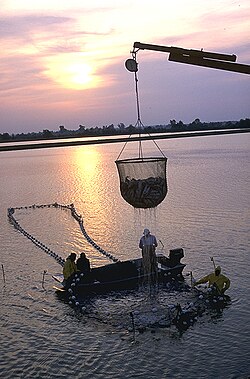
Aquaculture, often referred to as aquafarming, is the controlled cultivation of aquatic organisms. This diverse practice encompasses the farming of fish, crustaceans, mollusks, algae, and various aquatic plants like the lotus. Unlike commercial fishing, which involves harvesting wild populations, aquaculture operates under controlled or semi-natural conditions to breed, grow, and harvest species of value.
Beyond food production, aquaculture plays a vital role in environmental stewardship. It is used to restore and rehabilitate both marine and freshwater ecosystems and can help reconstruct populations of endangered aquatic species. When aquaculture is conducted specifically in seawater habitats and lagoons, it is known as mariculture. When the focus is strictly on farming fish for food, the practice is called pisciculture.
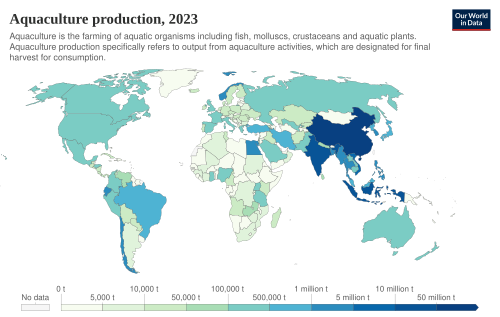
Key Facts
![Aquaculture production (2023)[22]](/images/db/0f/db0f1538730249284ae62fe0cae4d45f2366339577dde13f648ec2432c61057a.webp)
- Aquaculture has grown at an average rate of approximately 8% per year for over three decades.
- In 2021, global fish production was split almost equally between capture fisheries and aquaculture.
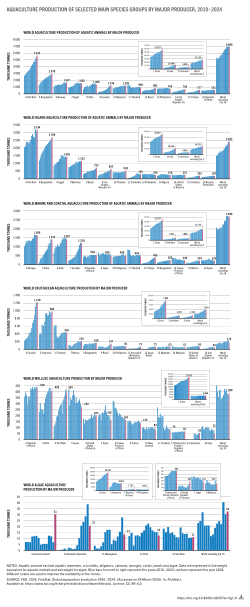
- China is a global leader, accounting for 70% of world production in 2005.
- Aquaculture includes diverse methods ranging from land-based tanks to offshore ocean cages.
- Seaweed production is a massive component, dominating the aquatic plant sector.
Methods of Cultivation
![World capture fisheries and aquaculture production by main producers (2018), from FAO's Statistical Yearbook 2020[30]](/images/2c/d1/2cd1e63fa5e411d73cd593efe8b48fd9ed16acac699748f69649cc37562e3694.webp)
Aquaculture is not a one-size-fits-all industry; it utilizes various environments depending on the species and the level of human intervention required.
Onshore Aquaculture
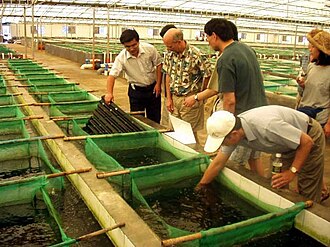
Conducted in completely artificial facilities built on land, onshore aquaculture relies heavily on human control. Common setups include fish tanks, ponds, raceways, and aquaponics (a system combining aquaculture with hydroponics). In these environments, farmers strictly manage water quality, including oxygen levels, temperature, and feed.
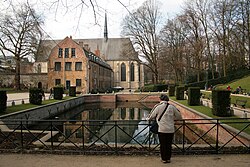
Inshore and Offshore Aquaculture
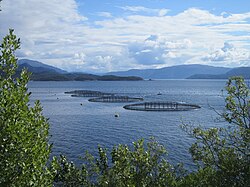
Inshore aquaculture takes place in well-sheltered, shallow waters near the coast. These species live in relatively more naturalistic environments compared to land-based tanks. In contrast, offshore aquaculture involves fenced or enclosed sections in open water away from the shore. These operations use cages, racks, or bags, exposing species to diverse natural conditions such as ocean currents, nutrient cycles, and diel vertical migration (the daily movement of organisms up and down the water column).
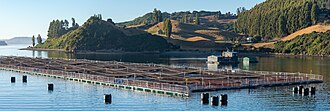
Species Groups and Production

The scope of aquaculture extends far beyond just finfish. The industry is categorized into several primary and minor species groups.
Aquatic Plants and Seaweed
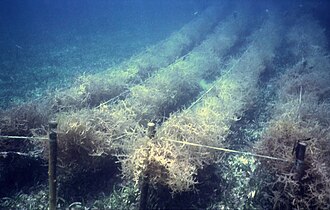
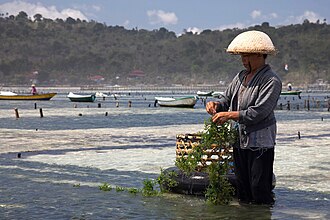
Aquatic plants represent a significant portion of the industry. In 2016, cultivated aquatic plants accounted for 96.5% of the total 31.2 million tonnes of combined wild-collected and cultivated aquatic plants. This sector is overwhelmingly dominated by seaweed, with global production growing from 13.5 million tonnes in 1995 to over 30 million tonnes in 2016.
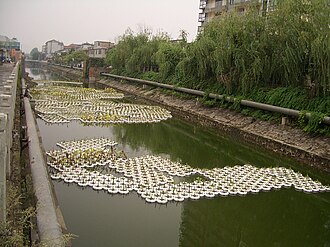
Fish, Crustaceans, and Mollusks
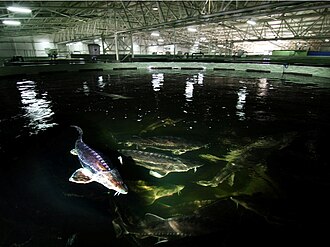
Fish remain a primary focus, with various species being farmed globally. Other major groups include crustaceans (such as shrimp) and mollusks (such as oysters and abalone). Specialized farming can also target unique species like sturgeon or various types of catfish.
Global Production Trends
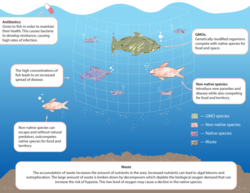
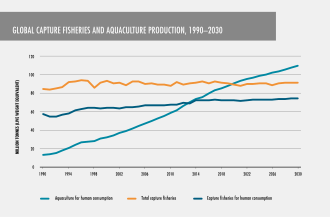
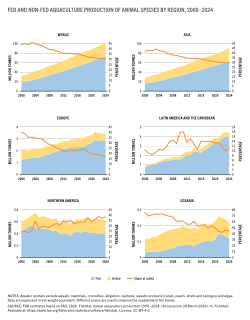
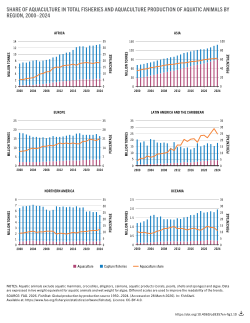
The demand for seafood has driven rapid technological advancements, allowing for increased growth in coastal waters and the open ocean. While wild-capture fisheries have remained relatively flat over the last decade, aquaculture has seen sustained and rapid growth.
In 2012, aquaculture contributed 66.6 million tonnes to the 158 million tonnes of total world fisheries production, representing about 42% of the total. By 2021, the landscape had shifted significantly; global fish production reached 182 million tonnes, with aquaculture providing 90.9 million tonnes—nearly matching the 91.2 million tonnes from capture fisheries.
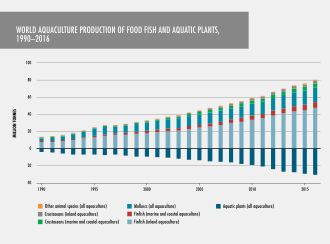
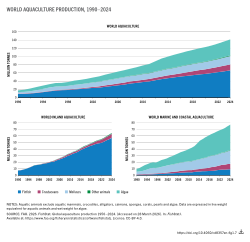
| Category | 2011 | 2012 | 2013 | 2014 | 2015 | 2016 |
|---|---|---|---|---|---|---|
| Total Capture | 92.2 | 89.5 | 90.6 | 91.2 | 92.7 | 90.9 |
| Total Aquaculture | 61.8 | 66.4 | 70.2 | 73.7 | 76.1 | 80.0 |
| Total World Production | 154.0 | 156.0 | 160.7 | 164.9 | 168.7 | 170.9 |
![Aquaculture production by region[71]](/images/a4/d6/a4d6146e3c0384b0dd0b43cba8b4614075cb79856614cf9ec5754719dd7b9a83.webp)
Frequently Asked Questions
What is the difference between aquaculture and mariculture?
Aquaculture is the broad term for the controlled cultivation of any aquatic organism. Mariculture is a specific subset of aquaculture that refers to farming conducted in seawater habitats and lagoons.
How does aquaculture differ from commercial fishing?
Commercial fishing involves the harvesting of wild fish from their natural habitats. Aquaculture involves the breeding, growing, and harvesting of organisms under controlled or semi-natural conditions.
What are the main types of aquaculture environments?
There are three main types: onshore (artificial land-based facilities like tanks and ponds), inshore (sheltered shallow waters near the coast), and offshore (enclosed sections in open water away from the shore).
Is aquaculture only about fish?
No. While fish farming (pisciculture) is a major component, aquaculture also includes the cultivation of crustaceans, mollusks, algae, and various aquatic plants.
What role does aquaculture play in environmental conservation?
Aquaculture can be used for restoring and rehabilitating marine and freshwater ecosystems, as well as reconstructing populations of endangered aquatic species.