Finches: Biology, Taxonomy, and Diversity of the Fringillidae Family
Finches are small to medium-sized passerine birds (perching birds) belonging to the family Fringillidae. Known for their stout, conical bills and often vibrant plumage, these birds are specialized for a diet of seeds and nuts. With a native distribution spanning the globe—excluding only the polar regions and Australia—finches occupy a vast array of habitats, from dense woodlands to arid deserts.
The family Fringillidae is diverse, containing over two hundred species across fifty genera. This group includes well-known birds such as canaries, siskins, redpolls, serins, grosbeaks, and euphonias, as well as the highly specialized Hawaiian honeycreepers. While many other birds are colloquially called "finches," such as the estrildid finches of the Old World tropics or Darwin's finches of the Galapagos, only those in the Fringillidae family are considered "true finches."
Key Facts
- Diet: Primarily granivorous (seed-eating), though some species consume arthropods, berries, or nectar.
- Physical Traits: Characterized by strong, stubby beaks and a typical count of 9 primary remiges (flight feathers) and 12 rectrices (tail feathers).
- Distribution: Found worldwide across the Americas, Eurasia, and Africa, but naturally absent from Australasia and Antarctica.
- Taxonomy: Divided into three subfamilies: Fringillinae, Carduelinae, and Euphoniinae.
- Historical Use: Finches and canaries were used in coal mines in the UK, US, and Canada to detect carbon monoxide until 1986 in the UK.
Systematics and Taxonomy
The family name Fringillidae was established in 1819 by English zoologist William Elford Leach. For decades, classifying these birds was challenging because different species often evolved similar physical traits to survive in similar environments, a process known as convergent evolution.
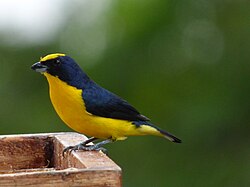
Starting around 1990, DNA sequencing of mitochondrial and nuclear genes revolutionized finch taxonomy. These studies revealed that some birds previously thought to be tanagers, such as the Neotropical Euphonia and Chlorophonia, were actually closely related to finches. Consequently, they were moved into the subfamily Euphoniinae.
Similarly, Hawaiian honeycreepers, once placed in their own family (Drepanididae), were found to be related to rosefinches and are now part of the Carduelinae subfamily. Other major changes included splitting the polyphyletic genera Carpodacus, Carduelis, and Serinus into more accurate, monophyletic groups to better reflect their evolutionary history.
Current Subfamily Classification
- Fringillinae: Contains a single genus consisting of the chaffinches.
- Carduelinae: The largest group, containing 183 species across 49 genera, including the Hawaiian honeycreepers.
- Euphoniinae: Includes the genera Euphonia and Chlorophonia.
Physical Characteristics and Distribution
Finches exhibit a wide range of sizes. The Andean siskin (Spinus spinescens) is among the smallest, measuring as little as 9.5 cm, while the collared grosbeak (Mycerobas affinis) can reach up to 24 cm. Weight varies similarly, from the 8 g lesser goldfinch to the 86.1 g evening grosbeak.
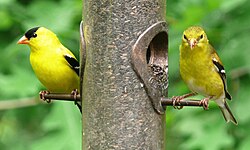
Their plumage is typically brownish or greenish, often accented with black. Many species display bright yellow and red colors derived from carotenoid pigments. Because these pigments can mask blue structural colors, true blue is rare in this family. Many species also exhibit sexual dichromatism, where males possess brighter colors than females.
Habitat and Range
While most finches prefer well-wooded areas, they are highly adaptable and can be found in mountainous regions and deserts. They are native to the Americas, Eurasia, and Africa. Although not native to Australia or New Zealand, several European species have been introduced to those regions.
Behavior and Ecology
Most true finches are granivorous, though diet varies by subfamily. Euphoniines eat berries and arthropods, while Hawaiian honeycreepers evolved to consume nectar. Nestlings across the family typically incorporate small arthropods into their diet for protein.
Finches are known for a "bouncing" flight pattern, alternating between flapping and gliding. Many are prized as cagebirds due to their singing ability, most notably the domesticated canary (Serinus canaria domestica). Their nests are generally basket-shaped and constructed in trees or bushes.
Summary of Finch Diversity
| Subfamily | Key Genera/Groups | Notable Characteristics |
|---|---|---|
| Fringillinae | Fringilla | Includes chaffinches and bramblings. |
| Carduelinae | Spinus, Carduelis, Loxioides | Largest group; includes goldfinches and Hawaiian honeycreepers. |
| Euphoniinae | Euphonia, Chlorophonia | Formerly classified as tanagers; eat berries and arthropods. |
Frequently Asked Questions
What is the difference between a true finch and other "finches"?
True finches belong to the family Fringillidae. Other birds called finches, such as the estrildid finches (Estrildidae) or Darwin's finches (Thraupidae), belong to different biological families despite sharing similar appearances.
Why were canaries used in coal mines?
Canaries and other finches were used to detect carbon monoxide because they are more sensitive to the gas than humans, providing an early warning system for miners.
How did Hawaiian honeycreepers evolve?
Hawaiian honeycreepers are an example of adaptive radiation, where a single ancestral species evolved into a wide variety of forms with different bill shapes and sizes to exploit various food sources on the islands.
Are all finches seed-eaters?
While most are primarily granivorous, some species have evolved different diets. For example, some euphoniines eat berries and insects, and some Hawaiian honeycreepers specialize in nectar.
Where are true finches not found naturally?
True finches are native to most of the world except for the polar regions and Australasia (though some have been introduced to Australia and New Zealand by humans).