Fertile Crescent: The Cradle of Human Civilization
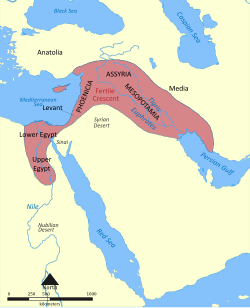
The Fertile Crescent is a crescent-shaped region in the Middle East that serves as one of the most significant landscapes in human history. Spanning modern-day Iraq, Israel, Jordan, Lebanon, Palestine, and Syria, it also encompasses northern Kuwait, south-eastern Turkey, and western Iran. Some scholars extend its boundaries to include Cyprus and northern Egypt.
This region is widely recognized as the birthplace of settled farming. Here, early humans began the process of clearing and modifying natural vegetation to cultivate domesticated plants, a transition that paved the way for the rise of the world's first complex societies.
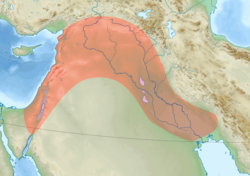
Key Facts
- Location: Spans the Middle East, primarily Iraq, Syria, Jordan, Israel, Palestine, Lebanon, Turkey, and Iran.
- Significance: Believed to be the first region where settled agriculture emerged.
- Major Innovations: Early development of writing, the wheel, glass, and irrigation.
- Key Sites: Includes Göbekli Tepe, Jericho, and the cities of Sumer.
- Nickname: Often referred to as the "Cradle of Civilization."
Terminology and Geography
The term "Fertile Crescent" was popularized by archaeologist James Henry Breasted in his works Outlines of European History (1914) and Ancient Times, A History of the Early World (1916).
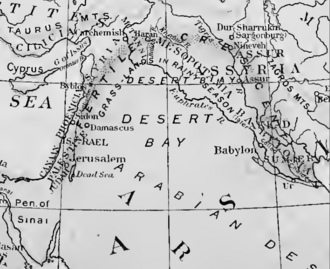
Geographically, the region is a diverse zone characterized by high, snow-covered mountains. This diversity is the result of tectonic activity, specifically the divergence between the African and Arabian plates and the convergence of the Arabian and Eurasian plates.
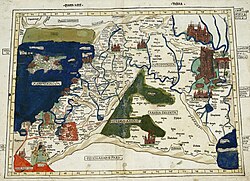
The Dawn of Agriculture and Settlement
The Fertile Crescent is most famous for its role in the origins of agriculture. While the region hosted early humans throughout the Pleistocene, it was the Epipalaeolithic semi-sedentary hunter-gatherers, known as the Natufians, who preceded the first farmers.
Around 9,000 BCE, the western zone near the Jordan and upper Euphrates rivers saw the rise of the first known Neolithic farming settlements. This period is referred to as Pre-Pottery Neolithic A (PPNA). Notable sites from this era include Jericho (Tell es-Sultan), Chogha Golan, and Göbekli Tepe in modern-day Turkey, the latter dating back to circa 9,000 BCE.
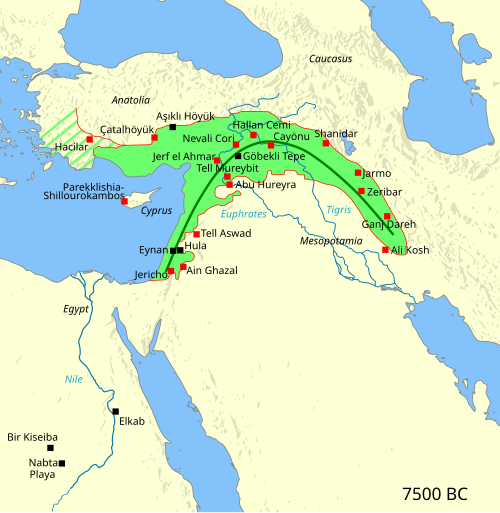
Early Domestications
Evidence suggests that the transition to farming happened in stages. Seedless figs discovered at Gilgal I in the Jordan Valley indicate that fig trees were being planted as early as 11,400 years ago. By 9,000 years ago, cereals were being grown in Syria. In addition to crops, the region saw the domestication of legumes—such as peas, lentils, and chickpeas—as well as small cats (Felis silvestris).
The Rise of Complex Societies
The eastern portion of the Fertile Crescent contains Mesopotamia (Greek for "between rivers"), the land between the Tigris and Euphrates rivers. This area became the heart of early complex societies during the Bronze Age.
The region witnessed the rise and fall of powerful empires, including Sumer, Akkad, Assyria, and Babylonia. These civilizations introduced groundbreaking technological advances, including irrigation, the wheel, and the first systems of writing. Furthermore, the world's first libraries appeared approximately 4,500 years ago, with the oldest known examples found in Nippur (Sumer) and Ebla (Syria) around 2500 BCE.
Population Diffusion and Genetics
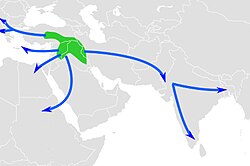
Research into craniofacial measurements suggests that the pre-Neolithic, Neolithic, and Bronze Age populations of the Fertile Crescent were relatively diverse. This diverse population eventually migrated away from the Near East, spreading agricultural practices westward into Europe and North Africa, northward to Crimea, and northeastward to Mongolia.
Genetic studies indicate that most modern Europeans descend from at least three ancient populations, one of which is the Early European Farmers. These migrants, who were genetically close to present-day Near Easterners, interbred with local hunter-gatherers while establishing farming across the continent. The strongest genetic ties to the original inhabitants of the Fertile Crescent are found in Southern Europeans.
Linguistic Diversity
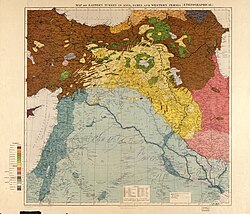
By the third and second millennia BCE, the region was a mosaic of different language groups:
- Sumerian: A non-Semitic language isolate.
- Elamite and Hattic: Other non-Semitic language isolates.
- Indo-European: Languages such as Hittite and Luwian; while once thought to be later arrivals (after 2000 BCE), some evidence suggests they may have emerged from the region as early as 6000 BCE.
- Egyptian: A distinct branch of the Afroasiatic languages.
- Hurro-Urartian: A small language family that may include the Kassite language.
- Proto-Euphratean: A hypothetical non-Semitic substratum language.
Summary of the Fertile Crescent
| Category | Key Details |
|---|---|
| Primary Geography | Iraq, Syria, Jordan, Israel, Palestine, Lebanon, Turkey, Iran |
| Key Time Period | Pre-Pottery Neolithic A (c. 9,000 BCE) through the Bronze Age |
| First Domesticates | Figs, cereals, peas, lentils, chickpeas, and small cats |
| Major Civilizations | Sumer, Akkad, Assyria, Babylonia |
| Technological Firsts | Writing, the wheel, glass, irrigation, and libraries |
Frequently Asked Questions
Why is the Fertile Crescent called the "Cradle of Civilization"?
It is given this nickname because it is the region where the first settled farming emerged, leading to the development of the first complex societies, cities, and early state-level hierarchies.
Which plants were first domesticated in this region?
The earliest domestications included seedless figs (around 11,400 years ago), followed by cereals (around 9,000 years ago) and legumes such as chickpeas, lentils, and peas.
What is the difference between the Fertile Crescent and Mesopotamia?
The Fertile Crescent is the broader crescent-shaped region encompassing several modern countries. Mesopotamia is a specific area within the eastern part of the Fertile Crescent, located specifically between the Tigris and Euphrates rivers.
How did the Fertile Crescent influence modern Europe?
Early migrants from the region carried agricultural practices into Europe and North Africa. Genetic research shows that "Early European Farmers" descended from these Near Eastern migrants, contributing significantly to the ancestral makeup of modern Europeans, particularly in the south.
What were some of the earliest technological inventions from this area?
The region, particularly Mesopotamia, is credited with the early development of writing, the wheel, glass, and advanced irrigation systems.