Aramaic: The History and Evolution of a Semitic Powerhouse
Aramaic is one of the oldest continually spoken languages in the world, originating in ancient Syria at the end of the Late Bronze Age (approximately 1500–1200 BC). As a member of the Afro-Asiatic family—specifically the Northwest Semitic branch—it evolved from a regional tongue into a global lingua franca (a common language used for communication between people of different native tongues) across the Fertile Crescent, Mesopotamia, and beyond.
From its early roots among the Arameans to its role as the administrative backbone of the Persian Empire, Aramaic has shaped the religious and political landscape of the Near East for millennia.

Key Facts
- Family: Afro-Asiatic > Semitic > West Semitic > Central Semitic > Northwest Semitic.
- Core Regions: Levant, Mesopotamia, Sinai, Southeastern Anatolia, and Eastern Arabia.
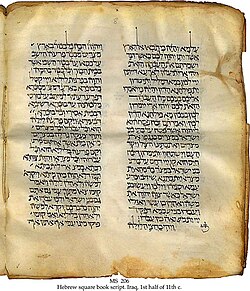
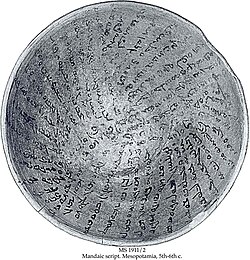
- Writing Systems: Historically used the Phoenician and Aramaic alphabets; later evolved into Syriac, Mandaic, and Hebrew scripts.
- Historical Peak: Served as the official administrative language of the Achaemenid (Persian) Empire.
- Religious Significance: Used in the Bible, the Talmud, and as the language of Jesus.
The Chronology of Aramaic
Scholars have proposed various periodizations to categorize the evolution of the language. While dates vary slightly between experts like Klaus Beyer, Joseph Fitzmyer, and Aaron Butts, the general progression follows a path from Old to Modern forms.
Old and Imperial Aramaic
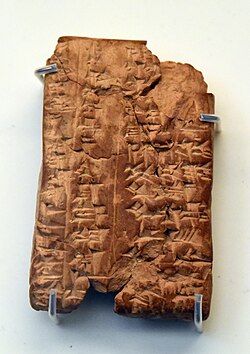
Old Aramaic encompasses the earliest records of the language. By approximately 700 BC, it gained regional prominence, eventually becoming Imperial Aramaic. During the Achaemenid period (c. 538–333 BC), it was adopted as the official language of the Persian Empire, allowing for efficient administration across vast, multi-ethnic territories.
![The Carpentras Stele was the first ancient inscription ever identified as "Aramaic". Although it was first published in 1704, it was not identified as Aramaic until 1821, when Ulrich Friedrich Kopp complained that previous scholars had left everything "to the Phoenicians and nothing to the Arameans, as if they could not have written at all".[26][27]](/images/03/5d/035d66c1f1927570ee2912f0a8cb0a929f5be26438fead0c66fd0434348df0b7.jpg)
Middle and Late Aramaic
Following the Persian era, Aramaic branched into various regional dialects. This period saw the rise of Biblical Aramaic and the development of distinct Eastern and Western dialects. Middle Aramaic (roughly 200 BC to 200 AD) is particularly notable as the linguistic environment during the lifetime of Jesus, who spoke phrases such as "Talitha kumi" and "Eloi, Eloi, lama sabachthani?"
Modern and Neo-Aramaic
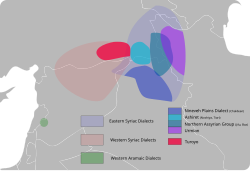
From approximately 1200 AD to the present, the language has existed as Neo-Aramaic. While its use has declined in favor of Arabic and other languages, it persists in various communities across the Near East, particularly in religious contexts and small linguistic pockets.
Dialects and Writing Systems

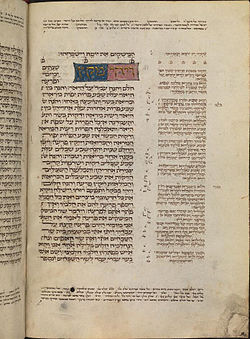
Aramaic is not a single monolithic language but a collection of dialects. These are broadly split into Eastern and Western groups.
Eastern Dialects
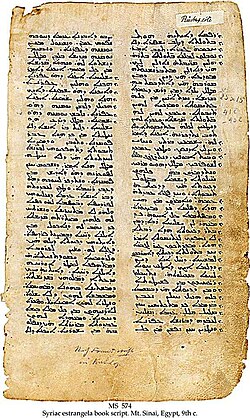
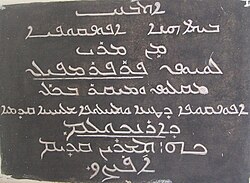
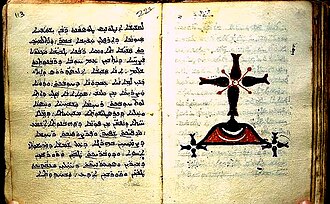
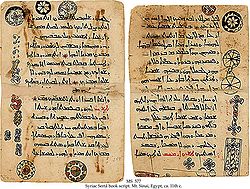
- Syriac: A major Christian dialect with its own alphabet, used extensively in liturgy and scholarship.
- Jewish Babylonian Aramaic: The language of the Babylonian Talmud.
- Mandaic: Used by the Mandaean community.
Western Dialects
- Samaritan Aramaic: Used by the Samaritan community.
- Palmyrene: An extinct dialect from the city of Palmyra.
- Nabataean: Used by the Nabataeans in the Levant.
![One of the Bar-Rakib inscriptions from Sam'al.[85] The inscription is in the Samalian language (also considered a dialect).](/images/15/fa/15fa0068823fd7c70d2ece9e3b2bb2bb7bd2cb31ed72bf07913823bab980160f.jpg)
Linguistic Structure
Phonology
Aramaic phonology is characterized by three basic vowel sets: open a, close front i, and close back u. Its consonant system includes a variety of fricatives and pharyngealized sounds (such as Ṣāḏê and Ṭêṯ) typical of Semitic languages.
Grammar and Verbs
The language utilizes a complex system of verbal stems to alter meaning. The most common include the Pə‘al (basic active), Pa‘‘ēl (intensive), and Hap̄‘ēl (causative). Nouns and adjectives are declined based on state (absolute vs. construct) and gender.

Aramaic in History and Religion

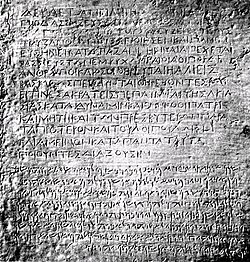
Aramaic's influence extends far beyond linguistics. It appears in the Targums (Aramaic translations/interpretations of the Hebrew Bible) and was used in the Kandahar Bilingual Rock Inscription by the Indian king Ashoka in the 3rd century BC.
| Period | Approximate Timeline | Key Characteristic |
|---|---|---|
| Old Aramaic | Earliest records to c. 700 BC | Early tribal and regional development. |
| Imperial Aramaic | c. 700 BC to c. 333 BC | Official language of the Persian Empire. |
| Middle Aramaic | c. 333 BC to c. 200 AD | Diversification into regional dialects. |
| Late Aramaic | c. 200 AD to c. 1200 AD | Rise of Syriac and Jewish Babylonian Aramaic. |
| Neo-Aramaic | c. 1200 AD to Present | Modern spoken dialects and liturgical use. |
Frequently Asked Questions
Was Aramaic the language spoken by Jesus?
Yes, Aramaic was the primary spoken language in the region of Judea and Galilee during the 1st century AD. Several Aramaic phrases are preserved in the New Testament Gospels.
What is the difference between Aramaic and Syriac?
Syriac is a specific dialect of Aramaic that became the primary literary and liturgical language for many Eastern Christian churches.
Is Aramaic still spoken today?
Yes, though it is endangered. Various Neo-Aramaic dialects are still spoken by small communities in the Near East, including parts of Iraq, Syria, and Turkey.
How does Aramaic relate to Hebrew?
Both are Northwest Semitic languages. They are closely related, sharing similar grammar and vocabulary, and have historically influenced one another, particularly in Jewish religious texts.
What was Imperial Aramaic?
Imperial Aramaic was a standardized version of the language used as the administrative tongue of the Achaemenid Empire to facilitate communication across its diverse territories.