The Evolution and Global Reach of the English Language
English is more than just a means of communication; it is a global phenomenon. As a West Germanic language within the Indo-European family, English has evolved from a regional dialect into a primary tool for international diplomacy, science, and commerce. With approximately 380 million native speakers (L1) and an estimated 1.077 billion second-language speakers (L2), the total number of English speakers worldwide reached roughly 1.457 billion by 2021.
| Feature | Detail |
|---|---|
| Language Family | Indo-European → Germanic → West Germanic → Anglic |
| Total Speakers | 1.457 Billion (2021) |
| Official Status | Official in 57 countries and 30 dependent territories |
| Writing System | Latin alphabet (historically Anglo-Saxon runes) |
| Primary Vocabulary Sources | French (28.3%), Latin (28.2%), Germanic (25.0%) |
The History and Evolution of English
The journey of English is marked by distinct stages of development, each influenced by migration, conquest, and cultural exchange. It began as Proto-English before evolving into Old English, the earliest form of the language.
Old English was heavily influenced by the arrival of Germanic tribes and later by Old Norse, the language of Viking settlers. This era produced some of the most famous early works of English literature, characterized by a structure and vocabulary very different from what we use today.
![Manuscript (written in uncial script) of Beowulf, an epic poem composed in Old English between 975 and 1025.The poem begins: Hƿæt ƿē Gārde / na ingēar dagum þēod cyninga / þrym ge frunon ...[Listen! We have heard of the glory in bygone days of the folk-kings of the spear-Danes ...][24]](/images/f6/2b/f62b464b24b09f250a43c4f66742f7db1167eb98ad904b298e44a31f8bd597f4.jpg)
From Middle English to the Modern Era
Following the Norman Conquest, the language transitioned into Middle English, which saw a massive influx of French and Latin terms. This was followed by Early Modern English, a period of significant phonetic change. One of the most critical shifts was the Great Vowel Shift, a series of changes in the pronunciation of long vowels that fundamentally altered the sound of the language.
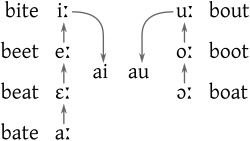
The spread of Modern English was further accelerated by colonial expansion and the rise of global trade, leading to the pluricentric nature of the language—meaning it now has multiple interacting standard forms across the globe.
Global Distribution and Official Status
English serves as an official language in 57 countries and 30 dependent territories. Beyond national borders, it is the primary working language for major international organizations, including the United Nations (UN), the European Union (EU), NATO, the IMF, and the WTO.
![Majority native language Co-official and majority native language Official but minority native language Secondary language: spoken as a second language by more than 20 per cent of the population, de facto working language of government, language of instruction in education, etc.[3]](/images/80/13/80137040c56ceace1b3d9936a4b3a356a0234efaffdf892a91b79348d244ec85.png)
The distribution of English is often analyzed through the "Three Circles" model, which distinguishes between native-speaking regions, regions where it is an official second language, and regions where it is learned as a foreign language. Proficiency levels vary significantly by region, as seen in data from the English Proficiency Index.
![EF English Proficiency Index 2019 in Europe:[69] Very high (63.07–70.27) High (58.26–61.86) Moderate (52.50–57.38) Low (48.69–52.39) Very low (40.87–48.19) Not included in report](/images/9e/20/9e20a9359708c64d05c08673262310365013680ce10142286c1ce2a764bec880.png)
In many parts of the world, English is integrated into public education systems, appearing as either a mandatory or optional subject depending on the region's linguistic needs.
![Status of English in public education by region[114] Mandatory subject Optional subject No data](/images/45/68/456805d214cd631f0d145c2b83679969139af2840a70561f48ed236319a05480.png)
Recent data continues to track these proficiency trends, highlighting the varying levels of fluency across different continents.
![2014 English Proficiency Index[115] Very high (80–100 per cent) High (60–80 per cent) Moderate (40–60 per cent) Low (20–40 per cent) Very low (0.1–20 per cent) No data](/images/da/99/da99a71948d017e2e26a08c5968f2f730417e2acacb2942ebdd46776b7fd8b09.webp)
Dialects, Accents, and Regional Variation
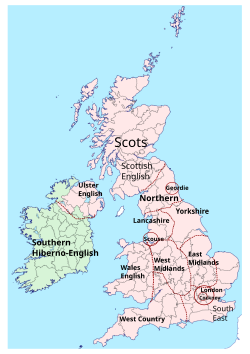
Because English is spoken across so many diverse geographies, it has branched into numerous dialects. These are generally categorized into major regional groups: British, North American, Caribbean, Australian, New Zealand, South African, and Hiberno-English (English spoken in Ireland).
British and Irish Variations
In the United Kingdom and Ireland, dialects vary significantly by region, influenced by local history and neighboring languages.
North American Variations
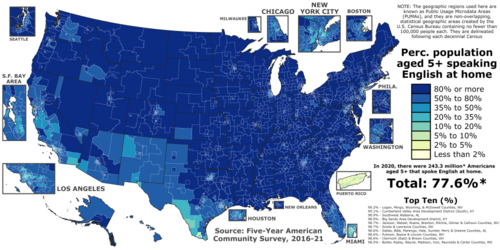
In the United States and Canada, English usage is widespread, though the percentage of people speaking it at home varies by state and territory.
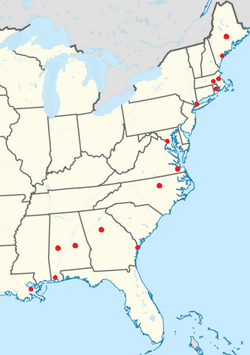
One of the most defining features of North American English is rhoticity—the tendency to pronounce the "r" sound at the end of syllables. While rhoticity dominates the region, non-rhoticity (where the "r" is dropped) is still found in certain metropolitan areas and is a key feature of African American Vernacular English (AAVE).
The Mechanics of the Language
Phonology and Sound
English phonology (the system of contrastive sounds) differs between major standards, such as Received Pronunciation (RP) in the UK and General American (GA) in the US. These differences are evident in vowel sounds and specific mergers, such as the "cot-caught merger" or the "father-bother merger," where two previously distinct vowel sounds become identical.
Grammar and Syntax
English follows a basic SVO (Subject-Verb-Object) constituent order. For example, in the sentence "The dog bites the man," the dog is the subject, bites is the verb, and the man is the object.

The language utilizes seven word classes, including nouns, verbs, and adjectives. Nouns typically form plurals by adding "-s" (regular), though irregular forms like "men" or "mice" persist. Verbs are categorized as either regular or strong (irregular) based on how they form the preterite (past tense).
Vocabulary and Word Origins
The English lexicon is a hybrid, drawing from a wide array of sources. While its core is Germanic, a vast portion of its vocabulary comes from Romance languages and classical sources:
- French (including Anglo-Norman): 28.3%
- Latin (including scientific terms): 28.2%
- Germanic (Old English, Old Norse, Dutch): 25.0%
- Greek: 5.32%
- Other sources: Including proper names and miscellaneous loans.
This openness to borrowing has not only shaped English but has also led to English loanwords appearing in other languages worldwide.