Daniel Jones: The Architect of Modern Phonetic Reference
How do we accurately describe the subtle differences in human speech? For linguists and language learners, the answer often lies in the work of Daniel Jones (1881–1967). A towering figure in British phonetics, Jones transformed the way we visualize and categorize vowel sounds, creating a standardized system that remains influential in classrooms and research labs worldwide.
The Life and Career of Daniel Jones
Born in London on September 12, 1881, Daniel Jones began his academic journey at the University of Cambridge, where he earned a BA in mathematics in 1903 and an MA in 1907. His foray into phonetics—the scientific study of speech sounds—began in 1900 at William Tilly's Marburg Language Institute in Germany.
Jones further refined his expertise in Paris under Paul Passy, a founder of the International Phonetic Association (IPA). This mentorship proved pivotal, as Jones later married Passy's niece, Cyrille Motte, and integrated Passy's theories into his own work. He also received private instruction from the renowned British phonetician Henry Sweet.
His professional life was centered at University College London (UCL), where he started as a part-time lecturer in 1907. By 1912, he became the head of the Department of Phonetics, eventually holding a chair in the department until his retirement in 1949. His leadership extended to the International Phonetic Association, where he served as assistant secretary, secretary, and eventually president from 1950 until his death in 1967.
Revolutionizing Vowel Description: The Cardinal Vowels
Before Daniel Jones, describing vowels was a complex and often inconsistent process. While predecessors like Alexander Melville Bell, Alexander John Ellis, and Henry Sweet had attempted to systematize vowel symbols, Jones developed a practical solution known as the cardinal vowel system.
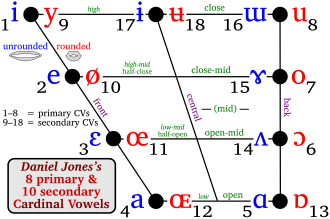
Cardinal vowels are a set of reference vowels used as a fixed coordinate system. Rather than describing a sound in isolation, linguists can describe a vowel by its relationship to these fixed points. Jones visualized this using a quadrilateral diagram—a map of the mouth's interior space.
This system relies on two primary parameters of articulation (the physical production of sound):
- Tongue Height: The vertical axis represents whether the tongue is "close" (high) or "open" (low).
- Tongue Position: The horizontal axis indicates whether the portion of the tongue being raised is toward the front or the back of the mouth.
Jones initially established eight "primary Cardinal Vowels," which he recorded on gramophone discs in 1917 to provide an auditory standard. He later expanded this to include eight "secondary Cardinal Vowels" with reversed lip shapes (front rounded and back unrounded), as well as symbols for central vowels.

From Articulation to Auditory Space
While Jones viewed the vowel quadrilateral as a strict map of physical articulation, modern linguists have evolved this perspective. Today, the diagram is largely seen as a representation of auditory space—a visual way to map how sounds are perceived by the ear rather than just how the tongue moves.
Despite this shift in theory, the International Phonetic Association continues to use a version of Jones's model in its official handbook and the International Phonetic Alphabet (IPA) leaflet, making it an indispensable tool for phoneticians globally.
Major Contributions to Linguistics
Beyond the cardinal vowel system, Daniel Jones left a permanent mark on the study of language through several landmark achievements:
- The English Pronouncing Dictionary: First published in 1917, this seminal work provided a standardized guide to pronunciation and remains in print in revised editions.
- Received Pronunciation (RP): In his 1918 work, An Outline of English Phonetics, Jones provided the first comprehensive description of the standard pronunciation of any language, known as Received Pronunciation.
- The Concept of the Phoneme: In 1917, Jones became the first Western linguist to use the term phoneme—the smallest unit of sound that can distinguish one word from another—in its modern sense.
- Global Phonetics: Jones applied his expertise to various languages, producing masterly treatments of Cantonese, Russian, Sinhalese, and Tswana (Sechuana). In his Sechuana Reader, he provided a sophisticated description of an African tone language and introduced the concept of downstep (a lowering of the pitch baseline).
Legacy and Influence
Daniel Jones was more than a researcher; he was a mentor to a generation of linguists, including A. C. Gimson, Harold Palmer, and Ida C. Ward. His department at UCL served as a global hub for phonetic research for several decades.
Interestingly, some scholars suggest that Jones, rather than Henry Sweet, was the real-life inspiration for Professor Henry Higgins, the phonetic expert in George Bernard Shaw's play Pygmalion.
Jones remained dedicated to his publications until his death on December 4, 1967, in Gerrards Cross, Buckinghamshire. His extensive archives, including research materials and lecture notes, are preserved at University College London.
Summary of Daniel Jones's Profile
| Category | Details |
|---|---|
| Lifespan | 12 September 1881 – 4 December 1967 |
| Primary Role | Phonetician |
| Key Institution | University College London (UCL) |
| Major Invention | Cardinal Vowel Diagram |
| Notable Publication | English Pronouncing Dictionary |
| IPA Roles | Assistant Secretary, Secretary, and President |
| Education | University of Cambridge; studied under Paul Passy (Paris) |