European Solidarity: The Political Evolution of Petro Poroshenko's Party
The trajectory of European Solidarity reflects the volatile nature of Ukrainian politics over the last two decades. From its origins as a small parliamentary faction to becoming a dominant force during the presidency of Petro Poroshenko, the party has undergone numerous name changes, mergers, and strategic shifts to maintain its influence in the Verkhovna Rada (the Ukrainian parliament).
The Early Years: Solidarity (2000–2013)
The party's roots trace back to 2000, when Petro Poroshenko established a parliamentary faction called "Solidarity." This move was allegedly supported by then-President Kuchma to curb the influence of the Social Democratic Party of Ukraine (united). The faction grew as deputies from the Peasant Party of Ukraine and Hromada joined the fold, eventually leading to the creation of the Party of Ukraine's Solidarity.
The party's early history was marked by strategic alliances. In 2000, it merged into the Party of Regions, which later became the largest party in Ukraine. However, by 2001, Poroshenko sought to join the Our Ukraine Bloc. Because the original Party of Ukraine's Solidarity could not break away from the Party of Regions, Poroshenko created a "phantom party" also named "Solidarity" to facilitate this entry.
During the 2002 parliamentary elections, Solidarity successfully joined Our Ukraine. Key members who secured mandates via the party list included Volodymyr Plyutynsky, Volodymyr Makeyenko, Eduard Matviychuk, and Anatoliy Korchynsky, while Poroshenko won a single constituency seat in Vinnytsia Oblast.
Following 2002, the party ceased participating in elections. By 2004, it left Our Ukraine but maintained 23 deputies in the Verkhovna Rada. After a period of inactivity, the Ministry of Justice questioned the party's status in 2013. Despite a brief leadership change in June 2013, when Yuriy Stets took over, the party was legally eliminated on December 31, 2013, due to a lack of reporting and a decade of electoral absence.
The Rise of the Petro Poroshenko Bloc (2014–2019)
In early 2014, Poroshenko effectively revived the "Solidarity" brand by taking leadership of the National Alliance of freedom and Ukrainian patriotism "OFFENSIVE," renaming it the "All-Ukrainian Union Solidarity." This entity had a complex history, having previously been registered in 2000 as the All-Ukrainian Party of Peace and Unity (HPEM) and failing in several previous election cycles.
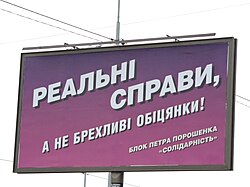
Following Poroshenko's election as President of Ukraine in 2014, the party underwent a major rebranding. On August 27, 2014, it became the Bloc of Petro Poroshenko, with former Minister of Internal Affairs Yuriy Lutsenko appointed as leader.
To strengthen its infrastructure, the Bloc entered a strategic agreement with Vitali Klitschko's Ukrainian Democratic Alliance for Reform (UDAR). This partnership allowed the Poroshenko Bloc to utilize UDAR's extensive organizational networks. In the October 2014 parliamentary elections, the Bloc won 132 seats, becoming the largest party in parliament, though the People's Front narrowly beat them in the nationwide party vote (22.14% vs 21.81%).
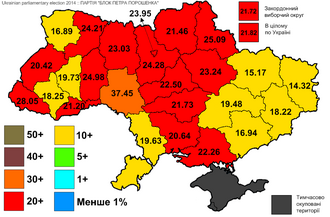
The party's influence grew through further consolidation. In August 2015, UDAR and the Petro Poroshenko Bloc officially merged, with Vitali Klitschko becoming the party leader. The party performed strongly in the 2015 local elections, particularly in West and Central Ukraine and the Kherson Oblast. However, internal composition shifted; by 2016, research indicated that 22% of the party's regional council representatives and 12% of its MPs were former members of the Party of Regions.
Klitschko eventually resigned as chairman on May 26, 2016, due to a law prohibiting the head of the Kyiv City State Administration from leading a political party. By May 2019, UDAR announced it would once again run as an autonomous entity.
Transition to European Solidarity (2019–Present)
On May 24, 2019, the party rebranded as European Solidarity. Petro Poroshenko stated this change was necessary to introduce new leadership and prepare for the 2019 parliamentary elections.
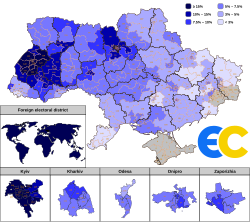
The 2019 elections saw a significant decline in the party's popularity. European Solidarity received 8.10% of the vote, securing 23 MPs via the party list and two constituency seats. The party subsequently voted against the confidence motion for the new Honcharuk Government.
The party saw a recovery during the 2020 local elections. Under the leadership of Oleksandr Turchynov, who headed the election headquarters, the party improved its results across all Ukrainian oblasts, particularly in the west and center. European Solidarity secured approximately 10.73% of available local council seats, with 3,543 representatives winning positions.
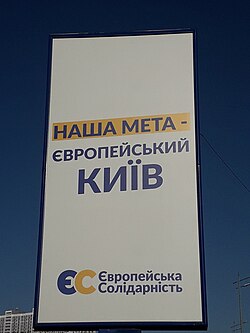
Key Facts
- Founder: Petro Poroshenko.
- Evolution: Transitioned from Solidarity → Bloc of Petro Poroshenko → European Solidarity.
- Peak Power: Won 132 seats in the 2014 parliamentary elections.
- Strategic Mergers: Formed a significant alliance and eventual merger with Vitali Klitschko's UDAR party.
- 2019 Performance: Dropped to 8.10% of the vote in the parliamentary elections.
- 2020 Local Success: Won 3,543 local council seats (10.73% of total seats).
| Period/Year | Party Name | Key Event/Result |
|---|---|---|
| 2000–2013 | Solidarity | Founded; joined Our Ukraine Bloc; legally dissolved Dec 2013. |
| 2014 | Bloc of Petro Poroshenko | Won 132 seats in parliamentary elections. |
| 2015 | Petro Poroshenko Bloc | Official merger with UDAR party. |
| 2019 | European Solidarity | Rebranded; won 25 total seats (8.10% vote). |
| 2020 | European Solidarity | Won 3,543 seats in local council elections. |
Frequently Asked Questions
Why was the original Solidarity party dissolved in 2013?
The party was legally eliminated on December 31, 2013, because it had failed to participate in any elections for over 10 years and suffered from a lack of required reporting.
How did the Petro Poroshenko Bloc gain so many seats in 2014?
While the People's Front won a slightly higher percentage of the nationwide party vote, the Petro Poroshenko Bloc won a dominant 69 constituency seats, resulting in a total of 132 seats.
What was the purpose of the merger with UDAR?
The merger allowed the Poroshenko Bloc to utilize the large-scale organizational structures of UDAR, which the Bloc lacked at the time.
Why did Vitali Klitschko resign as party chairman in 2016?
He resigned because a new law took effect on May 1, 2016, which barred the head of the Kyiv City State Administration from serving as a member or chairman of a political party.
How did European Solidarity perform in the 2020 local elections?
The party performed well in West and Central Ukraine, significantly improving its 2019 results and winning approximately 10.73% of all available local council seats.