Opposition Bloc: The Rise and Fragmentation of a Ukrainian Political Force
The Opposition Bloc emerged as a significant political entity in Ukraine during a period of intense national transition. Born from the remnants of previous political structures and shaped by strategic rebranding, the party sought to consolidate those opposed to the government following the events of 2014. Its trajectory reflects the complex interplay of individual ambitions, regional loyalties, and the influence of powerful political advisors.
Origins and the Role of Paul Manafort
The roots of the party trace back to the "Leading Force," which was registered with the Ukrainian Ministry of Justice on April 23, 2010, under the leadership of Anatoly Kornienko. However, this entity remained largely dormant, skipping the 2012 parliamentary elections.
The true catalyst for the Opposition Bloc occurred in September 2014. American lobbyist Paul Manafort was hired as an advisor to Serhiy Lyovochkin, the former head of the Presidential Administration under Viktor Yanukovych. While Manafort was initially tasked with rebranding the Party of Regions, he instead proposed the creation of a new party: the Opposition Bloc. According to political analyst Mikhail Pogrebinsky, Manafort's strategy was to create a broad symbol of opposition that avoided concrete specifics to attract the widest possible base of dissenters.
The 2014 Parliamentary Elections
The formation of the Opposition Bloc was marked by internal friction. Initially, the Party of Regions—the largest party from the 2012 elections—was intended to be a core part of the alliance under the leadership of Serhiy Tihipko. Tihipko refused, citing the presence of individuals he viewed as unpatriotic or tainted by corruption, leading him to revive "Strong Ukraine" instead.
By September 14, 2014, the Party of Regions officially declined to participate in the elections, claiming a lack of legitimacy because residents of the Donbas region were unable to vote. Simultaneously, a forum in Kyiv titled "Peace. Stability. Revival" resulted in several parties—including the Party of Development of Ukraine, Center All-Ukrainian Union, Ukraine – Forward!, Labour Ukraine, New Politics, and State Neutrality—agreeing to run as the Opposition Bloc.
Although Yuriy Boyko argued that the Bloc consisted of individual politicians rather than a coalition of parties, many candidates were former members of the Party of Regions. Key figures included Natalia Korolevska, Mykhailo Dobkin, and Vadim Rabinovich. Boyko, Dobkin, and Rabinovich had previously run in the presidential election, securing 0.19%, 3.03%, and 2.25% of the vote, respectively.
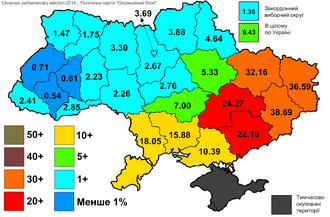
Election Results and Regional Strength
The party secured 29 seats in parliament, including two constituency seats. Its strength was heavily concentrated in the East and South of Ukraine. The party dominated in several regions:
- Kharkiv Oblast: Won all 14 constituencies.
- Luhansk Oblast: Won all 6 constituencies where voting was possible.
- Zaporizhzhia Oblast: Won 8 out of 9 constituencies.
- Dnipropetrovsk Oblast: Won 10 out of 17 constituencies.
- Donetsk Oblast: Won 6 out of 11 constituencies where voting was possible.
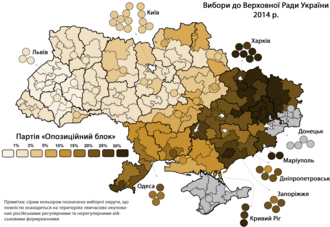
Following these results, a parliamentary faction of 40 people was established on November 27, 2014. The party continued its regional success in the 2015 local elections, gaining 11.5% nationwide and leading in most of South and East Ukraine, with the exception of Kharkiv Oblast.
The Shadow Cabinet
On March 31, 2015, the Opposition Bloc established a Shadow Cabinet. This project was designed to develop legislative bills that opposed the policies of the central government in Kyiv.
| Position | Appointee |
|---|---|
| Prime Minister | Borys Kolesnikov |
| VP for Regional Policy | Mykhailo Dobkin |
| VP for Industry & Donbass Reconstruction | Oleksandr Vilkul |
| VP for Law Enforcement Oversight | Vadim Rabinovich |
| Minister of Social Policy | Natalia Korolevska |
| Minister of Economic Development | Yevhen Murayev |
| Minister of Foreign Affairs | Kostyantyn Gryshchenko |
| Minister of Finance | Viktor Skarshevsky |
Internal Conflict and Fragmentation
By 2018, the party began to split along the lines of its primary financial and political backers. One wing was controlled by Serhiy Lyovochkin and Dmytro Firtash, while the other was controlled by Rinat Akhmetov.
In November 2018, Yuriy Boyko and Vadim Rabinovich (whose party was "For Life") formed an alliance called Opposition Platform — For Life. This move was contested by other leading members, such as Vadym Novynskyi and Borys Kolesnikov, who claimed the agreement was a personal initiative by Boyko. Consequently, Boyko and Lyovochkin were excluded from the Opposition Bloc faction on November 20, 2018, for allegedly betraying their voters.
The party's collapse accelerated in December 2018. After a court ruled that the party congress could not reorganize the party, the nomination of Oleksandr Vilkul for the presidency was declared invalid. To bypass this legal injunction, the Industrial Party of Ukraine (linked to Rinat Akhmetov via Zaporizhstal) was renamed Opposition Bloc — Party of Peace and Development. By the 2019 parliamentary elections, the original Opposition Bloc and its successor, the Party of Peace and Development, ran as independent entities.
Key Facts
- Founder/Advisor: Paul Manafort advised the creation of the party to stabilize Ukraine by gathering a broad opposition.
- 2014 Performance: Won 29 parliamentary seats with dominant support in Kharkiv, Luhansk, and Zaporizhzhia.
- Regional Base: Primary strength was located in the South and East of Ukraine.
- Fragmentation: Split in 2018/2019 into two main successor entities: Opposition Platform — For Life and Opposition Bloc — Party of Peace and Development.
- Shadow Government: Created a full shadow cabinet in 2015 to challenge Kyiv's policies.
Frequently Asked Questions
Who was the primary strategist behind the Opposition Bloc?
American lobbyist Paul Manafort was the key advisor who suggested creating the Opposition Bloc as a way to unify various political figures opposed to the current government without committing to a concrete platform.
Why did the Party of Regions not participate in the 2014 elections?
The Party of Regions deemed the elections illegitimate because residents of the Donbas region were unable to cast their votes.
What was the purpose of the Shadow Cabinet?
The Shadow Cabinet was established in March 2015 to develop alternative bills and policies in direct opposition to the government's actions in Kyiv.
How did the party split before the 2019 elections?
The party split due to internal conflicts between factions led by Serhiy Lyovochkin/Dmtro Firtash and Rinat Akhmetov, resulting in the creation of the Opposition Platform — For Life and the Opposition Bloc — Party of Peace and Development.
Which regions provided the strongest support for the party?
The party saw its highest support in the East and South, specifically winning all constituencies in Kharkiv and Luhansk (where voting was possible) and the majority in Zaporizhzhia and Dnipropetrovsk.