Petro PoroshenkoPresident of UkraineRoshenRevolution of DignityUkrainian politics

Petro Poroshenko: The Political Journey of Ukraine's 5th President

Petro Poroshenko: The Political Journey of Ukraine's 5th President Petro Poroshenko is a prominent Ukrainian businessman and politician who served as the 5th President of Ukraine from Jun...

Petro Poroshenko: The Political Journey of Ukraine's 5th President

Petro Poroshenko is a prominent Ukrainian businessman and politician who served as the 5th President of Ukraine from June 7, 2014, to May 20, 2019. Known in international circles as the "Chocolate King" due to his extensive confectionery empire, Poroshenko's career spans high-level diplomatic roles, legislative service, and a presidency defined by conflict and a pivot toward Western integration.

His rise to power occurred during one of the most turbulent periods in modern Ukrainian history, following the Revolution of Dignity—a wave of protests that led to the ousting of former President Viktor Yanukovych.
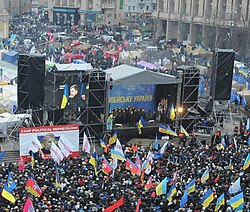
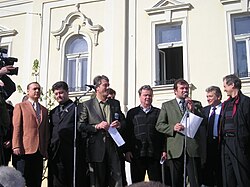
Poroshenko on stage speaking to Euromaidan protesters on 8 December 2013

Key Facts

Poroshenko and Viktor Yushchenko during the meeting before Mukacheve mayoral election on 16 April 2004
  • Presidency: Served as the 5th President of Ukraine (2014–2019).
  • Business: Founder of the Roshen group and owner of various agrarian and industrial assets.
  • Military: Served in the Soviet Army (1984–1986) and the Ukrainian Territorial Defense Forces (2022–present) with the rank of Major.
  • Education: Alumnus of Taras Shevchenko National University.
  • Political Party: Currently leads the European Solidarity party.

Early Life, Education, and Business Empire
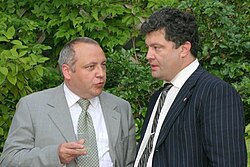
Poroshenko attending a U.S. Independence Day celebration at the U.S. Embassy in Kyiv, 6 July 2005

Born on September 26, 1965, in Bolgrad, Ukrainian SSR, Poroshenko pursued his higher education at Taras Shevchenko National University. Before entering the highest echelons of government, he built a massive business portfolio. He is most notably associated with the Roshen group, though his interests extended to television (5 Kanal), shipyards (Kuznia na Rybalskomu), and various agrarian holdings such as Zoria Podillia and MAS-Agro.

While his wealth earned him a place on various billionaires lists, his financial status fluctuated during his presidency. Reports indicate he lost his billionaire status during his term in office, partly due to the economic impact of the war.

Political Ascent and Ministerial Roles
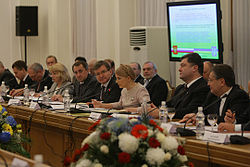
Poroshenko at the Russian-Ukrainian international commission meeting in 2009

Poroshenko's political career began long before his presidency. He served multiple terms as a People's Deputy of Ukraine, representing the Vinnytsia Oblast. His experience in governance was diversified through several key appointments:

  • Secretary of the National Security and Defense Council: Served from February to September 2005 under President Viktor Yushchenko.
  • Minister of Foreign Affairs: Held this post from October 2009 to March 2010.
  • Minister of Trade and Economic Development: Served from March to December 2012.
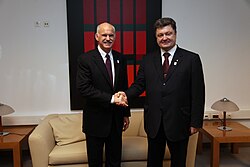
Minister for Foreign Affairs of Ukraine Petro Poroshenko in the Polish Senate with former Greek prime minister George Papandreou, December 2009

The Presidency (2014–2019)

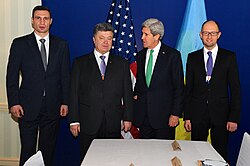
Ukrainian opposition leaders Vitali Klitschko, Poroshenko (second left) and Arsenii Yatseniuk (right) with United States Secretary of State John Kerry (second right) at the Munich Security Conference, 2014

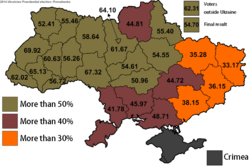
Following the 2014 Revolution of Dignity, Poroshenko ran for president and won with 54.7% of the vote. His presidency was characterized by the onset of the Russo-Ukrainian War and the annexation of Crimea.

Domestic Policy and Reform

Poroshenko focused on decommunization (the removal of Soviet-era symbols) and deoligarchization to reduce the influence of wealthy businessmen in politics. He also championed the "On provision of the functioning of the Ukrainian language as the State language" law to strengthen national identity.
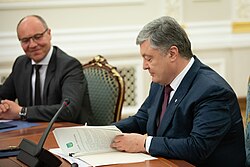
Poroshenko and Andrii Parubii signing the law "On provision of the functioning of the Ukrainian language as the State language"

In the realm of religion, he played a pivotal role in the unification council of the Orthodox Church of Ukraine in December 2018, aiming to establish an independent national church.
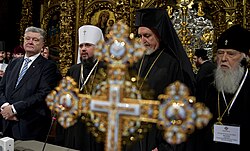
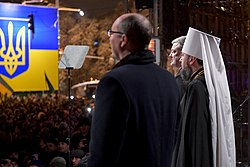
Inside the Saint Sophia Cathedral during the unification council. In order from left to right: Poroshenko, Epiphanius, Emmanuel and Filaret, 15 December 2018.

Foreign Policy and International Relations

A cornerstone of Poroshenko's presidency was the pursuit of closer ties with the European Union and NATO. He maintained strong diplomatic relations with U.S. Presidents Barack Obama and Donald Trump, as well as European leaders like Angela Merkel and Emmanuel Macron.
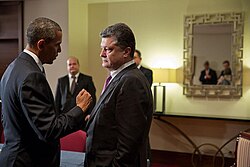
U.S. President Barack Obama meets with President-elect Poroshenko, 5 June 2014.

Despite efforts to negotiate peace in Eastern Ukraine, Poroshenko maintained that relations with Russia could not be normalized without the return of Crimea.
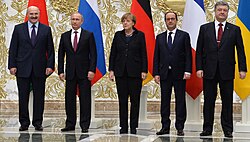
Poroshenko with German Chancellor Angela Merkel, French President François Hollande, Russian President Vladimir Putin and Belarusian President Alexander Lukashenko in Minsk, 11 February 2015

Post-Presidency and Later Years

2014 presidential election percentage of vote for Poroshenko

Poroshenko left office in May 2019 after losing the presidential election to Volodymyr Zelenskyy. Analysts attribute this loss to public fatigue with political elites, perceived failures in stemming corruption, and the inability to end the war in the east.

Since leaving the presidency, he has returned to parliament as a People's Deputy and continues to lead the European Solidarity party. He has also faced legal challenges, including criminal cases and scrutiny following the Panama and Paradise Papers leaks.

Following the full-scale Russian invasion of Ukraine in 2022, Poroshenko rejoined military service within the Territorial Defense Forces.

Summary of Political Career
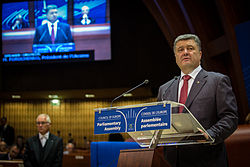
Poroshenko delivers a speech to the Council of Europe parliamentary assembly in Strasbourg, 26 June 2014.
Petro Poroshenko's Key Government Roles
Role Period Key Focus
Secretary of the NSDC 2005 National Security
Minister of Foreign Affairs 2009–2010 Diplomacy
Minister of Trade 2012 Economic Development
President of Ukraine 2014–2019 War, EU Integration, Reform
People's Deputy 1998–2007, 2012–2014, 2019–Present Legislative Governance

Frequently Asked Questions

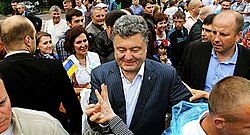
Poroshenko in Melitopol (2014)
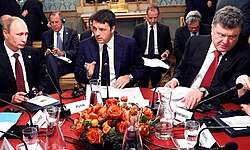
Poroshenko, Russian President Vladimir Putin and Italian Prime Minister Matteo Renzi, October 2014
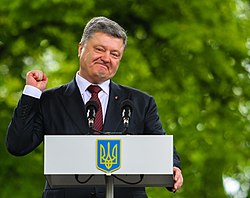
Poroshenko in Poltava (May 2016)
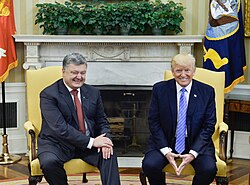
Poroshenko with U.S. President Donald Trump in Washington, D.C., 20 June 2017
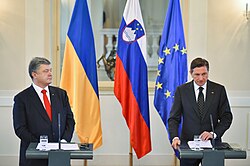
With the president of Slovenia Borut Pahor in Ljubljana, 8 November 2016
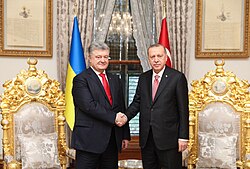
Poroshenko with Turkish President Recep Tayyip Erdoğan in Istanbul, 3 November 2018
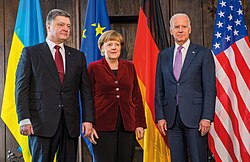
Poroshenko with Angela Merkel and Joe Biden, 7 February 2015
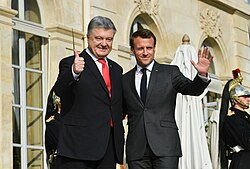
Poroshenko with French President Emmanuel Macron in Paris, 12 April 2019
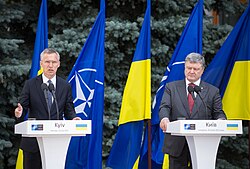
Poroshenko with NATO Secretary General Jens Stoltenberg in Kyiv, 10 July 2017
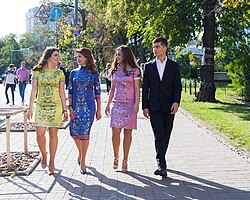
Maryna Poroshenko (in blue) with some of the couple's children on Ukraine's 27th Independence day, 24 August 2018
Poroshenko, Metropolitan Epiphanius and Andrii Parubii after the unification council of the Orthodox Church of Ukraine on 15 December 2018
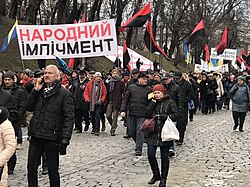
Mikheil Saakashvili-led protesters demand Poroshenko's impeachment, Kyiv, 3 December 2017.

Why was Petro Poroshenko called the "Chocolate King"?

He earned this nickname because of his ownership of the Roshen confectionery group, one of Ukraine's largest producers of sweets and chocolates.

What were the main goals of Poroshenko's presidency?

His primary goals included integrating Ukraine into the European Union and NATO, fighting corruption, implementing decommunization policies, and defending Ukrainian sovereignty against Russian aggression.

Did Poroshenko sell his businesses after becoming president?

During his campaign, Poroshenko expressed readiness to sell Roshen if elected. However, his financial status remained a point of public and legal debate throughout his term.

What is Poroshenko's current role in Ukraine?

He is currently a People's Deputy of Ukraine and the leader of the European Solidarity party, while also serving in the Territorial Defense Forces since 2022.

How did Poroshenko handle the issue of nuclear weapons?

During his presidency, Poroshenko stated that Ukraine had no ambitions to become a nuclear power again.

References

  1. Ukrainian: Петро Олексійович Порошенко, pronounced [peˈtrɔ olekˈs⁽ʲ⁾ijowɪtʃ poroˈʃɛnko]
  2. The status of the Crimea and of the city of Sevastopol is currently under dispute between Russia and Ukraine; Ukraine and the majority of the international community consider the Crimea to be an autonomous republic of Ukraine and Sevastopol to be one of Ukraine's cities with special status, while Russia, on the other hand, considers the Crimea to be a federal subject of Russia and Sevastopol to be one of Russia's three federal cities.[86][89]
  3. Hungarian Foreign Minister Péter Szijjártó said the law was "unacceptable" and part of an "anti-Hungarian policy" of Poroshenko.[137]
  4. The decree was not made publicly available "in accordance with the legislation on personal data protection".[226]
  5. "People's Deputy of Ukraine of the VII convocation". Official portal (in Ukrainian). Verkhovna Rada of Ukraine. Archived from the original on 13 January 2016. Retrieved 22 December 2014.