Error From Queen's Bench Act 1584 and the Court of Exchequer Chamber
The evolution of the English legal system is marked by the creation and dissolution of various specialized courts designed to ensure the accuracy of judicial decisions. One of the most significant developments in this process was the formalization of the Court of Exchequer Chamber, an appellate court dedicated to reviewing civil actions within the common law system.
While the court had its origins in the fourteenth century, it was the Error From Queen's Bench Act 1584 (27 Eliz. 1. c. 8) that established the court in its final form. This Act of Parliament was specifically designed for the redress of erroneous judgments within the court commonly known as the King's Bench.
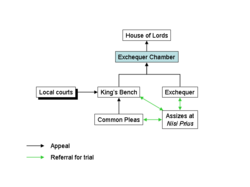
The Function and Structure of the Court
The Court of Exchequer Chamber served as a critical layer of oversight for the English judiciary. It primarily heard references from the King's Bench and the Court of Exchequer. Starting in 1830, it also began hearing cases directly from the Court of Common Pleas, rather than through indirect channels.
The court's composition was designed to ensure impartiality. It typically consisted of four judges drawn from the two courts that had not been involved in the case at first instance. However, for matters of exceptional legal importance, the court could expand its bench. In such instances, twelve common law judges—four from each of the three divisions below—would sit in the Exchequer Chamber to determine a specific point of law. Notably, these referrals were made by the court hearing the case, not by the parties involved.
Notable Legal Precedents
The Court of Exchequer Chamber handled several landmark cases that shaped English law and politics. Two prominent examples include the Case of Mines (1568) and R v Hampden (1637). The latter, known as the case of ship money, became a source of significant political controversy.
Key Facts
- Official Citation: 27 Eliz. 1. c. 8.
- Royal Assent: 14 September 1585.
- Commencement Date: 23 November 1584.
- Territorial Extent: England and Wales.
- Repeal Date: 28 July 1863, via the Statute Law Revision Act 1863.
- Successor: The Court of Appeal of England and Wales.
Summary of the Error From Queen's Bench Act 1584
| Feature | Details |
|---|---|
| Primary Purpose | Redress of erroneous judgments in the King's Bench |
| Court Established | Court of Exchequer Chamber (final form) |
| Jurisdiction | Appellate review of common law civil actions |
| Finality | Generally considered the definitive statement of law (prior to the 19th century) |
| End of Operation | Superseded by the Judicature Acts of 1873–1875 |
The Path to Modern Judiciary
For much of its history, a judgment from the Court of Exchequer Chamber was regarded as the final word on a legal matter. While appeals to the House of Lords were technically possible, such occurrences were rare until the nineteenth century.
The system eventually underwent a total transformation. The Court of Exchequer Chamber was superseded by the Court of Appeal of England and Wales following the reforms introduced by the Judicature Acts of 1873–1875, which streamlined the English court system into its modern structure.
Frequently Asked Questions
What was the primary purpose of the Error From Queen's Bench Act 1584?
The Act was passed by the Parliament of England to provide a mechanism for the redress of erroneous judgments specifically within the court known as the King's Bench.
Which courts provided references to the Court of Exchequer Chamber?
The court heard references from the King's Bench and the Court of Exchequer. From 1830 onwards, it also heard cases directly from the Court of Common Pleas.
How were the judges selected for the Court of Exchequer Chamber?
The court was typically composed of four judges from the two courts that were not involved in the original trial (first instance). In exceptional cases, twelve judges (four from each of the three lower divisions) would preside.
Was the Court of Exchequer Chamber the final authority on law?
Generally, yes. While the House of Lords could hear further appeals, this was rare before the nineteenth century, and the Exchequer Chamber's judgments were usually seen as definitive.
When and how was the Act of 1584 repealed?
The Act was repealed on 28 July 1863, by the Statute Law Revision Act 1863.