Exchequer in England and Wales
The Exchequer began as a central pillar of the Curia Regis (the King's court), serving as the heart of government administration and finance in medieval England. In its earliest form, there was no distinction between the monarch's personal wealth and public finances. While the Treasury was originally a simple strongbox kept in the king's chamber and later moved to Winchester Castle, the Exchequer emerged in the early 12th century as a dedicated financial office—essentially the royal court sitting specifically for financial purposes.
By the reign of Henry II in the mid-12th century, the Exchequer established its base at the Palace of Westminster, the monarch's primary London residence. This transition marked the beginning of a centuries-long evolution from a physical place of money storage to a complex system of auditing, taxation, and judicial oversight.
Key Facts
- Origins: First mentioned in a royal writ in 1110; likely influenced by the Exchequer of Normandy.
- Record Keeping: The Pipe Rolls, starting from 1130, provide a nearly continuous record of royal revenues.
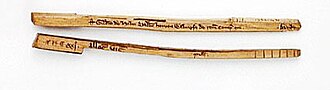
- The Tally System: Wooden sticks with notches were used as official receipts for payments until 1826.
- Financial Crisis: The "Great Stop of the Exchequer" in 1672 ruined goldsmith bankers and damaged Stuart credit.
- Modern Transition: The Exchequer ceased to be a distinct state department in 1866, eventually merging into the High Court of Justice.
The Early Exchequer: 12th and 13th Centuries
Foundations and the Pipe Rolls
The earliest written evidence of the Exchequer appears in 1110, addressed to the barones de scaccario (Barons of the Exchequer). A primary source of historical data is the Pipe Rolls, the oldest surviving of which dates to 1130. These rolls recorded royal revenues and taxation, though not every single levy was captured in these documents.
The Dialogus de Scaccario ("Dialogue concerning the Exchequer"), written in the late 1170s, suggests the system was adopted from the Exchequer of Normandy following the conquest of England, though it notes significant differences between the two systems.
The Lower and Upper Exchequer
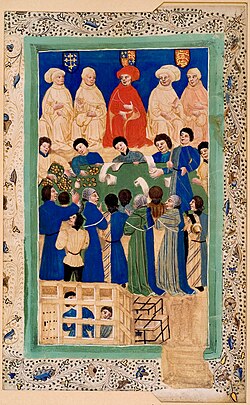
The institution operated in two distinct stages. The Lower Exchequer (Exchequer of Receipt) was where sheriffs paid in silver pennies. Tellers counted these coins into 5-pound batches, which were weighed against a Tower pound to ensure quality. Once verified, they were stored in double-locked strong boxes.
The Upper Exchequer was the administrative and judicial arm. Around 1234, the Barons of the Exchequer became permanent appointments. While initially revenue specialists, they began handling formal judicial business, with the earliest plea rolls dating to 1236.
![Part of the record of payments for the County of Lancaster in the Great Roll of the Pipe for the Sixth Year of King Richard I, Michaelmas 1194.[60]](/images/e3/ea/e3eac9699bdfb7d3071fca0620eeba762e59ffe94d3315aba9701a3600606adb.jpg)
The Tally System
To record payments, the Exchequer used tally sticks. A piece of wood was notched to represent the amount paid and then split lengthwise. The depositor kept the "stock," while the Exchequer kept the "foil." This served as a primitive but effective receipt system.

Evolution from the 14th to 17th Centuries
Tudor and Stuart Administration
By the 1490s, the Exchequer handled approximately 90% of the king's revenue. However, real-time financial reporting was non-existent; reports often took years to complete. It was not until 1823 that a full annual Balance-Sheet of Public Income and Expenditure was published.
During the Stuart period, the government created specialized boards to manage new revenue streams, including the Board of Customs (1671), Board of Excise (1683), and Board of Stamps (1694). These boards gradually diluted the judicial authority of the Barons of the Exchequer.
The Great Stop and the Bank of England
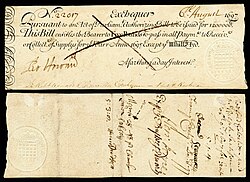
Between 1667 and 1672, the government issued "fiduciary Exchequer money orders" to raise funds. When the government could not meet its obligations, Charles II enacted the "Great Stop of the Exchequer" in 1672, forbidding payments. This event devastated the credit of the Stuart government and eventually led to the foundation of the Bank of England in 1694.
To recover credit, the National Land Bank Act 1696 allowed the issuance of Exchequer Bills—indented bills of credit that could be passed as currency. These remained a government revenue source until 1892.
Reform and Decline: 18th and 19th Centuries
Administrative Modernization
The 18th century saw a shift toward transparency and efficiency. The Proceedings in Courts of Justice Act 1730 mandated the use of English in courts, though the Exchequer of Receipt continued using abbreviated Latin and corrupted Roman numerals until 1834.
Key reforms included:
- 1783: The Receipt of the Exchequer Act abolished unnecessary offices and planned the replacement of tally sticks with cheque receipts (finalized in 1826).
- 1787: The Consolidated Fund was established to centralize all non-appropriated monies.
- 1797: The Bank Restriction Act allowed bank notes to be used for tax payments.
The Path to Dissolution
The 19th century brought the final dismantling of the old system. The Fines Act 1833 shifted the auditing of sheriffs' accounts to the Commissioners of Audit, rendering several Exchequer offices obsolete. In 1834, the Office of Receipt of Exchequer Act abolished the Tellers and the Clerk of the Pells, moving cash deposits to the Bank of England.
![A trial underway in the Court of Exchequer in 1808. The court sits in a room 'contiguous to the north-west corner of Westminster Hall'; the Lord Chief Baron presides.[95]](/images/b4/b0/b4b086c7c3ee36fed0ec927a9a0069fb70cd0bf21917902e4c2573a9fc5d7ab6.jpg)
By 1866, the Exchequer ceased to be a distinct state department. Its auditing duties were merged into the post of Comptroller and Auditor General. The standard weights and measures were moved to the Jewel Tower, and the Trial of the Pyx (the testing of coinage) was handed to the Treasury.
![New Palace Yard in 1807. The building to the right (i.e. west) of Westminster Hall housed the Court of Exchequer, the buildings to the left housed the offices of the Exchequer of Receipt (which "stretched across the entrance to the Speaker's House to the east of the Hall towards the river").[113]](/images/05/fe/05feb70795e65d4bea906be04be15b203d7ba30a59260ee36428086a69a4d7f1.jpg)
The Exchequer continued as a court of law until 1873, when it became the Exchequer Division of the High Court of Justice. Finally, in 1880, its business was absorbed into the Queen's Bench Division.
Summary of Exchequer Evolution
| Period/Year | Key Development | Impact |
|---|---|---|
| 12th Century | Establishment at Westminster | Centralized royal financial administration. |
| 1234-1236 | Rise of Barons & Plea Rolls | Formalization of judicial functions. |
| 1672 | Great Stop of the Exchequer | Collapse of Stuart credit; led to Bank of England. |
| 1787 | Consolidated Fund | Centralization of all public monies. |
| 1834 | Office of Receipt Act | Abolition of Tellers; shift to Bank of England. |
| 1866 | Exchequer and Audit Dept Act | Ceased to be a distinct Department of State. |
| 1880 | Absorption into Queen's Bench | End of the Exchequer as a separate court division. |
Frequently Asked Questions
What were the Pipe Rolls?
The Pipe Rolls were the primary records of royal revenues and taxation in England. The oldest surviving roll dates to 1130, and they provide a mostly continuous historical account of the crown's finances.
How did tally sticks work?
Tally sticks were wooden receipts. Notches were cut into the wood to denote the amount paid, and the stick was split in two. One half (the stock) was given to the payer, and the other (the foil) was kept by the Exchequer to prevent fraud.
What was the "Great Stop of the Exchequer"?
Occurring in 1672 under Charles II, this was a government default where the King "shut up" the Exchequer and forbade payments to creditors. This ruined many goldsmith bankers and severely damaged the government's financial reputation.
When did the Exchequer stop using Latin?
While most courts were required to switch to English by the Act of 1730, the Exchequer of Receipt was exempt and continued using an abbreviated form of Latin and special numerals until 1834.
What happened to the standard weights and measures?
Originally held by the Chamberlains and later the Auditor of the Receipt, these were moved to the Jewel Tower in the Palace of Westminster in 1866 after the Standards Department of the Board of Trade took over metrological responsibilities.