Epaulettes: The History and Evolution of Military Shoulder Insignia
An epaulette (also spelled epaulet) is an ornamental shoulder piece used by armed forces and various organizations as a visible indicator of rank. While often viewed today as purely decorative, these shoulder adornments evolved from practical military needs into complex systems of social and professional hierarchy.
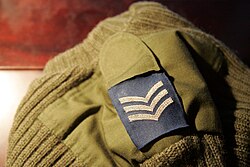
Depending on the material and design, these pieces vary in name. For instance, flexible metal versions—typically crafted from brass—are known as shoulder scales. It is also important to distinguish the epaulette from a shoulder mark (also called a shoulder board, rank slide, or slip-on), which is a flat cloth sleeve worn on a uniform's shoulder strap.
Key Facts
- Origin: Evolved from 17th-century shoulder ribbons used to prevent belts from slipping.
- Purpose: Primarily used to denote commissioned rank and distinguish elite units.
- Materials: Historically made from gold or silver for officers and colored cloth for enlisted personnel.
- Modern Use: Mostly replaced by shoulder boards or rank slides, though still used in ceremonial dress.
- Variations: Includes shoulder scales (metal), shoulder knots (braided), and shoulder marks (cloth).
The Evolution of the Epaulette
Origins and Early Design
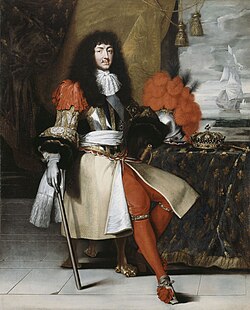
While they bear a resemblance to the pteruges (decorative leather strips) of ancient Greco-Roman military attire, the direct ancestor of the epaulette is the bunch of ribbons worn on military coats in the late 17th century. These ribbons served a dual purpose: they were decorative and prevented shoulder belts from sliding off the coat. Tied into knots with free fringed ends, these ribbons established the foundational design for the epaulettes of the 18th and 19th centuries.
The Rise of Rank Distinction
By the 18th century, European armies began using epaulettes to signal rank. An officer's status could be identified by whether they wore an epaulette on the left shoulder, the right, or both. This led to the introduction of the "counter-epaulette," a non-fringed piece worn on the opposite shoulder for those who only required a single fringed epaulette.
During the Napoleonic Wars, specialized infantry—such as grenadiers, voltigeurs, and light infantry—wore cloth epaulettes with colored wool fringes to separate them from standard line infantry. Other branches adopted unique variations: flying artillery used shoulder pads, while heavy artillery wore small balls representing ammunition.
Specialized Forms: Shoulder Scales and Boards
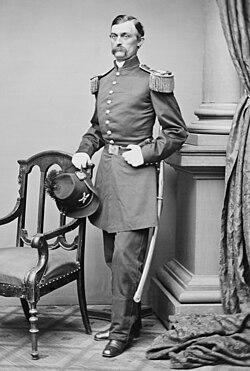
In the 19th century, some armies adopted shoulder scales—flexible metal pieces. In the United States, these were used by the Cavalry, Infantry, and Artillery between 1854 and 1872, though they were rarely worn during active field operations.
The Russian Army developed an intermediate form known as the shoulder board. Lacking a fringe and not extending beyond the shoulder seam, the shoulder board was a simplified version of the heavy full-dress epaulette, designed specifically for service wear.
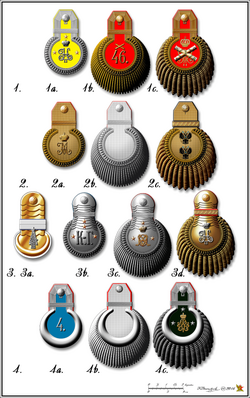
![Components and structure of the epaulette of an Imperial Russian lieutenant-colonel, 46th Artillery Brigade 1. Lining 2. Button 3. Spine 4. Attente/shoulder strap 5. Stars (or pips) 6. Branch insignia 7. Field 8. Unit number 9. Neck (bezel) 10. Fringe[clarification needed per discussion]](/images/1a/d2/1ad2acdd98a2d313ba9e91d9e3db90889b261123685c50f0ef1febe2f658b1af.png)
Global Traditions and Variations
France and Belgium
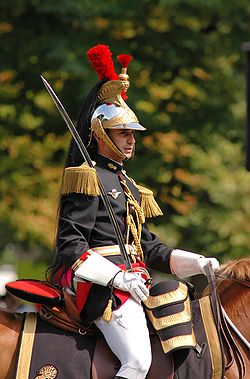
In France, gold epaulettes were traditionally for infantry officers, while silver was reserved for mounted units. Different colors of wool fringes identified various branches, such as red for line infantry and green for Chasseurs. Today, the Garde Républicaine and ESM Saint-Cyr still maintain these traditions. The French Navy and Air Force use attentes—gilded shoulder straps originally designed to clip epaulettes to the shoulder.
Belgium continues this tradition with the Royal Escort and Grenadiers, who wear red epaulettes with white or full red fringes.
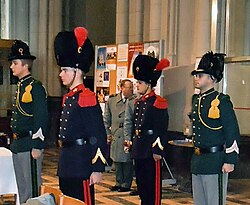
Germany and the "Shoulder Knot"
The Imperial German Army used silver epaulettes for full dress, with fringe thickness indicating rank (none for captains, fine for majors/colonels, and heavy for generals). Between 1919 and 1945, Germany became known for the shoulder knot—a braided "figure-of-eight" decoration. This style influenced military uniforms in several South American countries, including Chile and Bolivia.
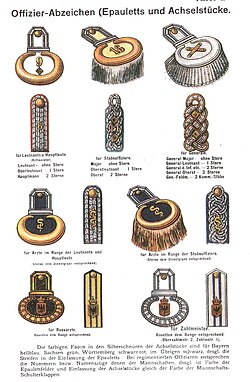
United Kingdom and the Commonwealth
The British Royal Navy adopted epaulettes in 1795, using silver stars to denote flag officers. By 1855, the British Army replaced large gold-fringed epaulettes with twisted shoulder-cords for full dress. Interestingly, some British cavalry units used chainmail epaulettes to protect against sword blows—a feature that survives today in ornamental silvered form on certain "Number 1 dress" uniforms.
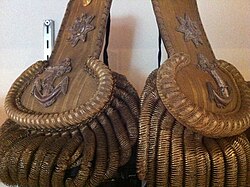
United States
The US Navy authorized epaulettes in 1797, with the number and position of the pieces indicating rank. In the US Army, 1832 regulations specified silver for infantry and gold for artillery. By 1851, gold became universal, with rank indicated by contrasting silver or gold insignia.
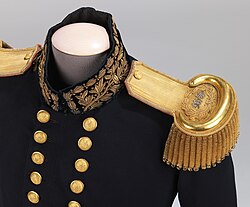
Modern Derivations
In contemporary military attire, the heavy fringed epaulette has largely vanished, replaced by the shoulder board—a five-sided cloth flap sewn into the shoulder seam. This further evolved into the shoulder mark, a flat cloth tube that allows personnel to easily swap rank insignia as their grade changes.
| Type | Material | Key Characteristic | Primary Use |
|---|---|---|---|
| Epaulette | Cloth/Gold/Silver | Often features fringes | Ceremonial / Full Dress |
| Shoulder Scale | Brass/Metal | Flexible metal plates | 19th Century Service |
| Shoulder Board | Cloth | Flat, five-sided flap | Modern Service Dress |
| Shoulder Mark | Cloth Tube | Slip-on sleeve | Modern Combat/Utility |
| Shoulder Knot | Braided Cord | Figure-of-eight pattern | Imperial German/Ceremonial |
Frequently Asked Questions
What is the difference between an epaulette and a shoulder board?
An epaulette is typically an ornamental, often fringed, piece used for full dress or ceremonial uniforms. A shoulder board is a flatter, more simplified cloth version sewn into the shoulder seam, used for daily service wear.
Why did military uniforms use epaulettes?
Originally, they served a practical purpose by keeping shoulder belts in place. Over time, they became a standardized way to communicate rank and branch of service at a glance, and in some cases, provided minor protection against sword blows.
What are shoulder scales?
Shoulder scales are a specific type of epaulette made from flexible metal, usually brass. They were popular in the mid-19th century, notably within the US Army's cavalry, infantry, and artillery branches.
Are epaulettes still used today?
Yes, but primarily in ceremonial contexts. Units like the French Garde Républicaine and the Belgian Grenadiers still wear them as part of their traditional full-dress uniforms.
What is a shoulder mark or rank slide?
A shoulder mark is a modern, flat cloth tube that slides over a shoulder strap. It allows the wearer to easily change their rank insignia without needing a new uniform garment.