Royal Marines Uniforms: A History of Tradition and Evolution
The Royal Marines uniform is more than just standardized military dress; it is a visual record of the Corps' evolution from 17th-century maritime infantry to modern elite commandos. Balancing the rigid traditions of the British Army with the practical demands of shipboard life, the uniforms of the Royal Marines have transitioned from bright scarlet coats to the iconic Lovat green and advanced camouflage patterns.
Key Facts
- Lovat Green: A unique shade of green introduced in 1964 for the Number 1B service dress.
- The Green Beret: Introduced in 1942 specifically for the Royal Marine Commandos.
- Wolseley Helmet: The distinctive white pith helmet adopted in 1912, still used in full dress today.
- MultiCam: The current proprietary camouflage pattern adopted in 2020 from Crye Precision.
- Historical Roots: Early uniforms (1664) featured yellow-brown coats and black felt hats.
The Historical Evolution of Marine Dress
Historically, Royal Marines uniforms mirrored the British Army's full dress. However, the realities of serving on ships necessitated practical adaptations. During the late 18th and early 19th centuries, marines often swapped their easily stained red coats for "slop" clothing—the loose attire worn by British sailors, known as Jack Tars. In the heat of battle, such as at the Battle of Trafalgar, many marines discarded their coats entirely, fighting in blue trousers and checked shirts.
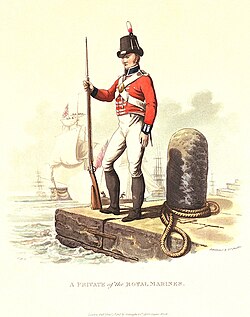
The earliest iterations of the uniform varied by regiment. Between 1664 and 1689, the Duke of York and Albany's Maritime Regiment of Foot wore yellow-brown coats with red breeches. By the mid-18th century, red coats with varying facings (the contrasting color on collars and cuffs) became standard. From 1755 to 1802, the Corps wore red coats with white facings and tricorn or bicorne hats.
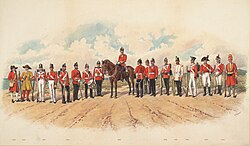
A significant shift occurred in 1802 when the title "Royal Marines" was granted, introducing dark blue facings and a lacquered felt round hat. This look became synonymous with the era of Admiral Nelson. By 1816, the Royal Marine Artillery adopted a dark blue coat with red facings and yellow bastion lace loops, aligning them more closely with the Royal Artillery.
As the 19th century progressed, the Corps adopted "bell top" shakos and tight tail coats. By 1882, during the Anglo-Egyptian Campaign, they wore dark blue serge jackets with bugle horn or grenade badges. The early 20th century saw the introduction of the white cloth helmet in 1905, which evolved into the Wolseley pattern pith helmet in 1912.
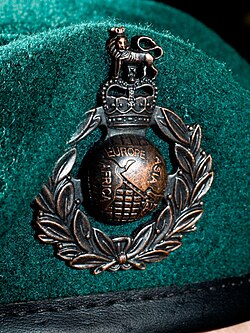
During World War II, the Royal Marines utilized khaki or blue battledress. The most enduring symbol of the era, the green beret, was introduced in 1942 for the Royal Marine Commandos, signifying their elite status.
Modern Uniform Classifications
Today, the Royal Marines maintain a complex system of dress orders tailored for ceremonial, formal, and operational duties.
Ceremonial and Full Dress
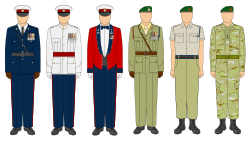
The Number 1 Full Dress, featuring a royal blue tunic with red facings and yellow cuff slashes, is primarily worn by the Royal Marines Band Service. Most other units performing ceremonial duties wear Number 1A "Blues", which consists of a blue uniform with scarlet stripes on the trousers, paired with either a peaked cap or a pith helmet.
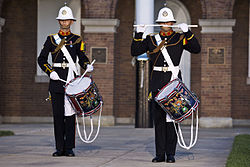
For tropical ceremonial duties, the Number 1AW is used, replacing the blue tunic with a white one. Officers and NCOs attending formal evening events wear the Number 2A Mess Dress, characterized by a scarlet jacket with a royal blue shawl collar.
Service and General Duty Dress
Introduced in 1964, the Number 1B "Parade Lovats" is a unique green service dress. The headgear for this uniform indicates the wearer's qualification: a commando green beret for those who have passed the commando course, and a navy blue beret with a scarlet patch for those who have not.
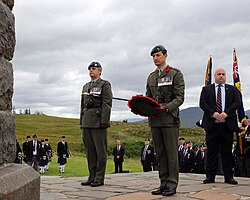
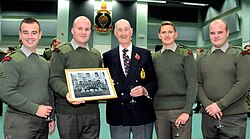
Day-to-day duties are handled by the Number 3 series. This includes 3A "Half Lovats" (stone-colored shirt and green trousers) and 3C (the winter version with an olive-green pullover). For summer training and field operations, Number 3B and 3D are used.
In June 2020, the Corps transitioned to a new combat uniform from Crye Precision, moving from Multi-Terrain Pattern (MTP) to MultiCam. This update included insignia changes, such as returning to red lettering on a navy blue background to emphasize their connection to the Royal Navy.
Uniform Summary Table
| Dress Order | Common Name | Primary Use | Key Feature |
|---|---|---|---|
| Number 1 | Full Dress | Band Service / Ceremonial | Royal blue tunic, white pith helmet |
| Number 1A | Blues | General Ceremonial | Blue uniform, scarlet trouser stripes |
| Number 1B | Parade Lovats | Service Dress | Lovat green color, beret |
| Number 2A | Mess Dress | Formal Evening | Scarlet jacket, blue shawl collar |
| Number 3A | Half Lovats | General Day-to-Day | Stone shirt, green trousers |
| Number 3B | Training Rig | Summer/Field Duty | MultiCam camouflage |
Frequently Asked Questions
What is "Lovat green"?
Lovat green is a unique shade of green used for the Royal Marines' Number 1B service dress, introduced in 1964 to mark the 300th anniversary of the Corps.
Who is allowed to wear the green beret?
The green beret is worn by Royal Marines who have successfully completed the rigorous commando course. Those who have not passed the course, including recruits and certain instructors, wear a navy blue beret with a scarlet patch.
What is the significance of the Wolseley helmet?
The Wolseley pattern pith helmet, adopted in 1912, is the most distinctive feature of the modern Royal Marines full dress and is used during ceremonial duties.
How has the combat uniform changed recently?
As of June 2020, the Royal Marines adopted the MultiCam pattern from Crye Precision, replacing the previous Multi-Terrain Pattern (MTP) and updating insignia to better reflect their history and Royal Navy affiliation.
What is the "Red Sea Rig"?
The Red Sea Rig (Number 2C) is an informal evening uniform worn within ships and establishments, consisting of a white shirt with shoulder boards, blue trousers, and a red cummerbund.