Edwin Blake Payson: The Legacy of a Pioneering American Botanist
Edwin Blake Payson was a distinguished American botanist whose brief but impactful career left a lasting mark on the study of plant taxonomy—the science of naming, describing, and classifying organisms. Despite his life being cut short, Payson's rigorous academic approach and dedication to the flora of North America earned him prestigious recognition and a permanent place in botanical nomenclature.
Early Life and Education
Born on February 18, 1893, in Norwood, Colorado, Payson was the son of Amon R. Payson, a cattle rancher and co-founder of Naturita, Colorado. His early life was marked by tragedy, as his mother, Sarah Payson, passed away approximately one month after his birth.
Payson's academic journey began at Montrose High School before he moved on to the University of Wyoming, where he earned his Bachelor of Arts in 1917. His passion for botany was evident early on, a pursuit he shared with his future wife, Louise Butler, a fellow botany student.
Military Service and Advanced Studies
Following his undergraduate studies, Payson served in the 89th Infantry Division during World War I. After training at Camp Funston and marrying Louise Butler, he served as an instructor at the American Expeditionary Forces University in Beaune, France. He returned to the United States in May 1919 to further his scientific training.
Payson pursued graduate studies at Washington University in St. Louis, where he served as a teaching fellow in the school of botany. He rapidly advanced through his degrees, earning a Master of Arts in 1920 and a PhD in 1921.
Academic Career at the University of Wyoming
Payson returned to his alma mater, the University of Wyoming, as an associate professor of botany. There, he worked as a protégé of Dr. Aven Nelson, the founder of the botany department and former college president. His rapid ascent in the academic world saw him promoted to full professor by 1926.
Tragically, Payson's health declined in his final years. In 1926, he suffered partial paralysis of his left arm. Following gallbladder surgery in 1927, he passed away from heart failure on May 15, 1927, at the age of 34.
Scientific Contributions and Research
Payson focused his research on phylogenies—the evolutionary history and relationships among individuals or groups of organisms. He was particularly interested in the families Cruciferae (mustards) and Ranunculaceae (buttercups).
His published works include several critical monographs and studies:
- "The North American species of Aquilegia" (1918)
- "A Monograph of the Genus Lesquerella" (1921)
- "A monographic study of Thelypodium and its immediate allies" (1923)
- "A Monograph of the Section Oreocarya of Cryptantha" (1927)
Recognitions and Botanical Honors
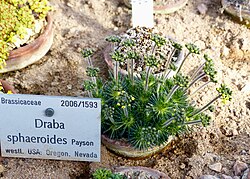
Shortly before his death, Payson was awarded a prestigious Guggenheim Fellowship. This grant was intended to support his evolutionary and taxonomic studies at Kew Gardens in London, specifically focusing on the genera Draba and Aquilegia.
In recognition of his contributions, several plant taxa were named in his honor. These include the genus Paysonia (formerly part of Lesquerella) and the species Cryptantha paysonii, Dryopetalon paysonii, and Astragalus paysonii. In botanical citations, the standard author abbreviation Payson is used to credit his work in describing new species.
| Category | Details |
|---|---|
| Lifespan | February 18, 1893 – May 15, 1927 |
| Education | B.A. (University of Wyoming), M.A. & PhD (Washington University in St. Louis) |
| Primary Specialization | Plant Taxonomy and Phylogeny |
| Key Plant Families | Cruciferae and Ranunculaceae |
| Major Honor | Guggenheim Fellowship |
Key Facts
- Academic Rank: Achieved the rank of full professor of botany at the University of Wyoming by 1926.
- Military Service: Served in the 89th Infantry Division and taught at the American Expeditionary Forces University in France.
- Taxonomic Legacy: The genus Paysonia and three other species are named after him.
- Research Focus: Specialized in the evolutionary relationships of flowering plants.
- Author Abbreviation: Cited as "Payson" in official botanical nomenclature.
Personal Life
Payson was married to Louise "Lois" Elizabeth Butler (1895–1970), who was herself a botanist, plant collector, and librarian. She was the niece of N. K. Boswell, a sheriff in Laramie. The couple is buried in neighboring plots at Greenhill Cemetery in Laramie, Wyoming.
Frequently Asked Questions
What was Edwin Blake Payson's primary area of study?
Payson specialized in botany, specifically the taxonomy and evolutionary phylogenies of flowering plants within the Cruciferae and Ranunculaceae families.
Which plants are named after Edwin Blake Payson?
The genus Paysonia and the species Cryptantha paysonii, Dryopetalon paysonii, and Astragalus paysonii were named in his honor.
Where did Payson earn his PhD?
He earned his PhD in 1921 from Washington University in St. Louis, where he also served as a teaching fellow.
What was the purpose of Payson's Guggenheim Fellowship?
The fellowship was awarded to allow him to continue his taxonomic studies of the genera Draba and Aquilegia, primarily conducting research at Kew Gardens in London.
Who was Payson's mentor at the University of Wyoming?
He was a protégé of Dr. Aven Nelson, who founded the botany department and previously served as the college president.