Understanding Ecosystems: The Complex Web of Life and Environment
Nature does not exist in isolation. Every living organism, from the smallest microbe to the largest mammal, is part of a sophisticated network known as an ecosystem (or ecological system). An ecosystem is a system formed by organisms interacting with their physical environment, where biotic (living) and abiotic (non-living) components are inextricably linked through energy flows and nutrient cycles.
The concept of the ecosystem was first introduced in 1935 by British ecologist Arthur Tansley, who sought to highlight the critical transfer of materials between organisms and their surroundings. Tansley viewed these systems not just as natural units, but as "mental isolates" to help scientists study the complex interactions of the "organism-complex" and the physical factors of the environment.
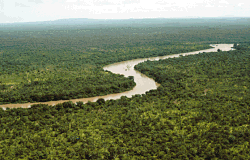
Key Facts
- Biotic factors are living components (e.g., plants, animals), while abiotic factors are non-living components (e.g., soil, sunlight).
- External factors, such as climate and topography, determine the overall structure of an ecosystem.
- Internal factors, including decomposition and species competition, control the availability of resources within the system.
- Ecological resilience is the capacity of a system to absorb disturbance and reorganize while maintaining its basic function and identity.
- Anthropogenic inputs (human-caused) now account for approximately 80% of all nitrogen fluxes in ecosystems.
The Building Blocks: Biotic and Abiotic Components
To understand how an ecosystem functions, we must look at its two primary components. Biotic factors encompass all living organisms. Plants act as the gateway for energy, using photosynthesis to convert sunlight into plant tissue. Animals then move this matter and energy through the system by consuming plants and one another. Finally, decomposers break down dead organic matter, releasing carbon back into the atmosphere and recycling nutrients for future use.
Abiotic factors are the non-living elements that support life, such as soil, water, and minerals. The interaction between these two groups creates the "ecosystem processes"—the transfers of energy and materials from one pool to another. These processes occur across a vast range of scales, from the surface of a single rock to the entire planet.
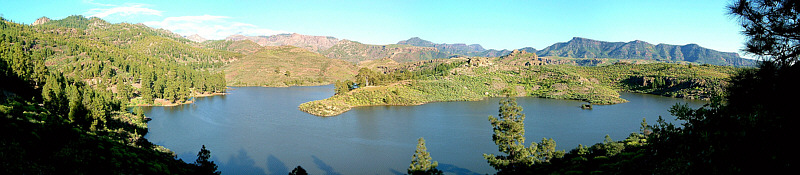
Factors Controlling Ecosystem Structure
Ecosystems are shaped by a combination of external and internal forces. These factors determine what can survive in a given area and how the system responds to change.
External (State) Factors
External factors control the ecosystem's structure but are not influenced by the ecosystem itself. The most dominant of these is climate, which determines the biome (a general category of ecosystem) in which a system is embedded. Rainfall and temperature directly influence photosynthesis and the total energy available. Other external factors include:
- Parent material: Determines soil nature and mineral nutrient supply.
- Topography: Affects microclimates, soil development, and water movement.
- Time: Influences the stage of development and recovery from past events.
- Potential biota: The pool of species available in a region to occupy a site.
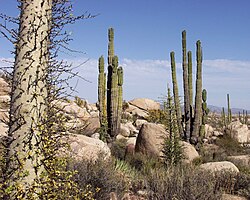
Internal Factors
Unlike external factors, internal factors both control and are controlled by ecosystem processes. While climate might determine how much water enters a system, internal factors like root competition, shading, and decomposition determine how that water is distributed and used. Other internal drivers include succession (the process of change in species structure over time) and the specific types of species present.
Energy Flow and Nutrient Cycling
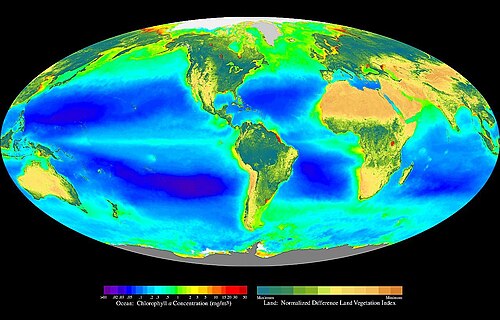
Energy enters an ecosystem through primary production and is lost through respiration or disturbances like wildfires. Net ecosystem production is the difference between gross primary production (GPP) and the total respiration of all living organisms. In stable conditions, this represents the net accumulation of carbon.
The Role of Decomposition
Decomposition is the essential process of breaking down dead organic matter. Without it, nutrients would remain locked in dead biomass, and atmospheric carbon dioxide would be depleted, eventually halting plant growth.

Nutrient Cycling: Nitrogen and Phosphorus
While energy flows through a system, mineral nutrients are cycled. Nitrogen is often the primary limiting factor for production. It enters the system via precipitation, dust, or biological nitrogen fixation—a process where specialized bacteria (often in symbiotic relationships with legumes or as free-living cyanobacteria) convert nitrogen into a usable form. This process is energy-intensive, costing plants up to 25% of their gross primary production.
Mycorrhizal fungi also play a critical role, transferring phosphorus and nitrogen from dead organic matter to plant roots in exchange for carbohydrates. This pathway may contribute more than 70 Tg of annually assimilated plant nitrogen globally.
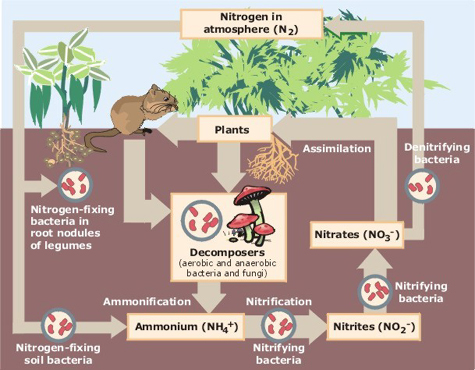
Phosphorus enters the system through the weathering of rocks. As ecosystems age, this supply diminishes, making phosphorus limitation more common in older landscapes, particularly in the tropics.
Biodiversity and Ecosystem Function
Not all species affect an ecosystem equally. The addition of species similar to those already present usually has a minimal effect. However, ecologically distinct species and dominant species have significant impacts. Some organisms, known as keystone species, have an effect on the ecosystem that is disproportionately large relative to their abundance.
Additionally, ecosystem engineers are organisms that physically create, modify, maintain, or destroy habitats, fundamentally altering the environment for other species.
Dynamics, Resilience, and Human Impact
Ecosystems are dynamic and subject to periodic disturbances. Their ability to remain near an equilibrium state is called resistance, while their capacity to absorb disturbance and reorganize while retaining the same basic function is called ecological resilience.
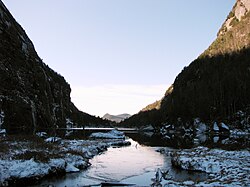
![Loch Lomond in Scotland forms a relatively isolated ecosystem. The fish community of this lake has remained stable over a long period until a number of introductions in the 1970s restructured its food web.[31]](/images/84/fa/84fa80293fa9ae43453263dcc5e9676534906b6ead75e3026c91b991ed0cd39b.jpg)
Human activities now influence ecosystems on a global scale, affecting even the external factors like climate. Ecosystems provide essential goods and services, categorized by the Millennium Ecosystem Assessment into four types:
- Provisioning: Tangible products like food, water, fuel, and medicinal plants.
- Regulating: Natural processes that moderate environment conditions.
- Cultural: Non-material benefits such as recreation and tourism.
- Supporting: Fundamental processes that allow other services to exist.
The assessment warns that human activity is reducing the resilience and biocapacity of these "life-support systems." When an ecosystem loses its defining features, it is considered collapsed. While species extinction is permanent, ecosystem collapse can sometimes be reversible through restoration.
Ecosystem Classifications and Study
Scientists study ecosystems through theoretical research, long-term monitoring, and manipulative experimentation. A landmark example is the Hubbard Brook Ecosystem Study (started in 1963), which monitored a watershed in New Hampshire and led to the discovery of acid rain in North America in 1972.
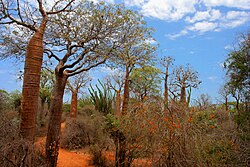
While the terms are often used interchangeably, biomes are general categories (like "tropical rainforest"), whereas ecosystems can be described with extreme specificity (like "wet coastal needle-leafed forests").
| Feature | External Factors (State Factors) | Internal Factors |
|---|---|---|
| Definition | Factors that control structure but are not influenced by the ecosystem. | Factors that control and are controlled by ecosystem processes. |
| Examples | Climate, Topography, Parent Material, Time. | Decomposition, Root Competition, Shading, Succession. |
| Primary Role | Determines resource inputs and biome type. | Determines resource availability and distribution. |
| Influence | Broad geographic and structural control. | Operational and process-based control. |
Frequently Asked Questions
What is the difference between a biome and an ecosystem?
Biomes are broad, general categories of ecosystems defined at a high level (e.g., desert or tundra). Ecosystems are more specific and are defined by the interaction of a biotic component, an abiotic complex, their interactions, and the specific physical space they occupy.
What is a keystone species?
A keystone species is an organism that has a disproportionately large effect on its ecosystem's function relative to its actual abundance or biomass.
How does nitrogen enter an ecosystem?
Nitrogen enters through biological nitrogen fixation (via bacteria and cyanobacteria), precipitation, dust, gases, or human-applied fertilizers. Currently, anthropogenic inputs account for about 80% of nitrogen fluxes.
What is the difference between resistance and resilience?
Resistance is the tendency of an ecosystem to remain close to its equilibrium state despite a disturbance. Resilience is the capacity of the system to absorb that disturbance and reorganize itself to retain its essential function and identity.
What are ecosystem services?
Ecosystem services are the benefits humans derive from nature. These include provisioning services (food, water), regulating services (climate control), cultural services (recreation), and supporting services (nutrient cycling).
What happens during ecosystem collapse?
Ecosystem collapse occurs when a system loses its defining features due to degradation or abrupt transformation. Unlike species extinction, ecosystem collapse can potentially be reversed through management and restoration.