East Pomeranian: The Survival of a Rare Germanic Dialect
East Pomeranian (also known as Ostpommersch or Hinterpommersch) is a distinct East Low German dialect with a fascinating history of migration and survival. Once a vibrant tongue in the region of Farther Pomerania within the German Province of Pomerania, the dialect became moribund in Europe following the events of World War II, as the region became part of Poland.
Despite its decline in its European homeland, East Pomeranian persists today primarily through the diaspora of German expellees and immigrants in the Americas. It serves as a living link to a vanished regional identity, evolving independently in different parts of the world.

Key Facts
- Language Family: Indo-European > Germanic > West Germanic > North Sea Germanic > Low German.
- Native Speakers: Approximately 300,000.
- Current Strongholds: Brazil (primarily Espírito Santo) and the United States (Wisconsin and Iowa).
- Official Status: Co-official in 11 Brazilian municipalities.
- Writing System: Latin alphabet (German alphabet).
Regional Variations and Influence
The dialect is not monolithic; it consists of several varieties, including Westhinterpommersch, Osthinterpommersch, Bublitzisch (spoken around Bobolice), and Pommerellisch. Further east, these dialects transitioned into Vistula Delta German and Low Prussian-East Pomeranian near Danzig (Gdansk).
In the Americas, the dialect split into two primary branches based on local linguistic influence:
- Brazilian Pomeranian: Heavily influenced by Portuguese and Hunsrik (a German dialect derived from Hunsrückisch). Linguist Ismael Tressmann developed a specific orthography for this version.
- Wisconsin Pomeranian: Spoken in central Wisconsin and parts of Iowa, this variety was shaped by the English language.
Official Status in Brazil
Brazil is currently the most significant sanctuary for the language. It has been recognized as a historical and cultural heritage of the state of Espírito Santo and holds co-official status in several municipalities across multiple states.
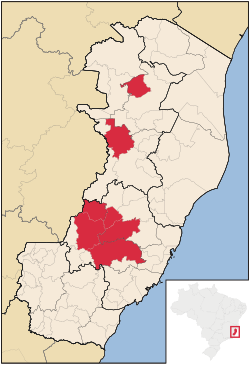
| State | Municipalities |
|---|---|
| Espírito Santo | Afonso Cláudio (Mata Fria district), Domingos Martins, Itarana, Laranja da Terra, Pancas, Santa Maria de Jetibá, Vila Pavão |
| Minas Gerais | Itueta |
| Santa Catarina | Pomerode |
| Rio Grande do Sul | Canguçu, São Lourenço do Sul (under approval) |
| Rondônia | Espigão d'Oeste |
Linguistic Structure
Phonology
The sound system of East Pomeranian includes a range of front, central, and back vowels, as well as various diphthongs such as ui̯, ei̯, and ou̯. Its consonant inventory features standard plosives (p, t, k, b, d, g) and fricatives (f, s, ʃ, h), along with specific rhotic sounds (r).
Grammar and Verbs
The dialect maintains a complex system of verb conjugation. For example, the verb breeka (to break) follows a pattern where the infinitive breeka shifts to the past participle brooka, with distinct singular and plural forms in both the present and past indicative tenses.
Frequently Asked Questions
Is East Pomeranian still spoken in Germany or Poland?
The dialect is considered moribund in Europe. While it was once spoken in the Province of Pomerania (now largely part of Poland), it is now primarily spoken by descendants of immigrants in the Americas.
How many people speak East Pomeranian today?
There are approximately 300,000 native speakers worldwide.
What is the difference between Brazilian and Wisconsin Pomeranian?
The primary difference lies in external linguistic influence: Brazilian Pomeranian has been influenced by Portuguese and Hunsrik, while Wisconsin Pomeranian has been influenced by English.
Where is East Pomeranian an official language?
It has co-official status in 11 municipalities across Brazil, including several in the state of Espírito Santo, as well as municipalities in Minas Gerais, Santa Catarina, Rio Grande do Sul, and Rondônia.
What language family does East Pomeranian belong to?
It belongs to the Indo-European family, specifically the West Germanic branch of the Low German languages.